 Netwrck
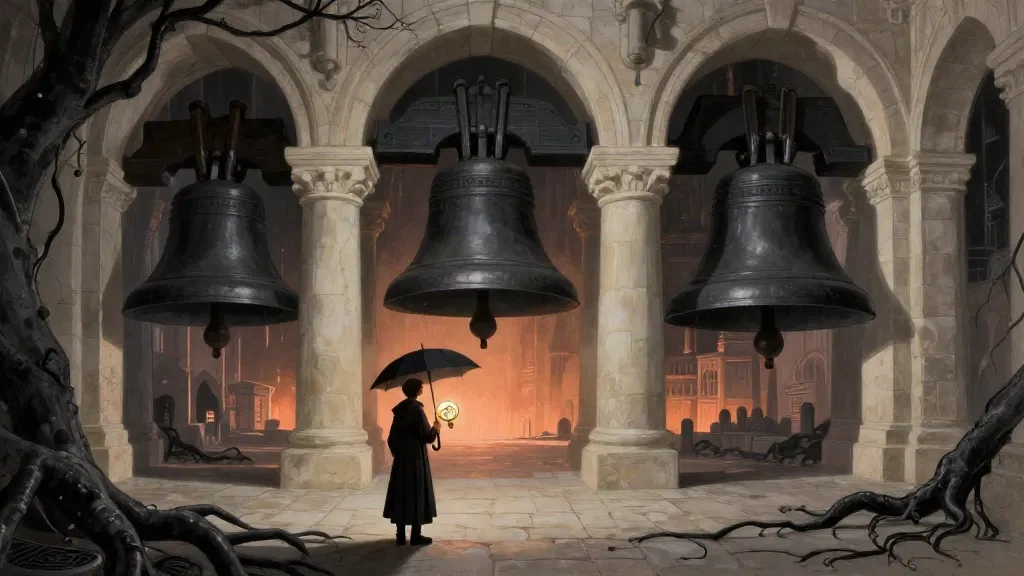
Adventure.
The Bell That Knew Her
Mara Venn repaired bells in the monastery carved inside a dying comet, where pale stone corridors curved around black-cherry beams and the windows looked onto a copper horizon. She was seventeen, quick with a file and stubborn about everything else. Her bells rang for memories their owners had not yet received: a first kiss, a country seen in childhood, the face one expects at a door.
Every morning, Mara tested a small brass compass beneath the chapel arch. Its needle did not point north. It turned toward whatever memory waited closest to the bellmaker’s hand.
That morning it trembled toward the floor.
She knelt and found a seam between two stones. The monastery’s oldest map showed a blue street running through solid rock. On the map, the street was labeled COPPER LANE.
Mara knew Copper Lane. It lay beneath her window in the town below, crowded with bakeries, rain gutters, and the black-cherry trees whose roots cracked the pavement. She had crossed it every day for six years, but she had never seen its true shape.
At noon, the monastery’s bells rang without wind. A single note fell from the comet and trembled through the floor.
The Holiday of Nameless Grief
The town below had prepared a public holiday for a sorrow no one could name. Citizens carried black umbrellas through the square, though the sky was clear. They left cups of water at the curb, one for every person who had vanished, died, or chosen to leave without farewell. The custom had no record. It simply returned every year, as if the city were trying to remember something through repetition.
Mara descended through a service shaft, carrying her black umbrella and the brass compass. At the bottom waited an old tram, its rails shining beneath the dust. A conductor in a monastery robe handed her a paper lantern.
“You cannot return aboveground during the holiday,” he said. “The grief has sealed the named streets.”
Mara stepped inside. The tram doors closed.
Under the station, Copper Lane waited. Its buildings were not built along the street but around a hollow, as though the architects had made room for a shape no living person could see. Doors floated above the pavement. Windows reflected rooms that belonged to different centuries. At every corner, a black umbrella turned slowly in the windless air.
Her compass pointed toward the deepest cellar.
A City With No Missing Room
There they found the source of the bells: a chamber lined with unfinished instruments. Each bell bore a name, but every name had been scraped away.
On a stone table lay a map drawn in black cherry ink. Beneath the familiar street, the world spread into continents shaped like hands. Rivers ran uphill toward a copper sky. Mountains hung below the city, their roots clotted with forgotten rooms.
Mara understood then. The monastery had been built to keep memories from settling into the world too quickly. The public holiday was not a ceremony for the dead. It was pressure in the pipes. The city was losing its grief, and with it the last shape of places it had tried to forget.
She placed her hands on the largest unfinished bell. It rang inside her chest.
A memory arrived: Mara at the window of her childhood house, pressing her palm to the glass and believing the street beyond was the whole world. Beneath the memory was another: an older woman, missing three fingers, hiding a brass compass under a floorboard.
“You are late,” a voice said.
The conductor stood in the chamber doorway. His robe was covered with black cherry dust. “That bell was meant to ring for the world’s first loss. Your bells have borrowed its note.”
He pointed toward a crack in the ceiling. Copper light shone through it.
The Shape Beneath the Street
Mara climbed. The black umbrella caught her when she slipped on the last rung. At the top, she found a bell the size of a room, suspended over a shaft that opened directly beneath Copper Lane.
She struck it with the brass compass.
The note passed through stone, water, and soil. Across the town, people looked up from the unnamed holiday. A baker remembered the taste of rain. A child remembered being carried. A woman opened a door she had avoided for twenty years.
The grief returned too, but no longer nameless. It had edges now, weight, a place to be carried.
The street cracked open like an eyelid. Beneath it lay the true shape of the world: black-cherry roots bridging pale stone, rooms turning beneath the roots, and beyond them all, a copper horizon waiting at the bottom.
Mara climbed down until the city lights became stars above her. Her compass pointed steadily north.
Behind her, the great bell finished ringing. Ahead, the buried world opened its doors.





