 Netwrck
Gothic Fantasy.
The Lamplighter’s Passage
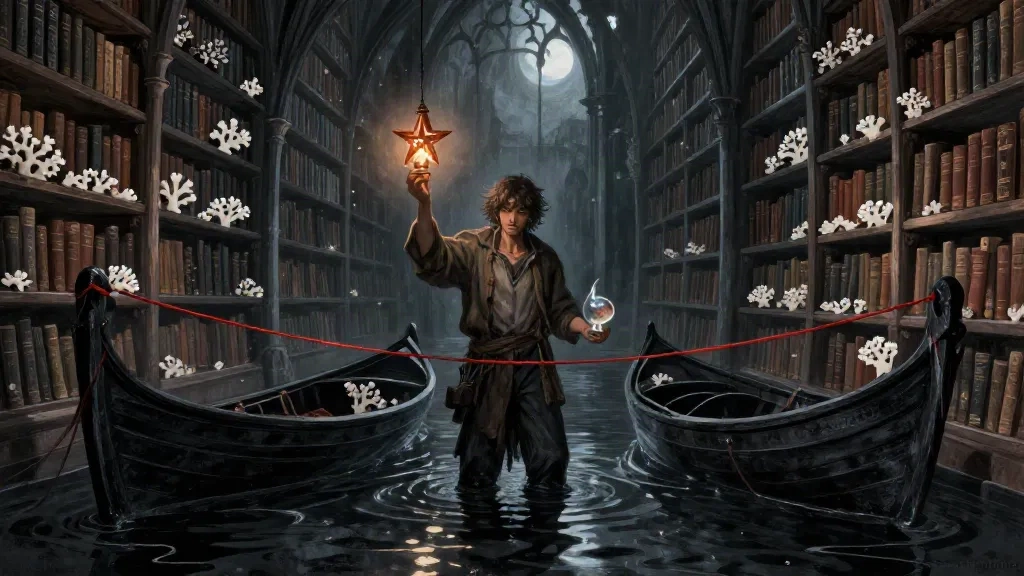
The archive had drowned so gracefully that the books still obeyed the old order. Their spines floated above the water in white coral ranks. Between them, librarians rowed black skiffs, calling shelf numbers to one another like birds trapped under a roof.
Orsa followed the thread of red wool knotted around her lantern. It crossed shelving, stair rails, and the moss-dark pillars in one unbroken line, though no one remembered who had tied it. Its final length descended through a hatch into the border chamber.
Inside her oilskin case lay a copper star and a glass bird. The star had come from the first lantern she made. The bird was her sister’s last unfinished gift, its wings cut but never joined.
Beyond the chamber waited the country of Calder, where the roads were dry and the names of carried things were written into the body. Orsa wanted to cross before dawn. She did not intend to surrender the case.
What the Water Confessed
The border clerk rose from a chair sunk to its knees in ink. He lifted Orsa’s declaration from the desk. It said she carried tools for making light.
“Tools may pass,” he said. “But what you keep inside them remains here.”
Orsa set the copper star on the desk. “Metal for navigation.”
The star gave one small chime.
“That is not metal talking,” said the clerk.
He unwrapped the glass bird. Water trembled inside its unfinished wings. Somewhere above them, a librarian stopped rowing, and the whole archive seemed to hold still.
“Who gave you this?”
“My sister.”
“What did she ask you to carry?”
The answer rose hot in Orsa’s throat. Her sister had asked her to keep the bird unbroken until the day Orsa could admit why she had locked her in the reading room while the roof burned. The glass bird had fused in the heat. So had Orsa’s promise to return.
The clerk touched its cracked tail. “The border records unfinished decisions.”
From beneath the water came a single bell note.
The Bell Without a Witness
Every drowning book struck its cover. Lamps swung in their cages. At the far end of the archive, three rowboats collided.
Orsa knew the sound. The bell rang only when someone made a decision no one was willing to admit.
She had decided not to leave the archive alive. Years ago, she had chosen guilt over rescue, the locked door over the open stair. Later she chose to call that accident rather than a choice. Every year she stayed aboard another boat was another refusal to speak.
“Turn it over,” the clerk said. “The glass carries what your voice will not.”
If Orsa surrendered the bird, Calder would receive the memory her sister had died trying to give her. The border would keep that memory, too. Crossing meant losing the last proof that her silence had belonged to someone capable of speaking.
The bell sounded again. A crack opened along the bird’s breast.
Orsa fastened the red thread to the copper star and lowered both into the black water. The thread drew taut between shore and nation.
Then she struck the glass bird against the clerk’s inkstone.
The Name She Carried
It did not break. It opened.
Inside was no feather, no folded message, no forgiveness. A small flame burned without consuming the glass.
Orsa spoke the name the border had been waiting for.
“Mara. I chose the door.”
The bell answered from every flooded aisle. White coral peeled from the shelves. Black water rushed toward the hatch, carrying red thread around lamps, desk, chairs, and case. The clerk held on to the declaration as it dissolved.
Orsa caught the glass bird before it sank. Its wings were whole now.
When the water settled, the border chamber stood open to the eastern quay. A red line marked the floor, neither wall nor threshold but the path between the two countries.
Calder’s officers waited beyond it, their slate tablets raised.
Orsa stepped over with the copper star in one hand and the glass bird in the other. For the first time, she carried no proof of innocence. She carried the decision itself.





