 Netwrck
Surrealism.
The Country Without a Morning
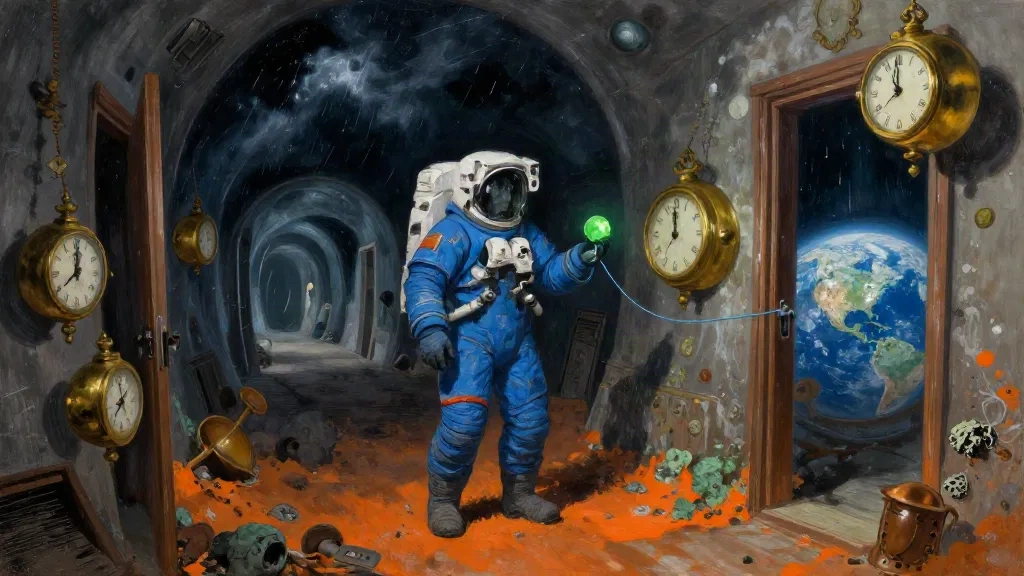
At the monastery of clockmakers, no one owned a watch. The walls held thousands of them, each behind a glass door, each keeping a different hour. Some advanced in patient increments. Some trembled at midnight. One had no hands and chimed whenever a bird passed.
Ilya Venn arrived wearing the blue thermal lining of his old astronaut suit, though the suit had been folded away for seventeen years. He had left orbit because the station’s instruments insisted Earth was a rumour: a green smear on a sensor, a pressure variation, a signal repeated until it became a nervous habit.
His voice had been recorded during the final orbit. It lay in the station’s public-address archive, buried beneath instructions for emergency docking and the crew’s forgotten arguments about coffee. Before he left, history had used him as background noise. His broadcasts played beneath news reports, over hospital alarms, during the funeral of a king whose face no one could identify.
Now he wanted it back.
Doors in the Storm
The abbess wore lichen-coloured wool and kept a green stone in her pocket. She said it had once belonged to the first clockmaker, who had tried to repair the country’s time.
“You cannot recover a voice by listening harder,” she said. “You must find the place where it was first made unnecessary.”
That night a blue storm-light entered the monastery. Lightning moved through the corridors before the thunder arrived. The doors began rearranging themselves. A door to the refectory opened onto the western wall. The western wall folded into a staircase. A staircase climbed down into the room where Ilya had first heard the news that Earth might be gone.
He held a blue thread around his finger. The abbess had given it to him, wound between the green stone and his own pulse. It was a thread pulled from the old station’s emergency harness, though neither of them said so.
When Ilya stepped through a low blue door, the storm closed behind him. He found himself in a room filled with mouths. Brass mouths. Ivory mouths. Glass mouths. They whispered fragments of his voice, each one incomplete.
“…not leaving.”
“…the ground was only a rumour.”
“…history is a room with the lights on.”
He reached for the nearest mouth. It bit his glove.
The Room Behind the Chime
Every door led to another monastery, then another country, then another version of the same corridor. Ilya moved through them until his suit was streaked with burnt orange dust and his boots carried the smell of rain on metal.
In the final chamber, a single clock stood beneath a lantern. Its face was blank. Behind it, reflected in the glass, floated an older Ilya, still in orbit, speaking into a microphone that had no wire.
“We are not abandoning Earth,” the reflection said. “We are abandoning the sentence that made Earth sound abandoned.”
Ilya pressed the green stone against the clock’s glass. The hands appeared. They were not pointing to an hour. They pointed inward.
He understood then that his voice had not been stolen. It had been made ambient, given to every background and no foreground. History had not erased him; it had placed him everywhere and nowhere.
The storm tore the chamber open. Doors swung through the walls, some opening onto rooms, others onto open sky. Ilya tied the blue thread to the clock’s pendulum and pulled.
A Frequency You Can Carry
The clock did not ring. It inhaled.
Then Ilya spoke.
He did not repeat the old broadcast. He spoke the names of the erased places, one after another, giving each a sentence no machine could classify as background. The blue storm-light bent around the words. The mouths in the walls went quiet.
At dawn, the doors returned to their proper frames. The abbess found him asleep beneath the blank clock, his hand closed around the green stone. The blue thread had disappeared into the pendulum.
He left the monastery before noon. The country had returned, though its roads still disagreed about which direction led to the sea. Travellers reported hearing a calm male voice beneath ordinary sounds: in the ticking of stoves, in the hiss of radio static, in the pauses between two birds calling.
Whenever someone asked who was speaking, the voice said their name.
Not a fact. Not a warning. A beginning.





