 Netwrck
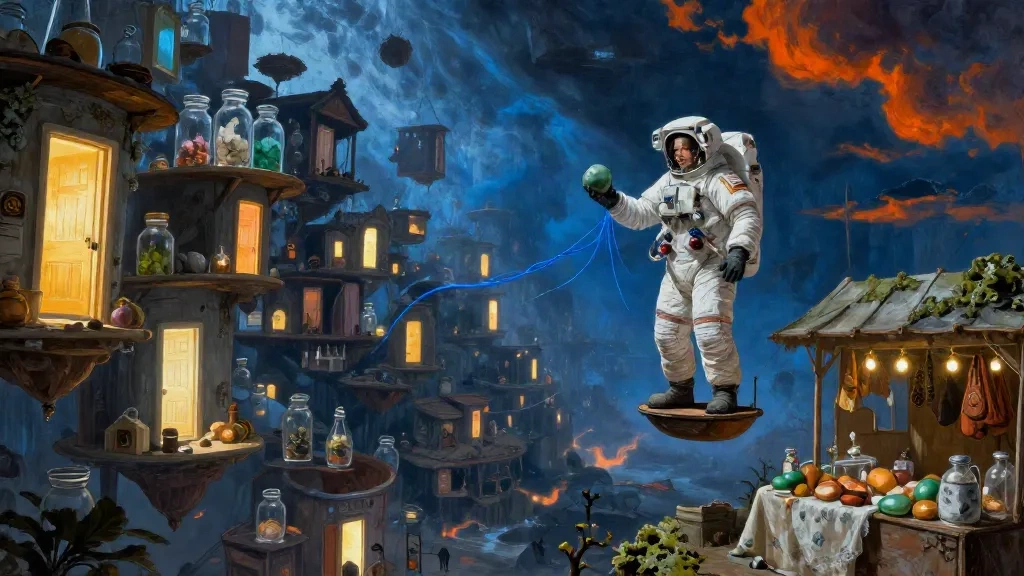
Surrealism.
The market above the weather
Mara Venn kept one orbit after leaving the astronaut corps. The station had been retired, its solar wings folded like the hands of a sleeping animal. Below, the night cloud reflected cities that no longer matched the old maps.
Earth was a rumour now. Some weeks it appeared in the market, priced by the kilogram. Other weeks it was only a blue smear beyond the railing, and Mara had learned not to ask who had measured it.
Her station hung above the floating market for memories that had lost their owners. Stalls drifted on chains of copper and kelp. A child’s first snow stood in a glass jar. A dead woman’s perfume sold by the sniff. Somewhere below, a door with a brass number kept opening onto a kitchen where nobody had eaten for sixty years.
Mara had come for one thing: the voice that history had used as background noise.
The voice beneath the stall
She had heard it first during the launch of the old moon observatory, a thin transmission buried beneath the mission commander’s countdown. It said nothing important. It simply counted, and in the gaps between numbers, it gave the darkness a voice.
Later, the recordings had been classified, compressed, mistaken for static. Mara knew the voice because it had spoken to her through the station’s failing speaker on the night she returned from orbit.
“You are still here,” it had said.
She had pretended the signal was interference.
At the market she found a stall made from a suitcase lined with moss. The vendor was a tall woman with burnt-orange gloves and a face hidden beneath a blue cord.
“That voice is not for sale,” she said.
Mara placed a green stone on the counter. It was smooth, warm, and marked with a pale seam. The vendor lifted the stone and listened to it as though it were a shell.
“It belongs to a door,” the woman said.
“Everything here belongs to someone.”
“Not the door. The voice belongs to the door.”
Under the suitcase lay a spool of blue thread. Mara touched it. The thread leapt upward, winding through the rafters, and every stall on the market turned to face her.
Doors in the storm
The storm arrived as blue light, then as wind. It did not blow through the market. It passed through the walls, dragging whole rooms with it.
Doors opened sideways. A bakery appeared inside a cloud. A stairwell rose from a fountain. The stall with the voice split into two, then four, each version containing a different vendor and the same green stone.
Mara ran.
In the first door she saw Earth from orbit: brown continents, white weather, no cities. In the second, Earth stood close enough to touch, but every building was repeating a phrase she could not hear. In the third, the door opened onto the station interior. Her old speaker was glowing.
“Mara,” said the voice, “you came back for the wrong thing.”
She put her palm against the frame. The blue thread tightened around her wrist.
“I came for proof,” she said.
“Proof of what?”
“That I was there.”
The storm shoved the door inward. Through it came the smell of rain on hot metal, the commander’s clipped breathing, and the low static that had kept her awake for eleven years.
A place to return to
At the final door the market was gone. Mara stood inside her station, though the station had been dismantled decades ago. The window showed a small orange sun and a green moon below it.
The voice came from everywhere.
“You want the recording,” it said. “But you remember it without me.”
Mara held up the green stone. “Then why hide it?”
“No one hides a sound. They bury it under louder things.”
She unwound the blue thread from her wrist and tied it around the stone. The light in the station dimmed. In the silence between one heartbeat and the next, the voice counted to ten.
Not background noise. Not a ghost. A measurement, patiently made by someone who had believed she would return.
Outside, Earth passed beneath the window. It was only a rumour, but rumours have weight. Mara pressed her hand to the glass and let it carry her.
The voice counted again. For the first time, she did not listen for the place beneath the numbers.
She listened for the journey.
Orbit is not distance
By morning the market had reassembled itself around her. The vendor had vanished, the suitcase was gone, and a blue thread floated above the stalls like a small, deliberate constellation.
Mara left the station unlocked. She carried the green stone in one hand and the spool in the other. The doors still rearranged themselves, but she no longer tried to keep them in place.
At the edge of the market she found a narrow gondola. Its operator pointed to the seats.
“Where do you go?” he asked.
Mara looked down. The world had no centre now, only doors, rumours, and the voices that survived them.
“Down,” she said.
The gondola dropped. Behind her, the floating market folded into a single orange flash, and the voice counted her descent.
This time Mara answered.
“Still here.”





