 Netwrck
Weird Fiction.
Orbit Was Still Available
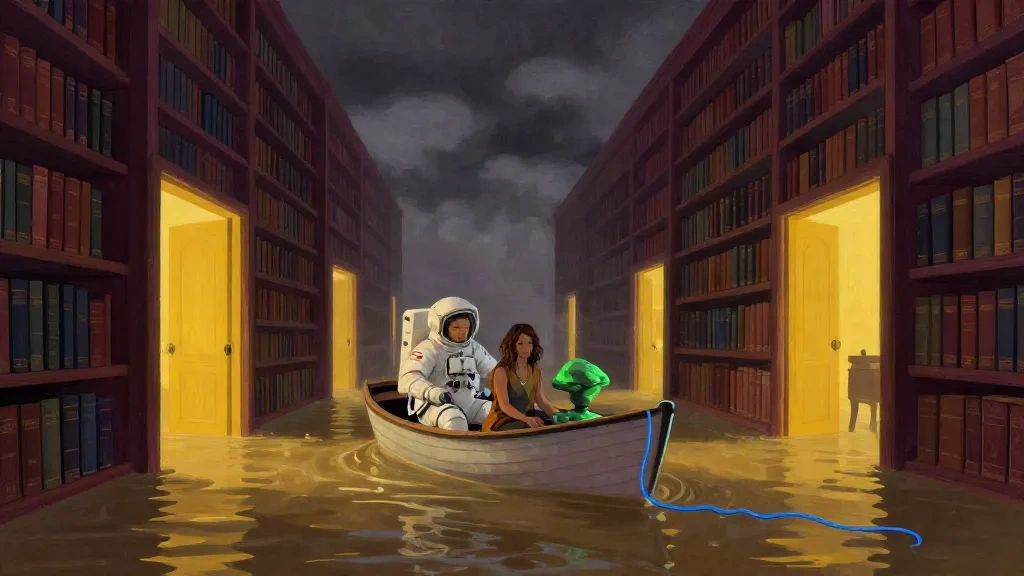
When I returned from orbit, Earth was only a rumour repeated by people who had never agreed on its shape. Mission Control showed me the old blue marble, serene and whole, but the streets below had sunk beneath saffron water. The archive rose from the flood in long black rooms, its shelves floating on stone barges. Librarians rowed between them, handing books across narrow gaps, calling citations to one another like birds.
I had been an astronaut before the water came. I knew the difference between an orbit and a trap: both kept you looking down, but only one let you return. So I stayed aboard the old observation capsule, tethered to the archive roof by a blue thread. Through the porthole I watched saffron yellow collect on the plum-dark shelves. The air smelled of smoke, wet paper, and the sweet mineral tang of storm.
Then I heard Vey.
Her voice had been used as background noise in the evacuation broadcasts: Stay calm. Remain where you are. The water is not an event. The phrase repeated until her name disappeared. I had known her voice before that, from a cockpit recording during a meteor storm. She had been the only person aboard who understood that a warning matters most when nobody thinks it is a warning.
I cut the capsule loose and took a rowboat through the stacks. In my pocket lay a green stone, smooth from the shore of the vanished sea. My mother had given it to me before the flood, saying it had once been a piece of the moon. I did not believe her. I carried it because belief was another kind of tether.
Doors Moving in the Storm
The storm arrived without thunder. It moved through the archive as a grey pressure, making the shelves lean and the lamps bend. At the end of the west aisle, I found a door standing alone above the water. No room was attached to it.
When I touched the handle, the door opened onto the interior of my capsule. I could see my cot, the loose screws on the floor, the porthole filled with falling water. Inside, a woman in a blue maintenance suit sat with her back to me.
“Vey?” I called.
She turned. Her face was younger than the voice in the broadcasts, and older than the voice I remembered. “You always waited until the ground was gone,” she said.
I stepped through. The door slammed behind me, then opened again onto a different aisle. The shelves slid apart with a sound like ribs expanding. Water surged under the boat. When I looked back, Vey was still speaking, but her voice had become small and distant, as if history were swallowing it one word at a time.
I row after her. The storm rearranged every door I passed: a classroom filled with drowned maps, a chamber where names were carved into ice, a room containing the first moon landing filmed from below. Each version of Vey told me to leave. Each version asked me to remember differently.
What the Water Preserved
The blue thread in my hand led to the capsule, but the thread had begun to move of its own accord. It pulled toward a low door beneath the stacks. I cut the oar loose and used it to pry the door open. The pressure beyond it was immense, and the air turned smoke-grey.
Vey stood inside, suspended in a cylinder of clear water. Her mouth moved without sound. The machinery around her displayed every recording in which she had spoken, layered into one continuous cry. The first records held only technical instructions. Later ones trimmed her pauses. Eventually the archive had used her voice to announce unrelated facts, until she became indistinguishable from the system announcing itself.
I pressed my hands to the cylinder. She looked at me through the deep plum dark.
I understood then what history had preserved. Not truth, not lies, but the shape of the noise that made people stop noticing one another. Vey had been made background so thoroughly that she could no longer reach the foreground.
I broke the cylinder open. The water struck me with the weight of a year’s silence. Vey inhaled, then screamed. Her voice filled every aisle, each door, every flooded chamber, until the archive seemed to have a throat.
The Return Was Not an Escape
By dawn the storm had moved all the doors back to their original places. The librarians rowed among the shelves, coughing, carrying salvaged books above the waterline. Vey sat in my boat with a blanket around her shoulders. The blue thread had fused into my palm, leaving a dark seam beneath the skin.
I wanted to ask her to say something the archive could not use. Instead she sang three notes from our first flight, an off-key fragment I had forgotten since childhood. The archive kept them. It could not make them quiet.
By then I understood that leaving orbit had never been the point. The point was finding a voice capable of making the world answer. I rowed toward the open roof, where the capsule waited like a small, battered moon. Vey held the oar. I kept one hand on the green stone and the other over the blue seam in my palm.
Above us, the sky was saffron. Beneath us, every door stood open.





