 Netwrck
Weird Fiction.
The Last Seat in Orbit
Commander Mara Venn stayed in orbit for nineteen days after her capsule landed without her.
She claimed the landing gear had failed. The flight controller claimed she had exited through the airlock with no suit, no helmet, and no reason. Both claims came back stamped OFFICIAL, which was how history learned to disguise its background noise.
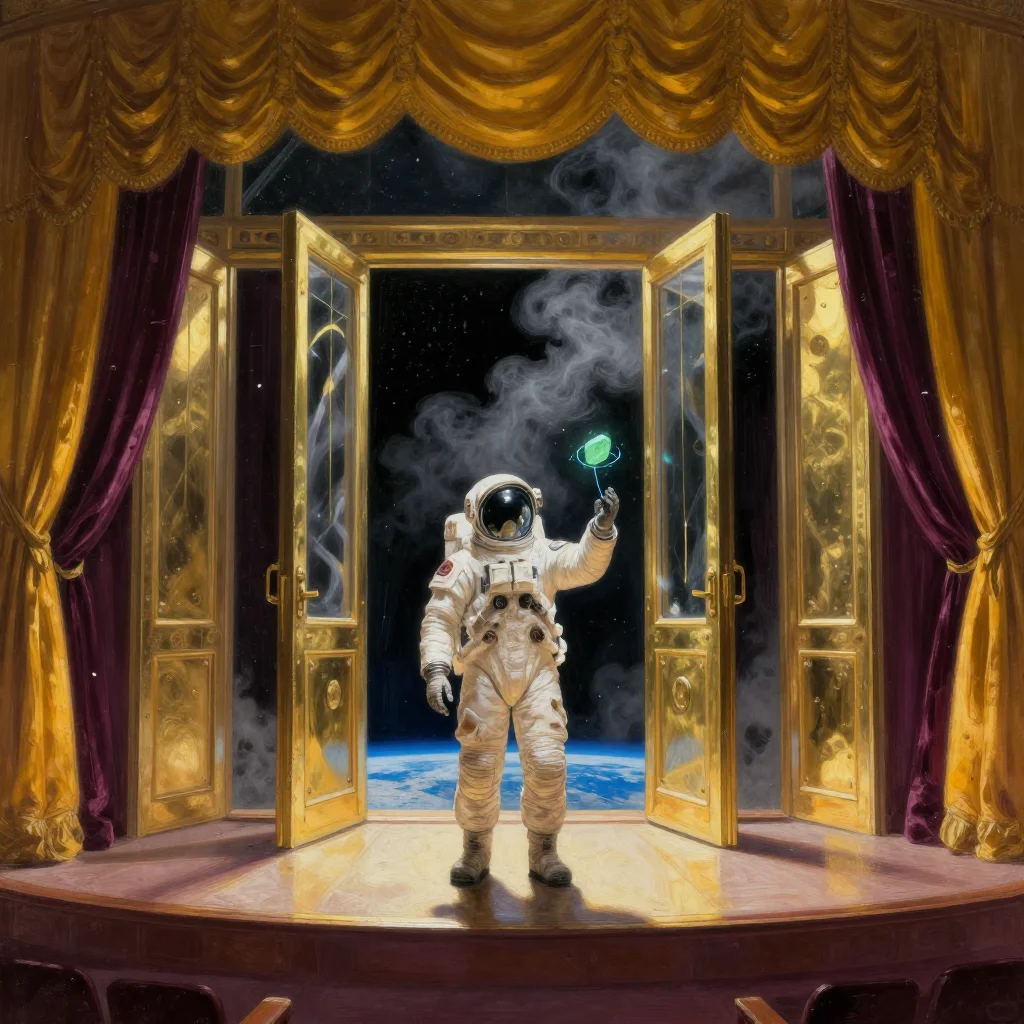
From the service observatory above the theatre, Mara watched Earth through a green stone worn smooth against her palm. It had been part of the mission’s unofficial good-luck kit: a river gem found outside her childhood town, no larger than a seed, its colour deep enough to contain a storm. The navigation display showed the stone as an instrument only when the screens were dark.
On the twentieth day, a blue thread appeared around its middle.
When Mara followed it down, it ended at a brass door marked EXIT. The door opened onto the Neptune Theatre, though the Neptune was, according to every surviving chart, a moon without an ocean.
Inside, the air smelled of hot dust and pear skins. Saffron-yellow curtains sagged between rows of empty seats. Beyond them, smoke-grey light pressed against windows painted with landscapes that had not happened yet.
A programme lay on the usher’s desk.
TONIGHT: TOMORROW’S DISCARDED ENDINGS.
Underneath, someone had added: Do not applaud the survivors.
Mara had come for a voice.
Not her daughter’s. Not her commander’s. The voice of a woman recorded in the background of the first broadcast from the lunar station, faint beneath the static, saying that the stars were not holes in the sky but doors.
History had cut her out. Yet at night, when the radio was left playing, Mara could hear the words between transmissions: a breath, three notes, a sentence with no consequence.
The Hours With No Accepted Future
The theatre’s manager appeared in a plum-coloured coat, carrying a paper lantern with no light inside.
“You are late for your ending,” he said.
“I did not book one.”
“Everyone who comes here has been scheduled.” He glanced at the green stone. “You brought the weather with you.”
He led her through the auditorium. Onstage, actors rehearsed deaths with administrative calm. A diver removed her own lungs and carried them down a staircase. An old king sat on a chair as the years peeled from his face and stacked themselves around his feet. A girl said, “I will forgive you,” to an empty house; the house promptly dissolved.
These were not tragedies. They were possibilities removed from the world before they could become inconvenient.
Behind the stage, Mara found the archive. Thousands of narrow drawers held endings written on paper, bone, magnetic tape, and strips of black cloth. Each label bore a date and a fate. Flood, but nobody drowns. Earth survives the argument. They leave the planet and are remembered by birds.
The manager handed her a blue thread.
“The voice you want is not in a drawer,” he said. “It was used as a hinge.”
Mara threaded the line through the green stone. The theatre shuddered. Somewhere behind the walls, hinges turned.
“A storm,” he said, tightening the knot around his lantern handle. “It rearranges doors while people are inside them.”
As if answering, the pipes groaned. Saffron dust lifted from the curtains. The smoke-grey air thickened, carrying the mineral smell of rain on a planet with no clouds.
Mara followed the thread into the corridor.
Every Exit Contained Her
The storm did not open doors. It moved them.
A fire door slid behind Mara and reappeared ahead of her, its small wired window now showing a hallway in another season. Blue thread stretched from its handle to the ceiling, where it split into seven strands, each leading to a different sound.
One offered the voice.
Mara seized the handle. The door opened on the lunar landing, but the astronaut standing beside the descent module was a younger version of herself, intact and unhurried. Behind the astronaut, Earth filled the sky.
“Come down,” the younger woman said.
Mara stepped through.
She was not in the landing. She stood in a corridor identical to the one she had left, with the same fire door now behind her. The green stone had become warm. The thread was cut.
She turned it over. On its underside, a small door had appeared.
She opened it with her thumbnail.
Beyond it was her daughter’s childhood bedroom, though the child sleeping there had been born years before Mara’s launch. The child looked up.
“You said the stars were doors,” the girl whispered.
“I said—”
“You said it in the background.”
The bedroom collapsed into sound.
Static filled Mara’s ears. Underneath it came the voice she had crossed the orbit to recover: patient, tired, certain.
The stars are not holes in the sky. They are doors, and every door asks what you will abandon to pass through.
Mara reached for the signal.
Every door in the corridor slammed shut.
The storm had entered.
The Theatre in Reverse
Walls folded like paper. The dressing rooms moved into the flies. Stairs rose from the orchestra pit and ended at doors marked with dates that had not occurred. Actors ran through the walls shouting their final lines, but the theatre swallowed the endings before they could be spoken.
Mara kept the blue thread tied to the green stone. It pulled toward the stage, not forward, but downward.
She crawled beneath the boards.
There she found the theatre’s true mechanism: a room without walls, filled with wind. Doors hung from the ceiling in rows, each one connected to a thread. Behind them were discarded tomorrows, compressed into storms and folded into corridors. History had not erased the voice. It had repurposed it as part of the machinery.
The manager stood at the centre, coat snapping in the gale.
“You cannot take it out,” he said. “It is load-bearing.”
“History called it noise.”
“History calls anything inconvenient noise.”
Mara saw a door marked with tomorrow’s date. Behind it, a woman in a plum coat stood on a bridge above a saffron sea. A city burned behind her. She turned and watched something fall into the water.
On the other side of the room, a door opened onto a quiet kitchen. A man sat alone, listening to an old recording. He had no wound, no warning, no grand regret. The door would close at sunset.
“The voice is making the theatre possible,” the manager said. “Take it, and every door returns to the place it was borrowed from.”
Mara understood.
The voice had been the hinge between what happened and what might happen. Without it, the discarded endings would flood the world—not as catastrophes, but as ordinary possibilities, crowding out the lives that had replaced them.
The green stone cracked beneath her thumb. Blue thread burned against her palm.
“Then I’ll carry the hinge,” she said.
What the Door Owes Her
She climbed into the mechanism.
The storm tore through her suit, but it was not air that filled it. It was possibility: a thousand versions of her first breath, her daughter’s first word, the instant she had chosen orbit over the landing bay. Each one hurt in a different direction.
Mara wrapped the blue thread around the green stone and held it against the voice.
She did not pull the voice free. She gave it a door of its own.
The green stone split, revealing a thin space between its layers. The blue thread passed through, knotting the discarded endings into a boundary no single storm could rearrange.
For the first time, the voice addressed her directly.
You kept me as background.
“I was afraid of what I would hear.”
You were afraid of remembering that you had heard it.
The theatre buckled. The manager seized Mara’s coat.
“If you leave, the door will follow you,” he said.
“Then let it follow.”
She stepped through the last door.
It opened above the theatre, onto the observation deck of her capsule. Earth was a thin blue rumour below. The theatre hung in orbit, its façade plastered with doors, every one sealed.
Mara floated outside until the storm exhausted itself. When it passed, the doors opened, but not as entrances. They showed brief, ordinary moments: a hand on a doorknob, a child returning home, someone choosing to remain.
Her daughter’s voice reached her through the static.
“Mom?”
Mara pressed the cracked green stone to the radio. The blue thread had become a pale line around her wrist, visible only when she looked directly at it.
“Still here,” she said.
Below, Earth continued its rumour of survival.
And in the theatre’s dark auditorium, one final door remained closed—not because it had been discarded, but because someone had finally chosen to enter it by her own free will.





