 Netwrck
Weird Fiction.
The Library Underfoot
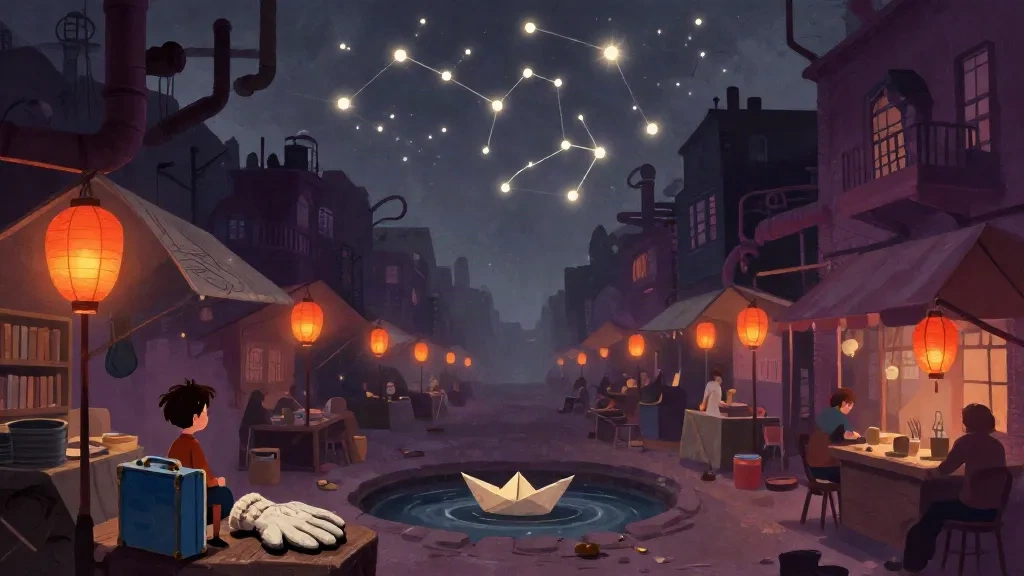
The market began where the city ended.
There was no stair down from the first floor, only a service lift that stopped one level too soon, and below that a ceiling of black pipes threaded with saffron bulbs. The air was smoke-grey, though the cooking smoke rose through unseen chimneys. Stalls leaned together beneath awnings stitched from old maps. Sellsaws whispered through bowls of pepper and bottled thunder.
On a night when the moon was absent, I carried my library between both hands.
It lived in a blue suitcase: catalogue cards, seed-paper sleeves, three pencils sharpened with a knife, and the small brass key that opened nothing. My mother had called the suitcase portable because she knew I would leave. She had not told me where.
Under the stall selling stars broken from old chandeliers, I found the map of the Lost Dipper.
It was not a place-name. It was a constellation, seven points joined by a red thread: the Swan Who Carries a City. Three months earlier it had vanished from the sky over the rooftops, leaving only a dark ache, as if the night had a missing tooth.
The map showed its place in a drawer beneath the market’s oldest well.
Deadline Before Morning
The archivist who owned the map was a thin man with a wool glove on his left hand and no left hand inside it. He kept the glove empty, folded over the map like a sleeping animal.
“You have until the market closes,” he said.
“Your hand is not dead,” I said.
He smiled without showing his teeth. “The deadline belongs to the person who has not died yet. That is why it cannot be moved.”
He told me the constellation had been borrowed from the sky to keep the city’s first floor above the underworld. Every night, the market exchanged pieces of daylight for pieces of sky. A stallholder had stolen the Swan and hidden it among the things people could not afford to lose.
At the north end, beneath a saffron lantern, I saw a paper boat drifting upside down in a bowl of rainwater. It was small, folded with impatient corners. Beside it lay a wool glove, grey with soot, its fingers pointing toward a ladder.
The glove was warm.
So was the ladder.
I climbed. The pipes parted, and beneath them hung a second market made of darkness. Stars were displayed in jars, each with a paper label: CHILDHOOD, LOST; SAILOR’S PROMISE; THE YEAR OF RAIN. The Lost Dipper had been divided among three sellers.
The Boat That Remembered Water
The seller of childhood wore my mother’s face, though I had buried her three years before. I gave her the catalogue card from my suitcase. She took one point from the jar and put it in her palm. It shone weakly, like a nail remembering sunlight.
The seller of promises was blind and sold eyes.
The seller of rain was an old woman folding paper boats beneath an open roof.
“The sky will not take them back,” she said. “Not if you return them with hands.”
She gave me a boat. Its sail bore a red line.
“What is it for?” I asked.
“Carrying a sentence to the place where it began.”
At closing time, the well struck once. Across the underground market, every lantern turned to the same deep plum. The red thread on my map began to tighten, pulling the seven points toward a shape not yet made.
I knew then that the constellation had not been stolen for the city. It had been stolen from someone who was still alive. The archivist’s empty glove was sewn from the sky’s missing hem. The red line was not a join. It was a leash.
I cut the thread with the key that opened nothing.
Return
At the well, I placed the paper boat in the water. I wrote on its sail the sentence I had carried since the market first opened:
Nothing below the first floor is under us.
The seven points rose.
They came out of the jars, out of the black pipes, out of the wool glove warming on the ladder. The blind seller looked up with borrowed eyes. My mother’s face became rain. The old woman folded one last boat and set it on the water.
The archivist stood beneath the well with his empty sleeve open.
“It will return to me,” he said.
No. I looked at the point inside his glove, bright as a small coal. The constellation was not his. It belonged to the sky, and the sky had been waiting all this time for someone to remember it.
I raised my face.
Above the pipes, beyond the market and the city’s sealed first floor, the Swan unfolded across the unseen roof. One point after another. Then its wings crossed the darkness, and the market became a patch of smoke-grey under a saffron morning.
In the blue suitcase, the catalogue cards shook themselves dry. The brass key clicked once.
It opened the sky.
And the archivist, still living, finally looked up.





