 Netwrck
Science Fiction.
The catalogue of the vanished
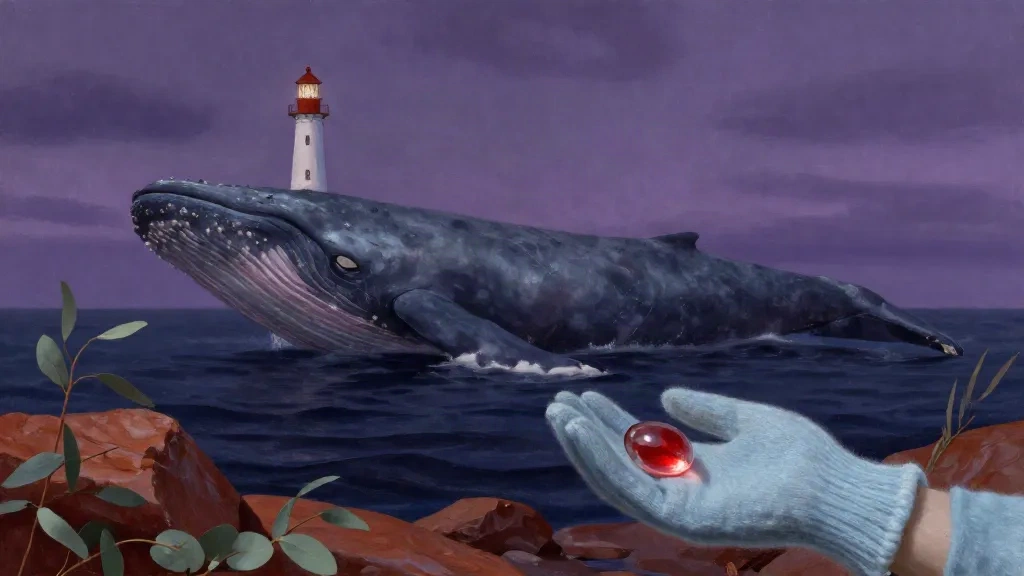
At the base of the lighthouse, where the whale’s iron ribs met the sea, Mara Venn kept the archive in a room shaped like an ear. Brass drawers climbed the walls in crooked rings. Each drawer held names that had belonged to villages, ships, storms, and people who had chosen to become weather.
She had been told the whale slept beneath the western archipelago, carrying the lighthouse away from the mainland. Its eyes were sealed beneath the hull. Its engines turned with the patience of tides. Above them, the lantern swept a bruised sky, staining the clouds terracotta, then eucalyptus, then the deep purple of fruit left too long in the rain.
Mara did not know which name the archive had taken from her. She had arrived at the lighthouse as a child, with no memory of the village before it, and had spent twenty years restoring what the water had misplaced. She knew the taste of salt on old paper. She knew that a name was not proof of a life, but a promise that someone had tried to keep it.
That morning she found a catalogue dated 2131, its pages stiff with heat. The lighthouse had no year printed anywhere. The catalogue listed islands that no longer existed, then children, then rivers. On the final page, beneath the heading Names requiring a living bearer, she read:
Mara Venn. Originally: Elian Rook. Place of return: the drowned western shore.
Her hands went numb. She remembered nothing. The land remembered her.
The shadow at the signature line
By dusk, the archive had filled with wind. The whale stirred beneath the floor, and a long tremor loosened dust from the ceiling. A second archivist entered carrying a wool glove, pale blue and matted at the fingertips.
“You found the catalogue,” said Lio.
“You knew I would.”
“I knew the future would make an appointment.”
He placed the glove on the desk. Inside it was a glass seed, no larger than a lentil, with a seed of red sand suspended at its center. Mara had seen one once in her childhood, in the hand of a woman standing at the edge of a field that no longer appeared on any chart.
She reached for it. The room darkened.
The shadow came from beneath the whale’s ribs, though there was no light there to make it. It wore a strip of black cloth around its shoulders. As it crossed the archive, its outline sharpened into a bureaucrat: narrow sleeves, stiff collar, one hand extended for a pen.
“Elian Rook is a person who no longer exists,” the shadow said. “To restore that name, you must surrender the one now attached to you.”
“That is not the law.”
“The law is whatever is signed.”
It offered Mara a document. At the bottom, the signature line had already been filled with her own handwriting. The first letter was hers. The second was not.
The shore beneath the whale
They descended through the lighthouse into the whale’s throat. A corridor of bone-colored metal curved downward, lined with dormant gauges. Mara carried the glass seed. Lio carried the wool glove.
“The glove belonged to the woman who found the seed,” he said.
“You said it was mine.”
“I said you would recognize it.”
The whale’s interior was warm. Its machinery breathed through hidden pipes, and beyond the walls, the sleeping engines made a slow heartbeat. Mara followed that heartbeat until it opened into a chamber beneath the hull.
There was no sea there. Beneath the whale lay a dry valley, filled with red soil, blue stone, and the roots of trees that had grown around an abandoned village. A weathered house stood at the valley’s center, its door sealed by a sheet of official paper.
The shadow had followed them. It held out the document again.
“Sign, and Elian Rook will return to the land. The bearer will be forgotten.”
Mara looked at the house. A name-mark had been cut into its lintel, but the letters were worn smooth. She understood then that the name had not merely been lost. It had been transferred. Every generation had taken it from the stone and hidden it somewhere else, until a little girl with no past could be made to carry it without knowing.
What the land remembers
“The land does not need me to die,” Mara said. “It needs me to speak it aloud.”
“Aloud is unstable,” the shadow replied. “Paper is durable.”
“Paper can be changed by a shadow.”
She opened her palm and dropped the glass seed into the red soil. It struck the ground with a sound like a small bell. The blue stone split. Eucalyptus leaves broke through the cracks, though the valley had no wind.
Mara pressed the wool glove against the name-mark. “I, Mara Venn, born Elian Rook, give this name back to the western shore.”
The shadow lunged for the document. Lio caught its sleeve. The black cloth tore, revealing not a face but a blank space, crowded with erased signatures.
Mara wrote nothing. She spoke again, louder, and the valley carried the name through its soil, through the whale’s ribs, through the lighthouse. The lantern turned once above the sleeping sea.
The house door opened. Inside, a woman sat at a table with a wool glove on her hand, waiting to be remembered.
Mara kept Elian Rook alive. She simply no longer carried it alone.





