 Netwrck
Surrealism.
The last orbit
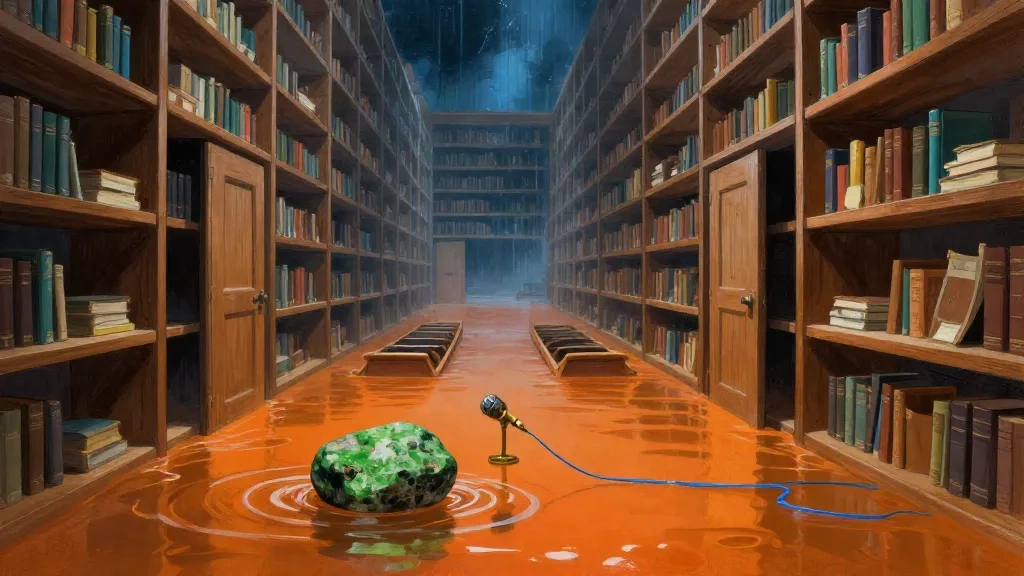
Mara Venn kept her wristwatch set to Earth time, though Earth had become a rumour told by static. From the observatory above the drowned archive, she watched librarians row between shelves, their oars making small green hinges of the water. Below them, blue storm-light trembled on the tops of submerged cabinets.
Her capsule had one seat left. It faced the sky, not the planet. She had strapped herself in years earlier, when the evacuation order arrived and every official voice said the same thing: leave now, and the world will continue without you.
Mara had not left.
She wanted to recover a voice that history had used as background noise. Her mother’s voice, perhaps. Or the voice of the woman who had spoken during the first moon landing, her breath rendered into numbers and discarded beneath the applause. Mara remembered only a low syllable, repeated three times, like a door being tested in another room.
Beside her console rested two objects recovered from the archive: a green stone smooth as a swallowed bell, and a length of blue thread tied around her smallest finger.
Doors in the weather
The storm came without thunder. It entered the archive as a blue pressure, bending the shelves and making every brass handle point north.
One librarian rowed toward a narrow door marked CATALOGUE. When she pulled it open, the door opened elsewhere: a pantry in a house that had vanished, then a lift descending through salt, then a black corridor lined with listening devices.
Mara descended by ladder. The water was warm and orange at its surface, though storm-light turned every submerged object blue. She carried the green stone in one hand and unwound the thread with the other.
The thread led her through a reading room where books floated open around a motionless reader. Their pages turned in sequence, whispering in a dozen borrowed tones.
Do not mistake a voice for the one speaking.
Mara searched the room for the speaker. Behind the catalogue door, she found a narrow chamber. Its walls were made of sound: footsteps, paper tears, a child counting, a man breathing through his teeth. In the centre, an old microphone hung above the water on a blue cord.
When she touched it, the voice returned.
It was not her mother. It was hers.
The voice under water
The recording began before Mara was born. It described rain striking a roof, a train passing behind a house, someone sharpening a pencil. Beneath the ordinary sounds, Mara heard the syllable she had carried in memory: or, or, or.
Her younger self had whispered it every night after the launch, when the capsule lights dimmed and the Earth became too distant to see. She had forgotten giving it to the recorder. She had forgotten anything at all.
The storm shifted. The door ahead vanished into the wall.
“Open,” Mara said.
The archive answered by opening every door at once.
Rooms folded through one another. Librarians rowed through walls. A shelf of atlases spilled into the sky, and the maps opened above her like cold wings. Somewhere, a man was still saying her name in a voice that had been used as background noise by history.
Mara tied the blue thread around the microphone and pulled.
The green stone split.
Inside it, no treasure waited, only a small orange room where her mother sat folding wet clothes. Mara wanted to run to her. Instead she placed the stone beneath the microphone.
“Say the word,” her mother said.
Mara had forgotten the word. She had kept the sound.
A recoverable voice
She leaned into the microphone and spoke the low syllable. Once. Twice. On the third repetition, the storm broke.
Blue light tore through the archive. Doors slammed shut, opened, slammed again. Shelves turned like compass needles. Every librarian stopped rowing and looked toward the chamber.
Then Mara heard her mother clearly, not as a memory but as a voice entering the room: You were never background.
The archive released the sound. It moved through the water, through the shelves, through the open sky above the drowned stacks. It touched the librarians, the maps, the stone and thread, the capsule waiting with its single seat turned away.
Mara climbed back to the observatory. The storm-light had thinned. The archive lay beneath her, immense and quiet, its doors finally facing the right directions.
She left the microphone recording behind. On orbit, she began writing down every voice she could remember, beginning with the ones no one had thought worth preserving.
By dawn, the green stone had dried. The blue thread pointed toward home.
Mara did not follow it. For the first time, she no longer needed to.





