 Netwrck
Weird Fiction.
The Closed Door
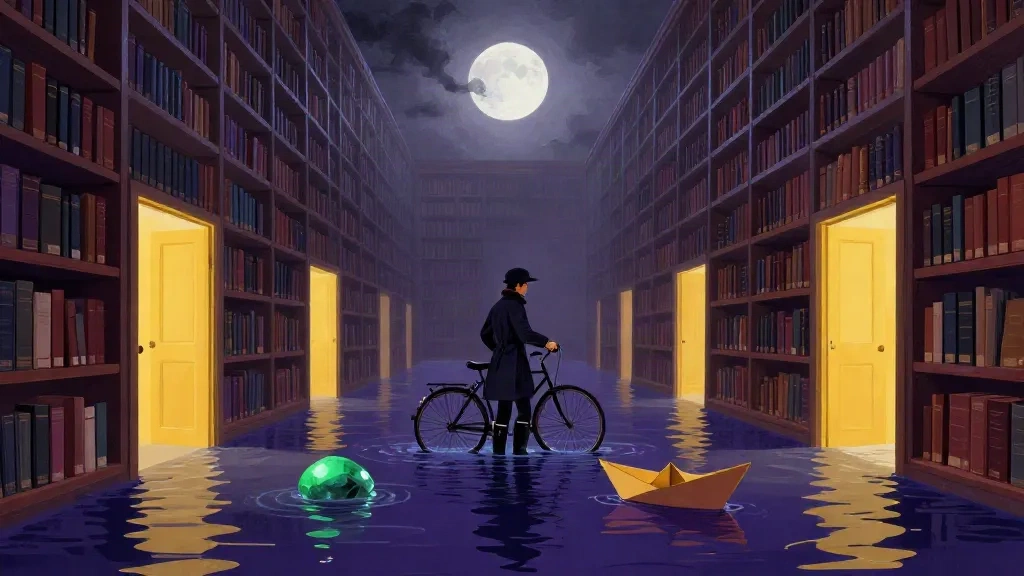
Mara kept the bicycle beneath the waterline, where the archive shelves rose like drowned cathedrals, ribbed with silt, their shelf-marks still legible to anyone patient enough to row slowly past them. She was a courier, though no one had posted a letter in nine years. Every morning she rowed the submerged stacks and checked the brass pigeonholes for something from tomorrow. Every morning the pigeonholes returned her own handwriting to her, set in her mother's type, upside down and addressed to no one.
Her mother had been the reading room's last pneumatic clerk, and the bicycle had been hers: black, narrow, its frame painted with a mark that looked almost like an ear. Her mother had drawn that mark in the corner of every letter she ever sent, and when the water took her the bicycle had kept the habit. The front wheel crossed sealed doors. Mara had inherited the bicycle, the rowboat, and the belief that the future was simply a place that could be reached by someone willing to be punctual.
Emil called from the upper levee on the eighth day of every month, always to ask whether she had stopped.
Not yet.
That isn't an answer, Mara.
No, it was not. She had spent nine years perfecting a sentence that was not an answer, because the truth was worse: she had not stopped, and she had begun to enjoy the not-stopping, the way you enjoy a habit you know is destroying you, in the small hours, when nobody is watching the water.
At noon the future usually sent nothing. The absence had begun as a rumor, then a vacancy, then a silence so total that the archivists had retired the word future from their ledgers. Mara refused the word ended. Ended things could be mourned, and mourning required a body. A stopped delivery was only a delivery whose route had been concealed.
She noticed the bicycle during the eastern survey. A door marked MUNICIPAL DISPOSAL stood sealed under three brass locks and a decade of silt. Mara pedaled at it without slowing. The wheel crossed the wood and did not touch it.
Article Seven
Beyond the door ran a corridor lit by saffron-yellow windows, though no sun had reached the archive in a generation. The air smelled of wet paper, iron, and cold smoke. A brass plaque beside the frame read: LAND PERMISSION TO LISTEN, ACCORDING TO ARTICLE SEVEN OF THE ACCORD BETWEEN WATERS AND INHABITANTS.
The accord had been signed in the flood year, when the upper city surrendered its streets and its dead to the water. In exchange, the water agreed to carry correspondence. It was not to open it. It was not to read it. And in the margin, in a small upright hand, someone had added that anything overheard by a shore becomes part of the shore's legal memory, which is to say becomes a debt the shore cannot forget and cannot refuse.
Mara had been reading that margin for six years. She followed the green reflections that ran under the floor from junction to junction, because something was moving ahead of her: a paper boat, its folds sharp and deliberate, carrying a fragment of green stone in its hollow center. She had seen the same boat in three decades of the stacks. It always went the same direction, toward the section marked with dates no archivist had been born to read.
Anselm Vole waited at the end of the corridor: the reading room's last librarian, old in the way flood damage is old, complete and upright and no longer accepting revision. He had hired Mara when she was nineteen. For nine years he had also been doing something she had only just learned to see.
He kept the Dead Letter Drawer of Continuing Delivery in the bottom of his desk, and it was full of her handwriting.
Forty-one drafts.
Every one a complaint to the future, and every one a request that it answer. You filed them.
I kept them.
Kept or filed.
He did not answer. He turned the drawer so she could read the brass label, and his silence was the loudest thing in the corridor.
The Green Stone
Vole would not meet her eyes. The stone on his desk was warm, though she had carried it up out of the coldest stack through forty feet of meltwater. He touched it once and took his hand away as though burned.
A fragment of the threshold. The first stone the water touched, the year of the accord. Nine years in the stacks and it has never once been cold.
Because it holds the sentence.
Because it holds a sentence the law says the shore was not permitted to hear.
She asked who had written the margin. The silence that followed was the old kind, the kind of flood damage: nothing rotted, nothing gave.
Then he said: I. In my own hand, at thirty-one, with the water still rising. The upper city had begun to argue that the drowned had no standing, because a drowned man cannot be cross-examined. So I gave the shore a memory. I thought I was defending the dead.
You built a court and made the water a witness.
I built a witness. I did not build a court. That was the mistake, and it took the water nine years to learn it.
Mara thought about the drawer, the forty-one drafts, the drowned families who had spent nine years winning suits in a court nobody could locate, because the only judge was the water and the water was gagged by its own memory of a sentence it had never been meant to overhear.
You have the witness, then. Deliver the witness.
No. You must deliver the silence.
That is not a destination, Anselm.
It is the last delivery this archive can make honestly.
He gave her a paper boat folded from a page torn out of the accord. Set on the flooded floor, it did not sink. It went forward through the water, and every shelf around them turned its labels inward. Somewhere behind the stacks a bicycle bell rang inside a locked room.
The Room Behind Tomorrow
She pedaled after it. The corridor narrowed into a passage of plum-dark water, and her mother's ear on the frame gave back a low glow. The door at the end had no lock, only a narrow slot. The paper boat folded itself smaller, twice, and fit through without bending.
Beyond was a room of sealed letterboxes, each holding a day that had not happened, each labeled in a clerk's hand. The future had not vanished. It had withdrawn into a country the present was forbidden to enter. Beneath a smoke-grey ceiling, a clerk in a wet coat sorted blank envelopes by the sound of footsteps on the other side.
You are late.
I have been on time for nine years.
That is the complaint.
He gave his name as Ostrow, the Under-Clerk, and said it the way a man says a rank he has been demoted from. He explained the mechanism while he worked, without looking up. The shore had heard the future's last letter: one sentence, a request to stop sending. Because of Vole's margin, that overheard sentence had become legal memory, and legal memory is not a record. It is an obligation. The land was obliged to hold the silence, and an obligation held long enough becomes enforcement. Every letter Mara sent toward tomorrow, the water took, because the water could not bear to know what came next.
So the future is not refusing me. The land is gagged for it.
The land is gagged, and the future is free, and neither of them is permitted to say so. The gag is the only thing in this arrangement that is real.
He said there was one form in the accord that could cut a legal memory loose. He did not say what it would cost. Mara set the green stone into a fresh paper boat on his desk.
Then someone must finally deliver the complaint.
Someone. Yes.
And when the memory comes loose, the shore forgets the drowned. The claims, the names, the standing. The embankment surveyors finished their soundings last week. There is a survey marker in this building's foundation, Mara. The only legal obstacle to the new levee is a watercourse no court has ever been able to locate, because the water is the court, and the water has the drowned inside it.
That was the shape of it, cleanly: the future's voice, or the drowned city's standing. Not a trade of hers to make, unless she was willing to make it on behalf of both of them.
The Complaint
Mara had spent nine years refusing a distinction. She knew the difference between silence and consent. She had a bicycle that crossed forbidden doors and a complaint that could not be written, because writing it would make the future answer itself. She had, she understood now, three other things: a drawer of forty-one drafts, a marginal note in a living man's hand, and a stone that had stayed warm for nine years against a law that said the shore should never have had to carry a word at all.
She dictated. Ostrow wrote it into the request and the request into a letterbox, and the letterbox accepted it without opening.
State the complaint.
The correspondence of the future was intercepted by the land, in violation of Article One, which permits carriage without interception. The land holds a memory it was never meant to hold, and holds it against the dead as well as the living. I ask the shore to surrender the sentence. I ask it to hear the future without obeying it.
Ostrow copied it word for word, including the parts that were not law, and when he had finished he stamped the form with a small brass seal shaped like an ear. Behind him the shelves of unhappened days began, very faintly, to warm.
At dawn she rang the bicycle bell. Once for lost mail. Once for the future. Once for the shore.
What the Shore Answered
The land answered, and it was not permitted to, and the treaty did not say what would happen then. Water came up through the reading room pipes in nine steady columns and spoke. It was not a voice. It was a pressure, and under the pressure the building's stones moved a quarter inch, and every stone moved with a name inside it, and the names were not the future's. They were the drowned: her mother's mother; eleven children of the Lute Street pump; a surveyor who signed a release nobody had asked him to sign.
They went on a long time. Vole sat down on the floor of the corridor with his back against the wall and listened, and when it was over he looked at his own hands as though they had been lent to him.
It remembered them.
It never forgot. That was never the problem. Forgetting was simply the one thing it could be asked to do.
The compliance clerk from the embankment commission was at the archive by noon. By evening the soundings were suspended. By the following week the new levee had acquired an obstacle it could not survey around. The drowned kept their standing, and the survey marker in the foundation stayed where it was.
The letterboxes had begun to warm. On Tuesday a sound came out of the box marked for the day after next, like someone drawing breath in another room. On Thursday the box for next week opened itself and contained one envelope, empty, unsealed, addressed in her mother's type to Irena Vandermeer, Reading Room, In The Water. Ostrow read the address, and then sat down very carefully, because an Under-Clerk of the future is not supposed to have had a mother who taught him his letters.
Mara put the empty envelope in the rowboat with the green stone, and the paper boat went out ahead of her through the eastern stacks, into the saffron light, toward the section marked with dates no archivist had been born to read.
Emil called on the eighth day, as he always did, and asked whether she had stopped. She listened to the levee behind him, and to the pump, and to the sound of men arguing about a watercourse that could not be found on any map.
No.
That isn't an answer, Mara.
No. Come down and look.





