 Netwrck
Weird Fiction.
Blue Suitcase, Saffron Air
Every morning, the lost-memory market opened above the fog.
Stalls hung from chains too long to count, and beneath them the air smelled of cold iron, burnt sugar, and rain caught in wool. Merchants sold birthdays without the faces that had witnessed them, quarrels missing their participants, lullabies whose singers had sunk into dementia. Owners abandoned them by degrees: a tongue lost its words, a house forgot its children, a day slipped beneath a cupboard and emerged smelling faintly of mouse drop.
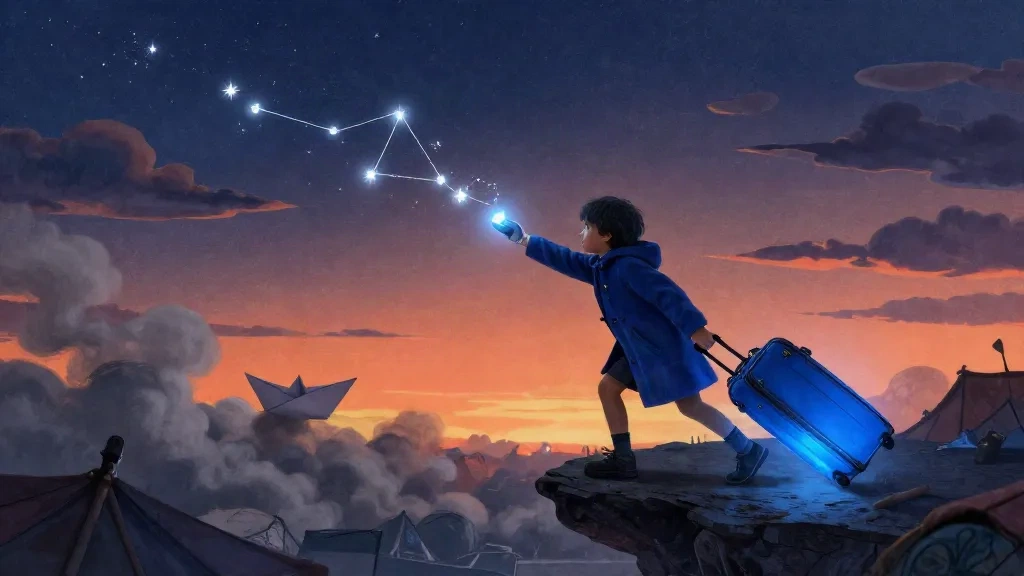
Nim walked through the smoke-grey streets carrying a blue suitcase.
Inside it lived his library.
Each memory rested in a glass phial, sorted by colour and consequence. He had learned the rules early. Grief travelled heavy and must be carried upright. Joy was fragile without context. Fear belonged in the bottom drawer, tightly stoppered. He was eleven, perhaps twelve; the years had been sold separately, and he preferred not to assemble them.
That day, near a stall selling extinguished bonfires, he found the wool glove.
Only one. Smelled faintly of cloves.
The glove belonged to a woman named Ilyan, whose name he knew because it was stitched inside the cuff. It had once held her hand while she watched a sky.
Not the present sky.
Another one had hung there before the city quarried its first tower, before the stars were nailed into government charts, before the harbour learned to stink of iron. In the glove’s palm, a small blue light pulsed like a trapped insect.
Nim opened the glove and saw a constellation inside it.
Six stars. A crooked river. One bright point at the centre.
The Woman Who Was Not Dead
He found Ilyan at the western gate, buying a memory of green grass.
She was alive. That was the trouble.
Memories should belong to the dead, or at least to those too absent to complain. Ilyan stood beneath a saffron awning, turning the glass jar between her fingers. Her hair had gone white at the temples. The constellation in her glove was trying to escape through the wool.
“You are late,” she told him.
Nim frowned. “I only found the glove.”
“It was waiting for you.”
She pointed upward. Above the market, between the stalls and the low, dirty clouds, a patch of night had gone blank. The stars around it shone with resentment, as if a sentence had been torn from a book.
Ilyan handed him a folded timetable. Tomorrow’s date was crossed out in violet ink. Beneath it, a single instruction:
Return the sky before I forget your face.
“That is not a deadline,” Nim said.
“It is if I am the one who gives it.”
He unfolded the timetable further. Inside were rules in Ilyan’s cramped hand. The sky had been taken from its original place by a municipal surveyor named Pell. He had cut out the constellation and sold it to a forgetter, who had hidden it in the glove. The glove had then wandered into the market when Ilyan began forgetting where she kept her hands.
“Who are you waiting for?” Nim asked.
“My daughter.”
She said it without looking at him.
“She is not dead.”
“No,” Ilyan said. “That is why the deadline is cruel.”
Dead people can leave instructions. Living ones can forget them.
Paper Boats on the Black Stall
Pell’s stall lay beneath the lowest bridge of the market.
He sold distances, missing stairs, and small silences. Nim asked about the stolen sky. Pell denied it first, then demanded the glove as payment. Nim offered three perfectly preserved summers. Pell refused. He wanted the child’s name.
“Names are expensive this week,” Pell said.
So Nim built a paper boat.
He used the timetable, folding the corners with a thumbnail. When he set it in the gutter, the water carried it beneath the bridge, through a drain black with syrup, and into a memory belonging to someone who had once loved boats.
The stall shuddered.
Inside its shelves, a folded night appeared: the missing patch of sky, compressed into a wool-lined box.
Pell lunged. Nim kicked the box into the gutter.
The paper boat rose.
Its sails were small and white. Its hull was dark with current. It carried the stolen sky through the market at impossible speed, ducking beneath tables, through the bellies of abandoned clocks, across the palms of sleeping vendors.
Nim ran after it.
Ilyan ran slower. Every few steps she stopped, touching her face as if checking that it was still there.
The Place Where the Stars Belonged
They reached the northern edge at sunset.
There the market ended in a field of unmade beds. The saffron light was almost gone. Plum-coloured clouds pressed low against the air. Beyond them, the blank patch in the sky waited like a missing tooth.
The glove was burning in Nim’s hand.
He could not reach the sky. No one could. The stolen constellation had to be returned to the place from which it had been taken, and that place no longer existed except inside Ilyan’s memory.
So Nim opened the suitcase.
He removed every phial he carried. Summer after summer spilled into the field. First holidays, then arguments, then the first time Ilyan had laughed and looked like her daughter. He poured them into the paper boat.
The boat grew.
Its hull became a dark lake. Its paper sides became hills, then forests, then the first city, then the sky above it.
Nim placed the glove at the bow.
The six stars jumped into the air.
For one heartbeat they hung over the market, saffron and white, and the wool glove became a small human hand. Ilyan reached toward it.
“Mara,” she whispered.
Her daughter’s name returned the way a key turns in a lock.
Then the sky closed around the stars. The boat burned without becoming ash. Its paper hull rose, carrying the stolen piece of night back to its proper place among the cold, indifferent stars.
The glove landed at Nim’s feet, empty except for one red thread.
Ilyan looked at him.
“What was your name?”
Nim opened the blue suitcase. Inside, the shelves were bare. He had given away the years that made him someone.
“I don’t know,” he said.
She nodded as if this were correct. “I will remember tomorrow.”
At the market below, vendors began packing away the last of the smoke-grey air. The stars returned one by one. When Nim looked up, the borrowed constellation was burning above the northern field, bright enough to guide home even people who had forgotten their own.





