 Netwrck
Adventure.
Tomorrow’s Discard Bin
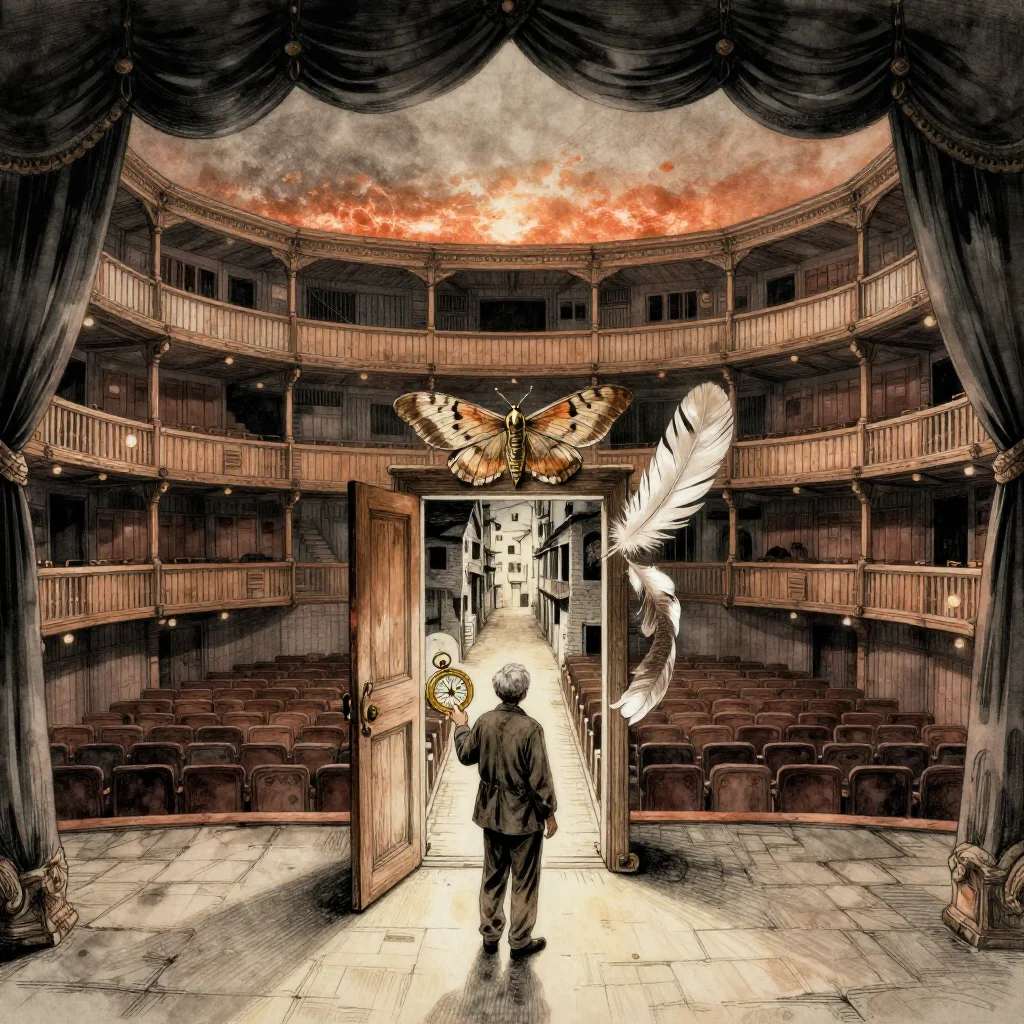
At noon, the Lantern Theatre swept yesterday’s endings into the basement.
Mara Venn heard them strike the stageboards: a gunshot repeated twelve times, each report slightly softer; a woman saying I forgive you in twelve languages; the crash of a city falling upward into a yellow sky. At dawn, the actors would arrive to find those moments gone and invent others.
For thirty-seven years, Mara had drawn coastlines, vanished mills, flooded monasteries. Retirement had not quieted her hand. On the theatre’s highest map table, she inked a narrow street between two estates that had burned down before her birth. The road existed in an 1846 survey, though every copy of that survey had been lost.
Then the street lifted from the paper.
Its doors rose along the tabletop, each no taller than a postage stamp. A brass staircase unfolded beside them. A card waited at the bottom:
<THE HOUSE OF UNFINISHED PLACES
Admission: one destination you can no longer find.
Mara brought a moth wing in a glass frame and a white feather in a paper sleeve. The wing had belonged to the last moth seen above the drowned village of Oren. The feather came from a skylark that vanished when the eastern airship route was abandoned. She had carried them for years, proof that disappearance was not the same as nonexistence.
The Market of Expensive Truths
Beyond the brass stairs lay an aisle of theatres, each playing a finale no audience had witnessed. In the nearest, a king murdered his daughter, rose, and asked the choir to applaud. Farther down, a runaway train reached a station where everyone aboard had already died.
Between them ran the market.
Stalls offered discarded places: a village preserved only in nursery rhymes, a railway platform used in the final dream of a condemned man, a hospital that existed whenever someone remembered the word mercy.
The cheapest stalls sold lies.
At one, a fox combed diamonds from its tail. At another, bottled laughter rang whenever shaken. The proprietor, a woman whose face changed with every bargain, displayed the white feather beside Mara’s moth wing.
“Exterior facts,” she said. “The wing remembers air. The feather remembers altitude. Here, facts have prices.”
She set a silver scale between them. A brass token trembled above the left pan. Beside it appeared a date: the night of Oren’s flood.
“Sell me when your village sank,” the proprietor said, “and the market will make it permanent. The wing, the feather, your little road, all of it preserved in perfect detail.”
Mara understood the trap. Permanence demanded a date, and every date belonged to something already lost. To make a haven for lost things, she would first have to consign another memory to certainty.
A Door Without a Destination
She refused the token.
The market reacted by removing its disguises. Painted shopfronts peeled away. Behind them, hammerfalls shook the ceiling. Names lifted from signs and flew overhead like startled birds. A child chased one called Morrow Steps into an alley.
“The theatre is closing!” the proprietor shouted. “Tomorrow keeps only the endings it wants!”
Mara opened her map case. She had drawn the vanished street precisely because every physical entrance had vanished. Yet the survey omitted its destination. At the margin she now added a square no larger than her thumbnail.
Within it, she drew a plain room with no walls.
The brass staircase shuddered. Paper doors struck the market floor. Through one appeared the flooded shops of Oren, blue water hanging motionless above their roofs. Through another, a sleeping woman held the skylark’s feather beneath her pillow.
The room was not a place the world had lost. It was a place waiting to be remembered without being owned.
Mara stepped through the plain door.
The Address of Enough
She found herself inside the unbuilt room. The moth wing cast a pale shadow. The white feather floated without wind. Beyond the walls, a thousand unfinished endings pressed close, whispering addresses.
She drew a small door for each thing that entered: the fox’s lost shadow, the child’s missing name, a street remembered only by its baker. None opened onto ownership. Each led onward. Some reached silence. Some returned home.
At dawn, the market had vanished. The Lantern Theatre stood empty, its stage swept clean, while beneath it waited a room that no map had ever recorded.
Mara left her retired surveyor’s compass on the sill. Its needle pointed through the paper door, toward all the places still seeking a name.
Then she opened it.





