 Netwrck
Folk Horror.
The Bicycle Underwater
On the seventh morning of rain, Mara found a bicycle beneath the archive floor.
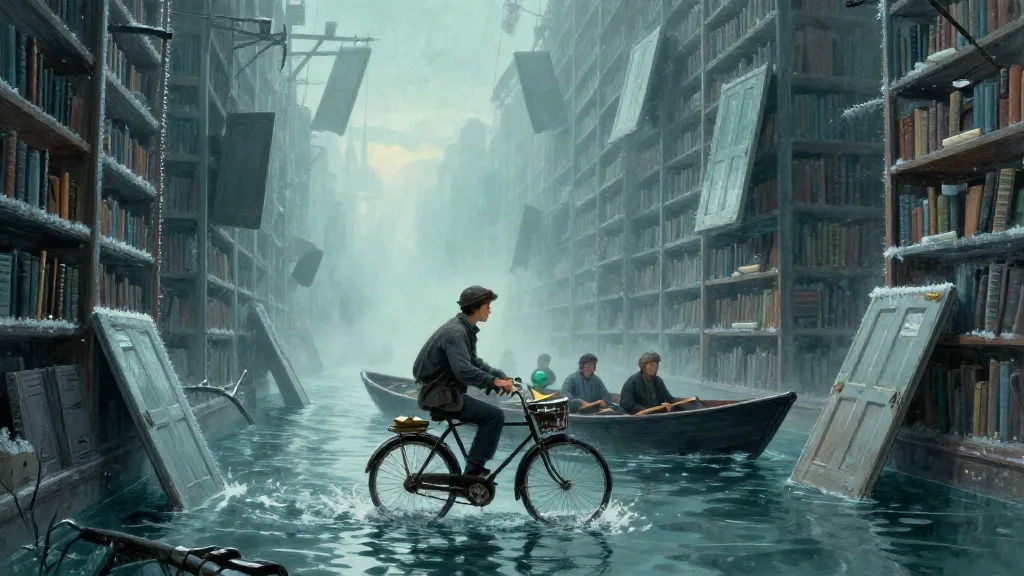
It stood upright in three inches of black water, its handlebars turning slowly toward the eastern shelves. The front wheel was a thin white circle. Its frame was painted the color of old iron, and the bell carried a small paper boat, folded neatly inside it.
She had come for a parcel, not a mystery. The parcel was a sealed letter addressed to the Year 2031, a year the river had not yet reached. Her courier route ended at the drowned reading room. Her bicycle waited on the landing with its front tire wet, even though she had locked it outside.
When she lifted the parcel, the bicycle rolled forward.
Its wheels sank through the wooden floor without breaking it. The frame passed between two shelves and vanished into a wall that had no door.
“That is not part of the route,” Mara said.
The librarian nearest the window kept rowing. He and his colleague moved between the high stacks in a narrow black boat, using brass hooks to pull themselves along. Their oars made soft strokes against the shelves. Each time they passed a cabinet, the drawers breathed out a thread of frost.
Mara put the letter inside her coat and followed the bicycle.
The Land That Listened
Behind the wall was a corridor filled with standing water. Doors floated at ankle height, their brass numbers inverted beneath the surface. The bicycle waited beside one of them, bell chiming once.
On the door was a notice:
By the Treaty of Patient Ears, the land permits all listeners to remain. No voice shall be sealed from the water. No name shall be mistaken for silence.
Mara knew the treaty. Every child in the river towns learned it before she learned to swim. It had ended the old wars between the village and the fen, because the fen had agreed to let the land hear every confession poured into its pools.
She touched the paper boat in the bicycle bell. It unfolded itself in her palm. A green stone sat inside, smooth as a river eye.
The door opened onto a winter field beneath a cyan sky. No sun had risen there for years. The light came from below the horizon, turning the snow pale blue and the distant trees transparent.
A row of librarians waited beside a mailbox.
“We have been waiting for the courier,” one said.
“Letters stopped coming years ago.”
“No,” Mara said. “The future stopped sending them.”
The oldest librarian held out a ledger. Its pages were blank except for one line, repeated until the paper split:
Tomorrow delivered: 0.
He said the land had listened to the future and heard only one voice, speaking from beneath every locked door. The treaty required them to preserve it. The bicycle had been carrying that voice between the years.
Every closed door, the librarian said, was a letter that had not yet been opened.
The Green Stone
Mara rode through the field. The bicycle refused the path and turned toward a black house half-submerged in the frost. Doors hung from its walls at every height. Behind them, shadows moved with the slow patience of fish.
She climbed from the archive floor into a bedroom where snow lay on the ceiling. A child sat beneath a window, shaping a paper boat.
“Are you the future?” Mara asked.
The child placed the green stone in the boat. “The future is what remains after everyone has explained it.”
Beyond the walls, the bicycle bell rang. The librarians began rowing, their oars striking all the doors at once. Each door opened a finger’s width.
Letters poured out: thin as insects, white as frost, smelling of iron and rain. They covered the floor, climbed the walls, and pasted themselves over the child’s face.
Mara understood then that the land had not stolen the future’s letters. The future had sent them, but the treaty made the land listen. Every word had been heard, repeated, and changed into a door. The future had gone silent because there was nowhere left to speak without being opened.
She took the green stone from the paper boat and set it on the floor.
The listening stopped.
The Door That Stayed Closed
Silence returned, but not the old silence. This was the silence of a room where someone had chosen not to speak.
Mara gathered the parcel’s letter in one hand and the stone in the other. She could return it to the future, though the address was impossible. Or she could break the treaty by carrying the stone outside, forcing the land to hear itself.
The child shook its head. “If it hears itself, it will never stop.”
Mara looked at the closed door behind her. It was the only door in the house that had not opened.
She placed the letter against it. The paper warmed. On the other side, something knocked once, not to be let in, but to be answered.
Mara pressed the green stone to the wood. Frost raced across the letters and sealed their edges. The bicycle appeared beneath the bed, its wheels already turning toward the flooded archive.
She mounted it.
Behind her, the child returned to the paper boat. The old librarians rowed between shelves that had begun to thaw. By the time Mara reached the corridor, the impossible dawn was fading, and the future’s letters lay quietly beneath the water, each one still carrying the weight of an unread name.





