 Netwrck
Hopeful Science Fiction.
The Note Beneath the Ice
Every tide brought back one forgotten thing.
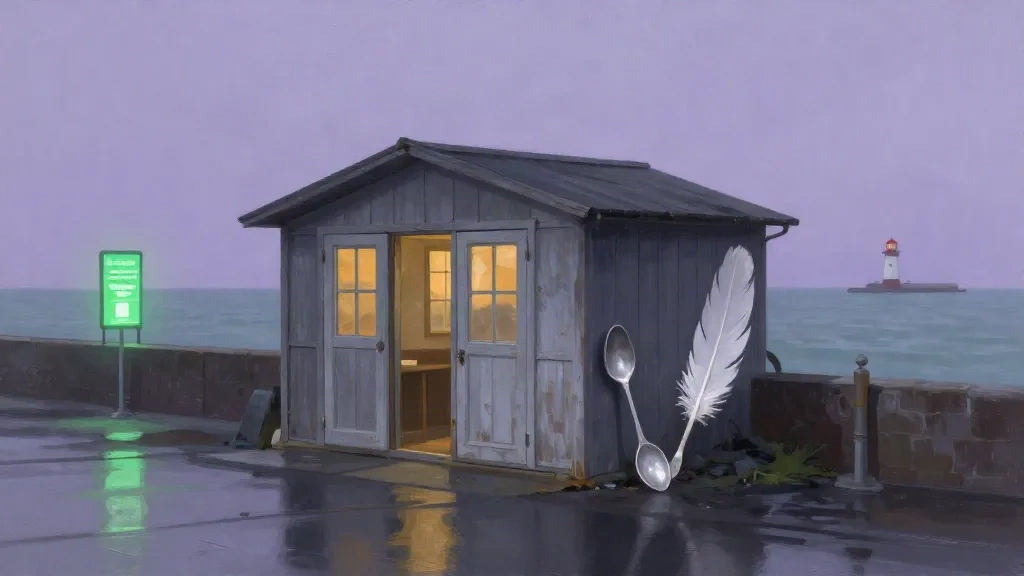
At six, it climbed the wet asphalt in a green shimmer from the pharmacy sign and waited beneath the sea wall. Children found rubber gloves with the fingers still curved. Fishermen retrieved keys polished by no lock. Once, a long-buried streetcar door appeared, its window reflecting a winter that had not yet happened.
Mara Venn tuned her cello in the upstairs room above the ferry office. The instruments in town were bought, repaired, and sold. Hers had been inherited, though no one could say from whom. When old Tomas told her the truth about his missing brother, she heard a clear C above the harbor wind.
Truth had always carried a faint color. Now it carried music.
The first winter note sounded that afternoon, when the lighthouse keeper admitted he had falsified the weather records to keep the ferry running. Mara heard a bright interval climb through the pipes of her instrument. Outside, snow began without clouds.
It did not melt. By midsummer, the bay was locked beneath lavender ice. By the next spring, the harbor bells no longer swung. The generation born inside that winter grew tall, then old, while the same silver sky pressed down.
A House Made Against Forgetting
At low tide, something returned: a white feather, dry as paper, unmarked by rain or age.
Mara carried it to Ilya Sen, the town engineer, who studied its barbs beneath a lamp tinted the green of pharmacy signs.
“Not a bird's,” he said. “The structure remembers how to distribute weight.”
With that, the C returned.
Mara had been thinking of a house. Not a shelter from winter, but a place that could survive the storyteller.
She had watched the first winter erase plans from lips as people died. She had listened to mayors describe warmer summers they never saw. By the time her granddaughter was born, winter was an ancestor everyone obeyed and no one questioned. Mara wanted walls the truth could enter. She wanted a foundation that would remember its makers.
They cleared the snow from the old ferry waiting room and began with what the tide supplied. Glass from lighthouse lenses. Salt-bright nails. A door without a house.
Each evening, Mara asked the workers what they needed. Each answer, if honest, added a note to her unfinished scale. The room learned their voices: the slap of Ilya's planer, the sharp cry of a saw, children arguing over whose turn it was to hold the lamp.
The Spoon and the Shape of Tomorrow
The winter deepened. Pipes froze solid. Milk froze in the creamery. Doors froze into their frames, and the sea itself developed a white crust.
The waiting room grew only twelve degrees.
“Your ancestors said this would last forever,” Ilya told Mara on her eightieth birthday.
She heard no note. He had lied to spare her.
At dusk, the tide broke through. A silver spoon slid across the frozen bay, glinting as it bumped from drift to drift toward the new house. Beside its bowl, someone had engraved a tiny map: three streets, a square, and a line reaching beyond the margin.
Mara understood. The spoon was a measure. Not of medicine, porridge, or wealth, but of a beginning. Its maker had understood that abundance could be counted in meals served, hands fed, songs carried through another winter.
She played the note she had hidden for eighty years: the note her mother made while teaching her that small truths mattered more than beautiful ones.
The white feather rose from the workbench. The spoon trembled. Lavender frost peeled away from the windows, and green light entered the room.
The Spring We Could Measure
Warmth did not return all at once.
It entered the house one truth at a time.
A child admitted she had been afraid to swim. A ferryman said the winter was changing him. Ilya acknowledged that his strongest wall was not his strongest, because someone else had done more work than he admitted. Each confession loosened the ice outside. Each note Mara played added another meter to the room.
By spring, the road beyond town was visible again. By summer, the harbor shone with a color no one had a word for. The generation born under winter planted beans along the seawall, arguing about whose grandfather had survived the worst year.
The finished house had no single style. Its walls held doors, instruments, spoons, feathers, and fragments of places the sea had swallowed. Travelers came to repair it. They slept beneath its windows and listened while Mara played until the truth had a shape all of them could inhabit.
Years later, she gave the white feather to the youngest child in the room.
“What will you build?” the child asked.
“Something that can survive the storyteller,” Mara said, smiling, because this time the answer was true.
Outside, the tide withdrew. It carried away no doors, no spoons, no names. Only the sea's oldest silence, leaving the lavender morning intact.





