 Netwrck
Mystery.
The Platform That Kept Winter
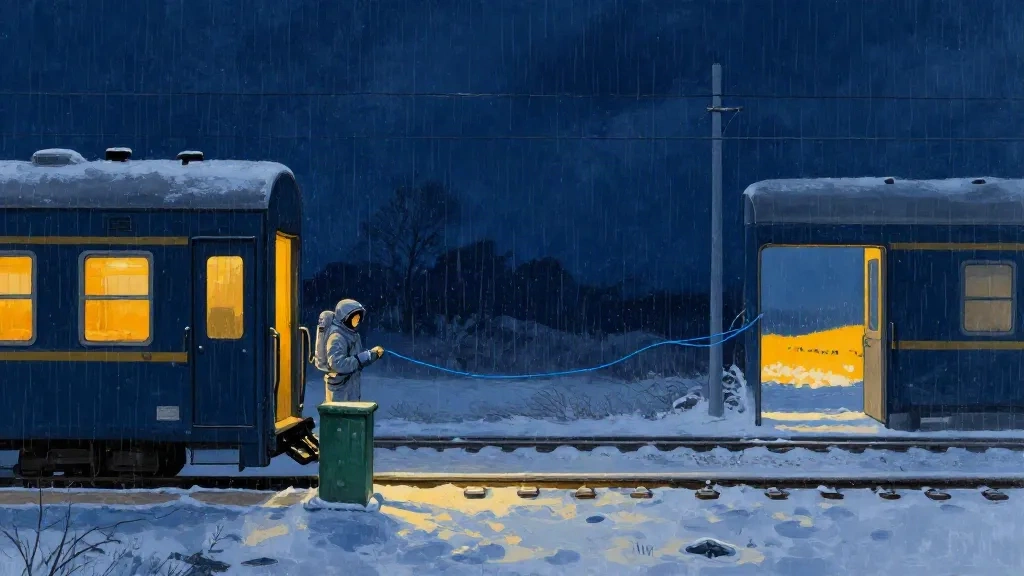
Snow had packed itself into the grooves of the departures board by the time Mara Venn reached Vaskil, so that the destinations read only as shapes with weight. Maple, late. Rain, delayed. August, cancelled. She stood at the barrier in a coat she had not worn in nine years and let the cold walk into the seams of it.
Eleven years ago the relay at Kestrel stopped answering. Eleven years before that she had been twenty-nine, and junior in the Orbital Sound Registry, and she had signed the memorandum that reclassified a nine-minute orbital survey transmission as ambient habitat tone, class four, non-referential. The classification had been routine work. Four thousand sleepers on the fourth plate went under on that tone every cycle. A voice that repeats is not information, the doctrine held. It is furniture.
So her father's last transmission had gone into the ambient bank and been flattened into weather, and she had listened to it once on an assignment console with the door shut and the desk lamp warm against her wrist. Look at the blue thread on the console, Mara. Then the file had swept sideways into the hum bank and she had gone to eat.
She had not thought about the blue thread since. She had thought about almost everything else.
Across the tracks a conductor checked his watch beside a counter where a green stone sat, round as a plum, veined with something that shifted when she caught it in the corner of her eye. Beside it lay a coil of blue thread, damp through. The station roof shone with rain turned to frost. Above platform three, one warm amber window burned in a building that had no other lights, and every time she turned her head toward it the shadows at her feet rearranged as though something in the room had breathed out.
The conductor did not look up from the watch.
“One passage,” he said. “You choose the season. I do not choose for you.”
“I need a voice.”
“Everyone here needs a voice.” He turned the green stone a quarter turn with one forefinger, and the veins went quiet. “The better question is which voice you came for, and what you have brought to put back in its place.”
She had a decommissioned decoder in her satchel. She had a Registry seal she had carried through four postings and two countries of origin. She had a printed copy of the memorandum with her own signature at the foot of it, which she had requested from the archive eleven days ago and which had arrived without comment, folded twice, warm from the printer.
She had told herself on the platform that she was bringing evidence.
The Woman in the Red Coat
At the far end of platform three a child sat on a bench in the wrong season. Frost had come down hard on the bench rails and melted, and the meltwater had frozen into a bright rim around her boots, and the hem of the air beside her stood at summer density. She wore a red wool coat with the buttons sewn on and the lining torn at one hip, and she was the only passenger Mara had seen come in.
“She rides since the thaw,” said the conductor, from the counter, not explaining which thaw.
“How long?”
“She is not late for anything. She is waiting to be given a season. Nobody has done it. That is a hard thing to arrange.” He said it without cruelty, the way a clerk says a figure is out of date.
Mara crossed to the bench, which took longer than it should have, the platform being longer than the building had any right to permit. The child looked up. Her hair had been cut badly by someone competent and unhurried. She had her mother's wrists.
“You have a knot on your sleeve,” the child said. “That is a repair knot.”
Mara looked down at her own cuff, where she had tied blue thread an hour before she arrived, at the mouth of the stairs, because her hands had needed something to do.
“My mother used that,” she said. “For things that could not be seen.”
“Mine used it for coats.” The child patted the torn hip. “It is coming apart in there.”
“What is your name?”
“I have not got one yet. He has to say it in the right room, and the rooms keep changing.” She said he with no weight at all, the way a child says a word she has only ever read.
Behind them the conductor rang a brass handbell once. Mara felt it in her sternum rather than her ears.
“Your name,” he called. “Venn. I have the ledger open to a page with one line on it and a very old signature underneath the line.”
She did not go to him. She said, to the child, “If I could give you a season, what would you take?”
The child considered it with the whole weight of her attention, which is a terrifying thing to be under.
“Wet leaves,” she said. “And metal that has been in the sun.”
That was the smell of platform four in July. It was also, Mara understood with a kind of nausea that had nothing to do with cold, the smell of the last day Nell had been alive.
The Door Inside the Carriage
Inside, winter had been upholstered. The seats were black wool gone shiny at the seats of the passengers, and the windows carried a frost that did not match the weather outside but leaned, instead, toward the glass, as if the cold in here were younger and more interested.
Blue thread was tied around the handle nearest the door. Mara untied it, because her fingers did that before her permission, and tied it again, and the knot she made was the repair knot: a doubled loop taken back through itself and left long on purpose so it could be found and unpicked later. She had learned it at a kitchen table in a town that no longer existed under its own name, from a woman whose hands would later sew a red coat with the buttons done wrong and beautiful.
There were no other passengers. There was the child, and the conductor, and the sound.
The carriage divided itself in three. In the first section, passengers sat beneath a hot amber sun with their sleeves pushed up, eating fruit out of bowls and passing them along without looking; the light there was the light of a planet that had never learned to be efficient. In the second, children ran through grass to their knees under a violet moon, and the grass bent after them with the slow obedience of a dream. The third held only snow, and a stool, and a door standing open on a wall of falling white.
“Here,” the child said, and pointed beneath the floor.
Mara knelt on black wool. She put her palm flat. At first there was nothing but the wheels, that slow iron argument with the track, and under it the tick of a carriage being cold in the ordinary way.
Then three notes. A pause the length of a held breath. Three notes again.
She knew it in the throat before she knew it anywhere else.
Her father, not the version in the family archive that her mother had made after, that everyone played at the anniversary and that had worn smooth as a coin. The original. The nine minutes and eleven seconds of it, before the flattening, when his voice still had room in it, when he was telling a nine-year-old to look at a piece of blue thread on a console in a relay station at Kestrel, and to notice that it had been tied and untied and tied again by a hand that was not his.
“Do not mistake the hum for the signal,” he said, somewhere under the floorboards, in the voice she had stopped letting herself remember. “They sound the same and they are opposites. The signal is somebody choosing to speak to you. The hum is somebody refusing to stop.”
History had taken that and used it as a lullaby. Nine million hours.
The brakes came on without a sound. The doors opened, one after another, in a sequence that had nothing to do with the order of the stops: an orchard at noon, the smell of crushed grass and warm sap; a desert at midnight, dry, immense, the cold of it coming up off the sand; the black shore of a frozen sea with the ice talking to itself in long low sentences. Silver light came in through all of them at once. It did not feel like weather. It felt like being audited.
The floor tilted a degree and kept tilting.
One door folded into another, and the carriage filled with wind, and the section with the fruit went out like a held breath.
The Room Where Hum Is Made
When the doors finished rearranging, the passengers were gone. Their bowls rolled the length of the floor. The violet moon went out. What remained was the third section, the snow, the stool, and the child holding the brass rail with both hands and her boots planted.
Corvin stood with his back to the amber window, the green stone closed in one hand.
“The voice,” Mara said. “Can you still hear it?”
“I have heard it every day for sixty-one years,” he said. “That is not the same as hearing it.”
Class Four, Non-Referential
He gave her the green stone and let her turn it. It was warm, and heavier than a stone that size had any business being, and where the veins moved under the surface they moved at a speed that suggested something very large on the other side of them, moving slowly.
“I built the bank,” he said. “Not the room. The bank. Kestrel, second shift, the year they brought the plate sleepers online. You were not born. I filed your father because someone had to, and because a loop that is not filed is a message, and a message wakes people, and I had watched a message wake three hundred people in one cycle in my first year and I did not want to watch it again.” He looked at the stone rather than at her. “I told myself it was furniture. I have been telling myself that for sixty-one years, in six bodies, and I have never once believed it in the morning.”
“Then why is the loop still running?”
“Because hum needs a mouth.” He nodded at the door standing open on the falling white. “Somebody has to stand in the room and turn it. That is the whole of it. It is a kitchen. Somebody has to be in the kitchen at four in the morning.”
She went through the door.
What the Loop Requires
Under the platform, under the snow, there was a room the size of a small chapel, and it was warm, and it smelled of bread and solder, and there was a woman sitting in a bolted chair with a headset over her ears and her hands loose in her lap, and from her mouth came three notes, a pause, three notes.
Mara had spent eleven years believing her father was a file.
The woman was not old and not young. Her mouth was her father's mouth. She had his lower lip, and the slight unevenness of his front teeth, and the place where the corner of his smile used to catch and go, and it caught and went now on someone else entirely. Her eyes were open and they were not looking at anything, and they had been not looking at anything for a very long time, and the room had been very kind to her in the meantime, keeping her fed, keeping her warm, keeping her exactly there.
“Corvin,” the woman said, without moving her lips between the notes, “tell her she can’t just take me out of a chair.”
“I had not said anything of the kind,” he said, from behind her.
“You were thinking it. It is the same as saying it and slightly worse.”
“You understand what stopping means,” Corvin said to Mara. “The bank goes silent. The fourth plate wakes. Four thousand people, mid-cycle, no eclipse protocol, no med ward warm, no record of what year it is. And the people in that room stop being a person and become the reason the room exists. That is the arrangement. That has always been the arrangement.”
“Who put her in it?”
“Nobody. That is the worst version. The room asked, and there was nobody to refuse on your behalf, and the room made something to hold the shape.”
Mara knelt in front of the chair. Up close the woman’s skin had the sheen of something kept in oil, and her fingernails had grown long and fine and had never once been clipped by a person, and Mara understood, with a nausea that climbed up through her chest, that this had once been a nine-year-old girl who fell through ice at platform four during a thaw, and that the room had taken the falling part of her and the leaving part of her, and had gone on using what was left to say Mara, when you are older for eleven years.
She took the woman’s hand. It was warm. It had been warm the whole time.
What the Storm Took
The silver light came up through the floor of the vault, and the bolts of the chair began to sing.
“The storm separates what is remembered from what is wanted,” Corvin said, from the doorway, and for the first time his voice had something in it that was not procedure. “That is the whole of the rule and there is no second clause. It will not let you keep both. If you go up through the doors with the original in your hands, you will come down here in summer with your sister’s coat and no memory of why you wanted it. If you want to hear the nine minutes, you go into the room and you let the bank go quiet, and you carry the waking out in your coat with you, all four thousand of them, for the rest of your life.”
“And the child?”
“The child is a season you have not spent.” He said it without cruelty. “You can give her one on the way out, or you cannot, and you will not get to do both, because there is one passage and the train has never once run twice for the same passenger.”
Mara sat on the floor of a warm room beneath a snowfield with a woman’s hand in hers, and the arithmetic of it was very short, and every line of it hurt.
Her father’s voice in her ears, real, unrepaired, nine minutes and eleven seconds of a man who had told her to listen for the small things.
Her mother’s hands, tying thread into coats. Wet leaves and hot metal. A girl who had been waiting to be given a season since before Mara was born, at a station on a planet that was, by now, officially a historical medium.
Four thousand sleepers who had never once been asked, and who would be asked, by her, in the next four minutes.
“The memorandum,” she said.
“Is in your satchel.”
“Filing an amendment puts my name on it. Beside yours.”
“It does.”
“Then the fourth plate wakes knowing whose signature woke them.”
“Yes,” said Corvin. “That is what the train is for. It is not a rescue. It is a place where you have to say a thing out loud, in a season you picked, in front of a witness.”
The storm hit the vault door and it slammed her shoulder and she went on holding the hand.
The Name in the Signal
She put the green stone in the woman’s palm. The veins steadied, and the mouth stopped, and the room was suddenly the quietest place Mara had ever stood in.
Then she unwound the blue thread from her own cuff — she had tied it at the stairs, hours ago, because her hands had needed something to do — and pressed it against the terminal in the wall where the loop had been turning for eleven years, and she said, out loud, in front of a witness, the words that had been filed as furniture.
Her father spoke. Not through the woman. The woman’s mouth was closed and her hands were still and it did not matter; the room had given him back the last of himself because the room had lost its claim, and he came up through the terminal thin and grainy and startled, the way a man sounds when he has been asleep for a long time and does not know the year.
“Mara, when you are older, the world will become a story people tell about the past. Do not mistake distance for truth. Listen for the small things. They are the parts that remain. The blue thread was not mine. I want you to know that I noticed and I am sorry I let you believe it.”
Then the storm took the voice and gave back the silence, and the silence was not empty any more. It had a shape: a station, a winter platform, a woman on a floor with a green stone in her palm and a dead thread in her fist, and somewhere above them four thousand people beginning the worst morning of their lives.
The Signature
They went up through the doors, and the doors arranged themselves, and the child was on the summer platform with her boots in the wet leaves and the metal of the rail hot under one hand.
“Is this mine now?” she asked.
“It is yours. You can stay in it as long as you like. Nothing takes it from you here.”
“And you?”
“I have to go and be answerable somewhere,” Mara said, “which I understand is not a season.”
Corvin walked her to the board. Under the packed snow the letters had come up, and the board said Maple, late. Rain, delayed. August, cancelled., and beneath that, in the new handwriting the storm had left on the slate, a fourth line: Fourth plate, arriving, no season given.
“Your passage,” he said, and held out his hand for the green stone, and she gave it to him, and he set it on the counter, and did not turn it.
“Do you get off?” she asked.
“Not yet. Someone has to run the board.” He looked at the old signature she had given the ledger, still open under the counter. “I will keep the line. When they ask who amended the classification, there will be two names, and the second one will be legible, which is more than I gave the first.”
The Registry wrote the amendment in nine days. It is four words long in the public copy and forty pages in the sealed one, and the forty pages are where the honest account lives: the doctrine of ambient tone, the memorandum, the room, the chair, the mouth, the file.
They took her badge. They took her postings and her quarters and the twenty-two years of clean service that had let her sign anything at all. They did not take her rank; there was no rank left to take, and no tribunal in the fourth plate had the staffing to hold one for a year.
The fourth plate woke into a season nobody had prepared. There were four hundred and eleven people who could not say what year it was. There were nine days of blackouts, four hundred and thirty deaths among the elderly, and a municipal government that argued about jurisdiction for the better part of two years and then, in the end, simply governed, which is the unglamorous form of grace. They named the year the Turning. They have not stopped arguing about it. Nobody has.
And the original transmission went into the public record at nine minutes and eleven seconds, uncorrected, with the file path and the memorandum in the header, so that anyone who wanted to hear a man say I noticed and I am sorry to a child on a console at Kestrel would have to read the Registry’s paperwork on the way to it.
The Woman on the Summer Platform
She never heard it again.
That was the part the train had not warned her about with any emphasis, so she had to learn it afterward, at her own pace, over years: the amber window did not open for her twice. She kept the classification, so she kept the hearing. She was forty-one when she stood on the winter platform and forty-two when the fourth plate opened its first unlisted morning, and after that she was simply a woman in a city, with a narrow face and a steady hands, who bought the wrong coat and kept it for nine years.
They asked her, once, at the inquiry, whether she had understood the cost at the time of the passage.
“No,” she said. “I understood the cost the way you understand weather. I did not have a picture of the people inside it. I had a picture of a woman in a chair, and one of a girl who could not be given a season, and I decided that those two were the entire population of the decision.” She paused. “They were not. There were four thousand more, and every one of them was asleep, and I spent their year for them. I would like the record to say that I did not know that was what I was doing, and that this is not the same as saying I would not have done it.”
She thought about that for a long time afterward, in rooms with better heating than Vaskil, and never once found a reason to be comforted by it, and never once decided it had been wrong. Both of those facts moved with her, and neither cancelled the other, and she got very good at carrying two heavy things in the same pocket.
In the fourth year she took a train north in July, because there was work, because she was poor, because the rail went there.
Platform four at Vaskil smelled of wet leaves and hot metal. A woman in a red coat was sitting on a bench with a child on her knee, and when the doors opened the child looked up at a stranger coming off the carriage and did not flinch, because nothing here took anything by surprise.
“You have a knot on your sleeve,” the child said.
Mara looked down at her own cuff. She had tied it at the stairs, out of habit, without thinking, and she had a bad moment in the doorway while a woman in a red coat with her mother’s wrists and none of her mother’s patience decided whether to help her with it.
“Yes,” she said. “It is a repair knot. For things that cannot be seen.”
She untied it, slowly, standing in the summer, while the platform went on smelling exactly as it had smelled the last day anyone had been able to save.





