 Netwrck
Mystery.
The Unmarked Door
Mara Venn arrived in Bellwether by the river on a rain-bright morning, carrying a leather case of copper tools and a map drawn in ink so pale it looked like water had erased it. She had been hired by the Municipal Engine House to translate the dreams of sleeping machines: old pumps, signal boxes, bridge locks, and the dry iron hearts beneath the town.
Every night the machines dreamed in voltages and pressures. By day, she turned their murmurs into human sentences. Her fee was enough to buy passage downriver, but Mara wanted more. She wanted to leave behind a better map than the one she had received—without the missing footpaths, the erased culverts, the streets that existed only on paper.
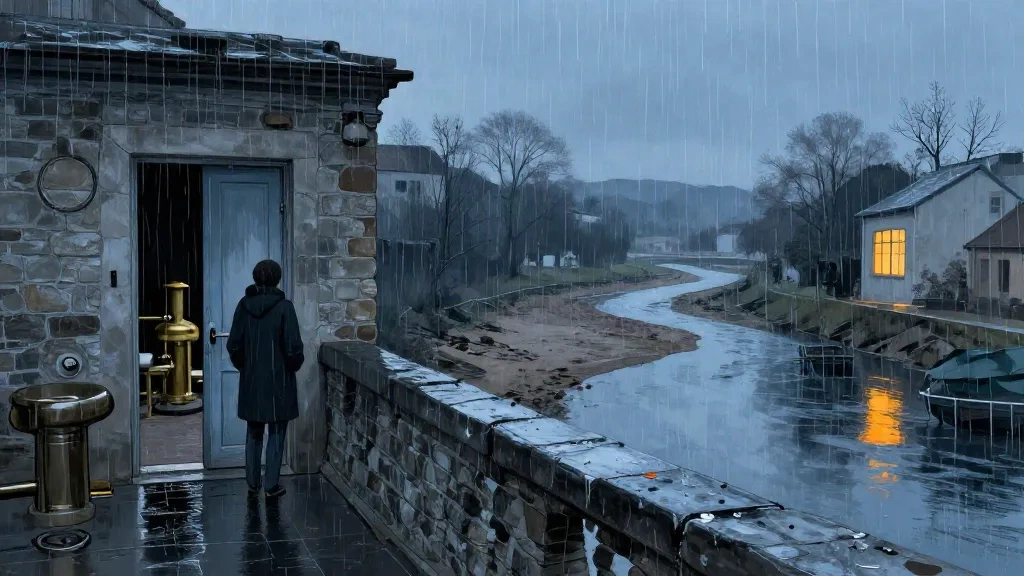
Her first room stood beneath the bridge called Keeper’s Promise. It had one amber window, glowing as if the glass held a trapped flame. Across the river, the hill rose black and bare. Near its foot was an unmarked door in a stone retaining wall, its paint the same rain-silver as everything else.
Mara opened it. Inside, a passage descended into the earth.
What the Machines Remembered
At the bottom lay the dry riverbed. The actual river ran two miles east, broad and brown, but beneath the town an older channel had been paved over. Mara followed it with her hand along the wall until she reached a chamber filled with sleeping machines.
They were arranged in family rows. Each bore the same crest: three lines crossing a bridge.
The first dream belonged to a pump. It showed a flood. The second showed a funeral procession crossing at midnight. The third showed a boy standing on the dry stones, waving to someone on the far bank.
Then a machine spoke without waking.
“We agreed to open the doors,” said Mara.
She translated the words into pressure, then current, then a name: Elias Venn.
Her father’s name.
He had vanished twelve years earlier when the Bellwether Bridge failed during the Spring Surge. The official account blamed a cracked pier. The family had divided faster than the water. Mara’s mother kept the house on the eastern bank. Her brother took work on the western locks. Her uncle sold the family’s papers and declared Elias a deserter who had promised to return with the river’s true course.
Each remembered the promise differently.
The Family Bridge
Mara returned to the chamber with a lantern and found the oldest machine at its center, a brass governor buried beneath dust. Its dream was clearer than the others. It remembered three people signing a paper beside the dry riverbed: Mara’s father, the bridge keeper, and a man in a blue coat no one in Bellwether could name.
They had promised to move the river.
Not metaphorically. They had built a channel beneath the town and planned to let the current carry away the falsified foundations beneath Keeper’s Promise. The bridge was not meant to survive. The family had agreed to replace it with a span no one could secretly alter.
Then the blue-coated man betrayed them.
Mara’s fingers tightened around the lantern. The machine showed no face, only a hand placing a brass key inside the governor. The key had a single amber tooth.
At dawn, she found the same key in her mother’s sewing box.
Her mother did not deny opening the unmarked door. She said her husband had returned once, after the bridge fell, and asked her to keep the key until he came back a second time.
“He promised,” her mother said, “that the river would keep our family safe.”
Mara looked at the dry stones under the chamber floor.
“He promised to move the river,” she said.
Her mother’s face became the amber window. “Not everyone meant the same thing.”
The River as Witness
That night Mara opened the governor. The town’s bridge locks began to sing. Water surged through hidden conduits, lifting dust from the old riverbed and shaking the walls. Families woke to bells they had not heard for years.
She climbed to the surface as rain silver poured over Bellwether. The unmarked door had opened by itself. Beyond it, the dry riverbed had become a channel, and the east and west banks were no longer separate worlds.
Her father stood on the opposite bank with the blue coat torn away.
He had not escaped the flood. He had entered the machinery beneath the town to stop the false bridge from killing the people crossing it, and the river had sealed him inside the current.
Mara took out the pale map and tore it into two. On one half she drew the buried channel. On the other she wrote the date her father had vanished.
The river rose around her boots, carrying leaves, ash, and fragments of every map anyone had trusted too easily.
Then the amber window appeared beneath the bridge, reflected in the water. It was not a promise to remain unchanged. It was a promise to show where the truth had gone.
Mara left the door unmarked. A better map should have doors people could open themselves.





