 Netwrck
Mystery.
The Bone Beneath the Well
Mara woke before the rain and found a blue thread caught in her teeth.
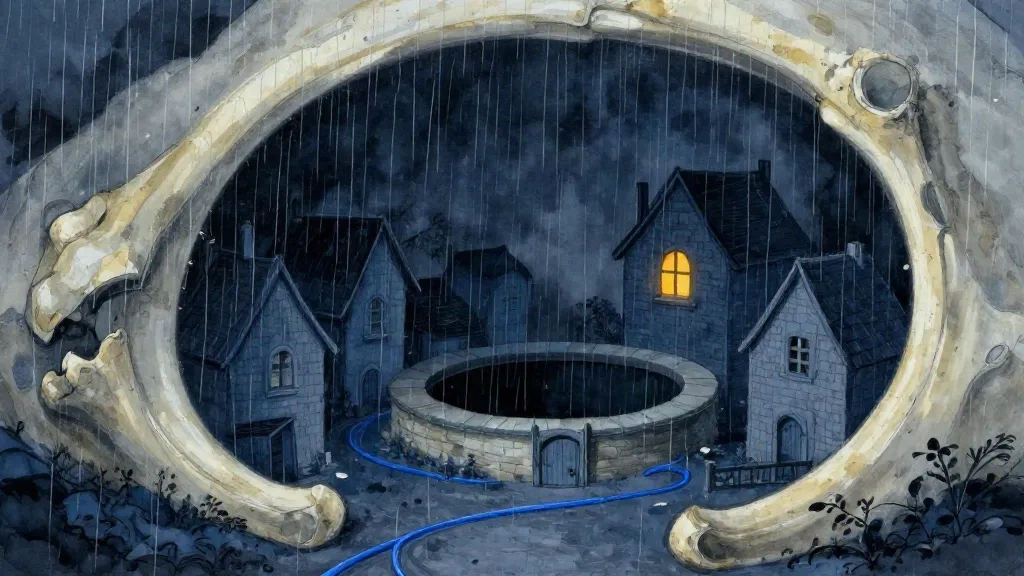
She spat it into her palm. It was smooth as river water, dark as the sky between stars, and warm from one end. Outside, the village stirred inside the ribs of the sleeping giant. Bone-white chimneys rose from the curved walls. The great heart, sealed beneath the eastern market, rose and fell with the breathing of the buried thing.
Mara was the village glassblower. Her furnace stood near the well, where black stones held the heat. She made windows for rooms in other worlds: a pane for a city where summer had lasted ninety years, a pane for a house whose owner had forgotten her own name, a pane for a kitchen on a coast of black sand. Each window was commissioned by someone who had crossed the village carrying a particular emptiness.
That morning, Mara had promised to keep one ordinary morning from being taken away.
Not a feast. Not a wedding. Not the morning after a miracle. She wanted the same arrangement she remembered from childhood: rain ticking against the shutters, porridge burning on the hearth, old Nera sweeping her step, children racing beneath the ribs before the bell. Tomorrow was too important. An ordinary morning had become a room she wanted to keep locked.
What the Thread Remembered
The blue thread led down through the well.
Mara lowered a lantern on a rope. Its light found stone walls, then a ladder carved into the giant’s rib. At the bottom stood an unmarked door.
She had passed that door as a child. Everyone did. The villagers said the giant had been asleep since before the village existed. They said the door led nowhere. They said this whenever children asked what color the giant’s skin was, whether the ribs were really bones, or where the blue thread came from.
Mara opened the door.
Warm amber light spilled across her shoes. Beyond it stood a small room with a table, a kettle, and two bowls. Steam rose from the porridge. Rain silver tapped the window. A woman sat with her back to Mara, folding a child’s coat.
“You promised,” the woman said.
Mara looked at the table. Her own hands had made the window set into the far wall: one clear pane, one amber pane, one pane of ink-blue glass. The woman turned. Her face was Mara’s, but older. A blue thread ran from her mouth to the door.
“The morning is already gone,” the older Mara said. “They took it from us.”
The Village Without Truths
Mara returned to the furnace and told no one.
By midday, the rain had stopped. A merchant found the well’s rope cut. A child claimed the giant had spoken. Old Nera denied having a grandson. A woman said her house was in another world, then laughed and called it a joke.
Each denial made the village safer.
The fire in Mara’s furnace burned lower. Stones loosened in the roof. The eastern market, once crowded, emptied as if people had remembered urgent errands elsewhere. Every truth spoken aloud seemed to give the giant another reason to wake.
At sunset, Mara carried the amber pane to the unmarked door. The blue thread had grown, winding up the ladder and across the village wall.
“If we tell the truth,” she said, “the morning returns.”
“If you tell the whole truth,” the older woman replied, “the village remembers what it was built to contain.”
Mara understood then. The village had not been built inside the giant. It had been built from a story told around him. The first frightened settlers had agreed that the giant slept. They had agreed the bones were walls. They had agreed every impossible thing they saw was only weather.
Safety had come from the agreement.
And the ordinary morning had been sealed inside the unmarked door.
The Window Left Open
At dawn, Mara struck the amber pane from its frame.
The sound rang through the ribs. Every hidden shape emerged: a staircase under the well, red grass beyond the giant’s teeth, a blue sky turning slowly above the village.
People woke in the wrong rooms. Some wept. Some laughed. Some ran toward doors they had spent years pretending did not exist.
The giant inhaled.
Mara opened the unmarked door and carried the pane into the ordinary room. She set it in the window. The first warm amber light fell across the table, the bowls, the rain-dark floor.
Then she told the truth.
Not a story about a sleeping giant. Not a story about a village protected by denial. The truth was smaller: she wanted porridge, burned oats, rain on the shutters, and a morning that belonged to no magic at all.
The blue thread snapped.
The giant opened one eye, and the world outside remembered how to be morning.
At the center of the village, one window burned amber through the rain.





