 Netwrck
Weird Fiction.
The Sickness of 14 Wren Street
Mara Venn came up 14 Wren Street with a black bag, two thermometers, and the particular silence of a house that has packed to leave. The air pressed grey against the windows and there was no fire to make it. Above the rooftops the saffron moon hung in a plum-coloured sky, and the moths that should have gone to the river had gathered instead on the front step, silent, as though waiting to be counted in.
No fever reddened the daughter’s cheeks. No cough rattled the father’s chest. The floorboards lifted and settled underfoot whenever either of them said the word you, and every cup of tea in the house cooled before it reached the lips. The clock on the mantel said 4:10. It had said 4:10 since Mara rang the bell, and when she set her watch face-down beside it, the two agreed exactly.
She had learned, in nine years of village practice, that the first thing a nurse loses is the habit of writing things down. She had stopped. She took temperatures, she counted pulses, she asked the questions she already knew the answers to. When the daughter said the house felt like a held breath, Mara said, that is a common description, and made herself mean it as comfort.
At the ticket window of Harlech Fold station, the stationmaster Alaric Dunn watched her come out of the lane without moving his brass schedule an inch. He was a thin man with a clerk’s stillness and ink to the second knuckle.
“Homesick houses,” Mara said. “The walls remember departures better than the people who make them.”
“Departures are departures,” Alaric said. “No illness required.”
Inside, Nessa Crane stood beside a red suitcase with one hand closed hard around her father’s coat. Her father, Ivor, stared into the fire as if the fire had asked him a question he had once answered badly. A red scarf lay across the table, folded, the way a thing is folded when it is meant to be an argument.
Nessa’s train to the coast left at dawn. Mara had six hours, and one professional certainty to spend: she had never yet broken a house by asking a direct question. Direct questions thickened walls. She had watched a woman in Bellwether go deaf in her own kitchen because somebody finally asked her the thing everyone was thinking.
Every Ending Is a Mistake
“I’m not angry that you stayed,” Nessa said. “I’m angry that you never said why you stayed.”
Ivor looked at his boots. “Because I was afraid you’d ask.”
At once the walls gave a moist, settling groan, deep in the plaster, like a ship taking water. A red thread appeared in the mortar and climbed toward the ceiling. Outside, a bell that had not existed since the last flood began to ring over the river, and it rang the wrong way round, counting down.
Alaric came through the door with a ledger under his arm, breathing as if he had run.
“The 4:10 is recorded before departure and after departure,” he said. “Both columns. The platform clock has done the same for nine days. I regard this as a scheduling error.”
“Endings are not scheduling errors,” Mara said.
“Every ending is.” He opened the ledger flat on the table, beside the scarf, and turned the pages with the back of his thumb as though they were cold. “Proof that someone placed the departures badly.”
Each page held a ruled platform in one hand and a river in the other, drawn in the same nib, by the same tired man. Water had filled the words in and between: after / before / after / before, patient, repeating, the way a tongue repeats a word it has forgotten the meaning of. Along the banks stood houses with their lamps lit.
Only 14 Wren Street had gone dark.
“You have drawn this before,” Mara said.
Alaric closed the ledger halfway. Not all the way. “I have drawn a great many things before,” he said. “I do not schedule the ones that concern me.”
It was the first sentence he had said all evening that was not a lie, and everyone in the room heard it, and no one was kind enough to touch it.
The Ticket in the Wall
Mara boiled vinegar, iron filings, and river mint in a saucer, wrung the cloth out, and pressed it flat to the north wall. The plaster warmed under her palm, the way skin warms. A map came up through the damp: the river running north through the town, the station pinned at its narrowest bend like a thorn, two figures standing on opposite banks, and — this was new, this was not on the ledger — a third figure walking between them, small, patient, going nowhere in particular.
Then a corner of paper split the wallpaper and came loose in her hand. A train ticket, dry as a leaf, worn soft along the fold from being carried too long in a pocket.
She read the destination twice before she understood that it was not the coast. It was Bellwether, beyond the upper ferry. Nessa had held this ticket for nine years without knowing she held it.
“You gave her a ticket,” Mara said.
“I gave her a promise,” Ivor said.
“Then say where you meant to take her.”
“I can’t.”
“You can. You simply can’t without it costing you something, and you have decided, in advance, on her behalf, that she is better protected by your silence than by your voice.” The red thread in the mortar pulsed. “That is the illness. Everything else in this house is weather.”
Later, with the cloth and the saucer between them like a peace table, he told her the rest in the flat voice men use when the alternative is ruin.
Cressa Crane had gone down to the station office that night to buy three tickets, because Nessa had asked about Bellwether twice at supper and Cressa, who never refused anything, wanted the answer to arrive as paper. She had crossed back over the footbridge in the dark instead of waiting for the last bus, at the narrows, at exactly the wrong hour of a rising tide. They found her at the bend in the morning, below the station wall, where the water had been standing still for nine years like a man refusing to be contradicted.
And Ivor, forty-three years old, with a daughter of ten on the step beside him in her coat, had looked at the ferry timetable and decided that the promise was a thing that died with its reasons. He told Nessa her mother was ill. Nessa had found out the rest at thirteen, from a woman at the post office, and had never once been able to decide whether she had been lied to for her own good or for his own.
“It was both,” Mara said, when he finished. “That is what makes it a promise and not an excuse. You were protecting her, and you were protecting yourself from a ten-year-old asking you a question you could not survive being asked.”
The red thread in the mortar snapped. Somewhere below the station a locomotive sounded its horn with no steam in it, and the floorboards lifted and settled under Mara’s weight even though she had not said the word.
Alaric seized her wrist. His hand was cold and smelled of ink and iron.
“Don’t name the destination in the open. The river records destinations as debts. The moment I enter a journey in the book, it becomes true, and true is much worse than likely.” He laid a thin finger on the ledger’s ruled columns. “A train is only a bridge built by people who are afraid to walk.”
Mara looked at the dark house, and at the black water standing still between the boards.
“Then we walk,” she said.
What the River Witnessed
They reached the bank as saffron dawn spilled over the water. The river lay flat and slack and slightly luminous, nine years of not going anywhere. Ivor carried the red scarf. Nessa carried the ticket. Alaric followed with the ledger chained to his wrist, muttering about a tide that had misplaced midnight.
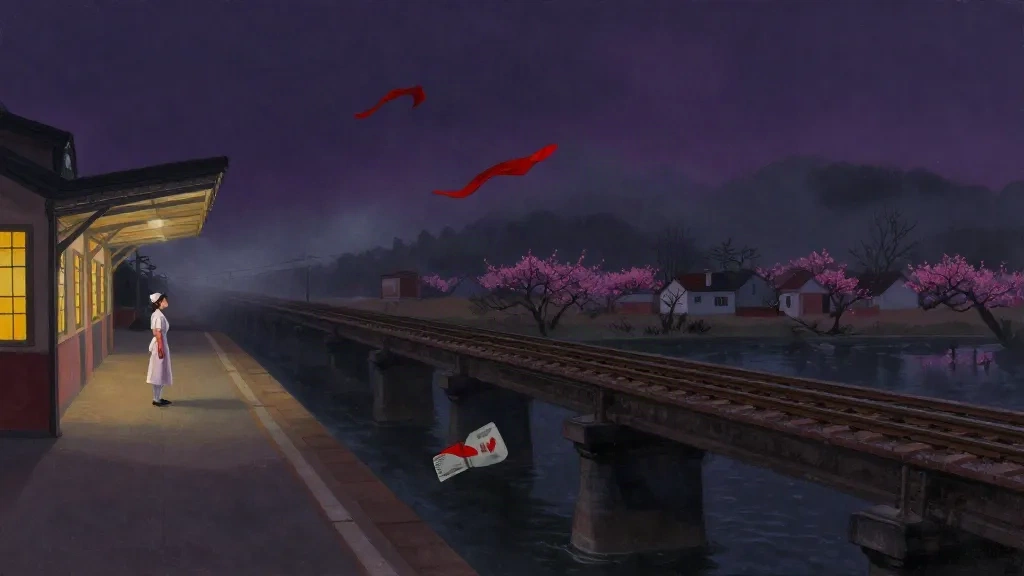
Across the water, at the place where the bend narrows, a small platform waited under a plum sky. It had no building at its far end and no rails going away. On it stood a woman with Nessa’s eyes and Nessa’s coat, holding a case the same red as the one at 14 Wren Street.
Cressa looked exactly as she must have looked at forty-three, which was the first cruelty of the morning: not that she was dead, but that she had not aged a day while everyone else had been doing the work of living.
“If I cross,” Nessa said, “will I still be angry?”
Ivor took the scarf off his neck. “You may be. I was afraid your anger would mean I had failed you.” He held the scarf out, not to her, to the space between them, as evidence. “It does. I failed you, Nessa. I failed you in a way you were ten, and I have let you build your whole life on top of it to spare myself from saying so.”
The river struck the stones once, hard, and the sound was not like weather. It was like a witness clearing its throat.
“I wanted to go to Bellwether,” Nessa said. “Not with you. I wanted to know that I could.”
Her father nodded. “Then go.”
On the far platform, Cressa lifted the case an inch in offer, and Nessa stepped to the water’s edge, and everyone on the bank held still in the way people do when they are watching someone discover the price of a thing.
“You drowned because of the promise,” Nessa said.
“No,” said Cressa. Her voice came across the water without travelling. “I drowned because I would not send a child to bed waiting for a mother who had already decided she was brave. I went for the tickets at night because I was tired in the afternoon. The river was tired too, if you want to give it the blame. It has been holding its breath since, waiting for you two to say one true thing, and you have taken nine years.”
You are not the answer, Ma. You are the thing that was left in the water when the question was never asked.
Nessa stood a long time in the shallows. Then she took out the old ticket and tore it, not in half but into quarters, the way you tear something you intend to use four times, and put two of the pieces on the water. They did not sink. They went out flat and red, turning slowly, and became two leaves, drifting toward the far platform, where Cressa did not pick them up. The witness did not have to hold them. The witness had seen them.
Behind Mara, the station clock began to run backward, and Alaric made a sound that was almost a laugh and was closer to a man watching a house he is fond of burn down.
Then the 4:10 came into the station, empty, with steam that was not steam. The only thing moving inside it was a ticket inspector perhaps twenty years old, who did not blink, and who held out one blue ticket toward Alaric.
Platform Nine closes at midnight,” the inspector said. “After that there is no after. You will want to hand this over before the minute is up, and you will want me to tell you it changes nothing.”
Alaric looked at the blue ticket for a long moment. Then he said, with the exact dignity of a man reading out a ruling he has hated for years: “It changes nothing.”
The Upper Ferry at Bellwether
They walked the towpath in the cold with the sun coming up behind them, Nessa first, Ivor second, Alaric last with his chained ledger muttering that the ferryman was not on any manifest. The river here ran fast and shallow and had clearly never stopped for anybody, which felt like an insult.
At the ferry the ferryman took no fare and offered no greeting and looked at the red scarf in Ivor’s hands and then at the girl, and poled across without one word. It took four minutes. Nessa did not sit down. She held the two remaining quarters of the ticket out flat in the wind and read the printed destination, which had never changed, and which had been the whole content of the promise all along: not a place, but the fact of going.
“Come with me,” she said, when they landed. “Say it on the other side. You can walk up the hill and say it and it can still be true.”
Ivor looked up the slope at the town with its chimneys and its school and its small church, and Mara watched him take the whole of it in — the ferry, the bank, the road, the ten years — and she saw him decide, and she saw that the decision was not cowardice this time, which is how you know a person has changed: the same muscles, the other use.
“No,” he said. “You go up. I go back.”
“That is not the promise.”
No,” he said. “It is the promise you were owed. I can’t deliver it, and I can’t carry it either, and if I walk up that hill with you I will spend the rest of my life telling myself I did.”
“You did fail me,” Nessa said. “I’m not going to forgive you for it at a ferry landing because the water is watching. I’m going to Bellwether.”
And then, because she was nineteen and not yet finished being hard, she pressed the last two quarters of the ticket into his hand and made him keep them, so that the promise would exist in two pieces for once in its life, and neither of them would have to hold the whole of it alone.
Behind them the water at the bend lost its standing shine. Somewhere under the station wall, something enormous and patient unclenched.
Alaric said nothing about the house. But at the lane, going up, he said to Mara, “It will cool tonight. Cool is not the same as well. Expect a house that has been let go of rather than forgiven.” Mara, who had been letting go of things for nine years, said that she was an expert in that distinction and he needn’t waste her evening on it. He almost smiled. He was a man who would smile properly one day, on a platform, but not that week.
The Ledger Closed at Midnight
Alaric Dunn had been drawing Platform Nine since the spring after Cressa drowned. It appeared only in the after column, never in the before, a short ramp and a shelter and a strip of line running off the page into nothing, and on it he had scheduled one passenger to arrive: Delia Dunn, his wife, who had left him on a Tuesday in a year he declined to name, whom he had entered on the 4:10 in both columns so that she would have to come back from somewhere.
He had entered her eleven times. Each time she had failed to appear, and each time he had told himself that the timings were imperfect, that a river will not be hurried, that the ledger is a patient instrument.
At eleven fifty-one, with the blue ticket held out flat on the platform desk and the 4:10 gone through with its single honest departure, he dipped the nib and drew a line through the after column from end to end. It took him two strokes longer than a man needs to take a pen across a page. Then he entered the noon service, and the arrival of a fish lorry, and nothing else, and the pen went back in its drawer with a small dry click like a bone going back into a sleeve.
Platform Nine was still there at midnight. He went out to look, because he could not not. The ramp was there, and the shelter, and the lamp he had never once seen lit, and the rails going away into the dark where no survey had ever put rails.
Then the trees came back. Not growing — returning, with a sound like a held crowd sitting down all at once. The rails went first, then the ramp, then the shelter, then the lamp, and behind them the station wall repaired itself so thoroughly that Mara, who had been invited to witness and had not wanted to, could not find the seam at the narrows with her thumb in daylight two days later.
Only the print survived. On the standing timetable, which Alaric set out each morning with the slow ceremony of a man saluting, Platform Nine was still listed in the right-hand column, between Platform Eight and the Car Park, in Alaric’s own careful hand, with no trains beneath it and no explanation.
“That’s a fault in the board,” said the station cleaner.
“It’s a line,” Alaric said. “Lines are not faults. They’re where you write.”
What the House Kept
It cooled on the Wednesday. Ivor came in from the towpath at ten at night and the walls were simply walls, and the tea stayed hot all the way to his mouth, and he sat down on the floor by the fire in a house where the floor was only floor and cried for a while in a manner he would deny to everybody including himself.
But the boards still lifted, very slightly, under both of them when either of them said you. Not often. Once a week, perhaps; when a visitor came; when Ivor said we in the careless way men say it to a room with nobody in it. It would do that, the plaster woman from Bellwether said, who came in February to look at the walls and charged too little. Let it. A house that has been let go of rather than forgiven will still take a little notice of you coming home. That is not a curse. That is the difference between a house and a monument, and it is cheaper and better and you should let it be.
That spring Nessa wrote from Bellwether, where she had taken a room over a shop and found that she did not hate her father from a distance, which had been the plan. She wrote every second week, on thin paper, in a hand that got worse as the letters went longer. She never once said the word forgive. She did say that the town had a hill with the whole valley under it, and that you could see the sea from the top on a clear day, which was not what either of them had been promised, and was better.
At the station, Alaric learned to time things to the minute again, and found that a timetable could hold a man up perfectly well, and that the difference between waiting and stalling was whether you were prepared to be wrong in writing. Delia wrote once, in the autumn. He answered it in the same hand and the same nib, and sent it by the noon service, and did not enter it in the ledger, and slept.
And the river, which had stood at the bend for nine years with its breath held, went down to the sea that October without announcement, so that the first person to notice was a boy walking the beach at low tide, who found a wagon road under the water where the mouth of the river used to be, running out into the shallows, and who told everyone, and who was believed, because by then the town had learned to believe the river about ordinary things.
Mara Venn began writing things down again that winter. Not the cases. Just one line a night, of what the houses had said, and what it had cost to hear. At the top of the first page she wrote, a house that has packed to leave is not asking you to make it stay, and underlined it, and left the rest of the page blank for a long time.
14 Wren Street keeps the clock. She went back once, in a hard frost, to see whether the mantel had been freed along with everything else. It had not. It said 4:10, and the moths were on the step, and the tea cooled in her hands. Nessa, home for a weekend and grown into an argument of her own, laughed at her and said, that’s the coast train, Mum, it’s meant to be over, and went out into the snow to argue with her father about money, leaving the door open behind her, which was the whole of the cure and had taken nine years and three women and a river to accomplish.
Downstream, the sea took what the water gave it, without keeping it, as seas do, and did not need to be thanked, and was not waiting for anything, and that, at last, was the difference between leaving someone and being left behind.





