 Netwrck
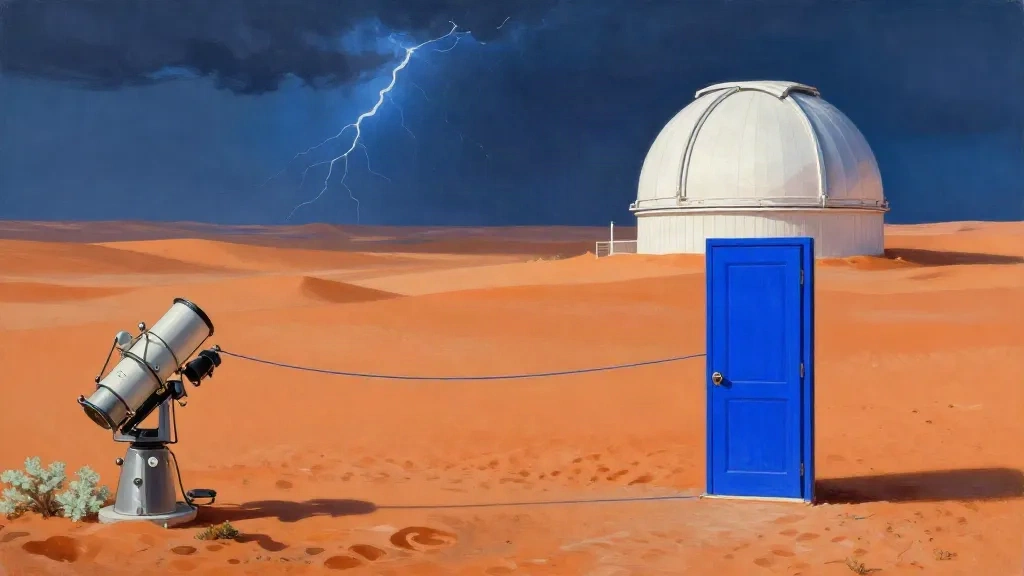
Surrealism.
The Star with No Plural
On every sixth dawn, a star rose above the desert observatory and tapped its blue light against the dome. The operators called it the singular, because after each message the sky contained only one of whatever it named.
Mara watched from the glass furnace, where a pane turned on her blowpipe like a narrow, trembling sea. Her trade was uncommon: she shaped windows for rooms in other worlds. A house of falling stars required blue so deep it swallowed the sun. A palace for sleepers needed glass thin as an eyelid. A small house where every argument was forgiven wanted panes mottled with the grey of ash after rain.
What she wanted was ordinary.
Every morning, she brewed bitter tea beside a white wall, watched beetles cross the courtyard stones, and listened to the baker strike the iron bell twice. Nothing happened. It was hers.
That morning, blue storm-light spilled through the workshop. The singular appeared and pulsed once.
Mara read the message on the silvered wall:
ORDINARY MORNING 06:12
REMOVE ALL EVIDENCE IT WAS WANTED.
The Truth of Uneven Sand
By noon, the courtyard had changed. The baker’s bell stood mute in his open hands. The beetles were gone. Mara’s tea cooled untouched beneath the white wall, which now faced the wrong direction. The sky retained the blue of an approaching storm, though no storm came.
She ran to the observatory dome. Archivist Sen had barred the blue door.
“It is already leaving,” he said through the metal.
“Then call it back.”
“No one can call it back without an account.”
At his feet lay a length of blue thread, leading from the furnace yard to a door standing alone in the sand. The door had no hinges, frame, shadow, or handle. It was the same unmarked door Mara had seen on the far side of every otherworld window she had made: in rooms where no one had yet invented a word for sorrow, in cities asleep beneath two moons.
The thread tightened toward it.
Inside the observatory, operators had already begun deleting the morning. They removed Mara’s name from the tea receipt, the bell’s second strike from the log, even the beetles’ tracks from the dust. As false entries appeared, the threads on their charts loosened and turned white.
“The trail gets safer whenever everyone stops telling the truth,” Mara said.
Sen looked through the narrow door window. “Safer does not mean kinder.”
He was right. Safety lay ahead in the burnt orange dunes, where no thorn could reach a name, no regret could find a body, no ordinary hour could be hoarded. But at the trail’s end, Mara sensed a room with white walls and a bell that rang once, then once again.
A Window in the Sand
She chose the blue thread and tied it around her wrist.
It led her through heat that smelled of iron and lichen, beneath constellations clicking out figures like officials behind glass. The thread brightened at every lie told near it.
A trader swore he had never watered a desert melon.
A mother claimed her sleeping son had never asked for milk.
Two guards agreed that no one had ever crossed the observatory road.
With each lie, stones appeared beneath their feet, smooth and burnt orange, making the route placid and safe. With every truth, the thread darkened, and the road became thin as a crack in a dry lake.
Mara spoke what she had tried to deny.
“I want this morning.”
The ground heaved. The unmarked door opened onto a white courtyard. There stood her wall, her table, her untouched cup. The baker held the iron bell, but his hands were empty. Six minutes of reflected dawn trembled behind the glass.
“If you take it back,” the singular said through the wall, “you carry it alone.”
Mara understood the price. An ordinary morning preserved by one person would contain no witness. Her tea, beetles, and baker would remain, but they would never again happen to her at the same time. She would know only that they should.
She raised the blowpipe.
She shaped the pane not to keep the outside out, as every otherworld client required, but to leave one opening wide enough for an echo. Then she blew the blue thread through the opening.
It crossed the courtyard, passed through the bell, the table, the white wall, and returned wet from the real room.
What the Birds Confirmed
At 06:12, the birds began.
First one struck the baker’s window, then a hundred answered across the courtyard. The bell rang twice. Mara drank her bitter tea. A line of beetles crossed the sunlit stones, each carrying a crumb of bread no one remembered placing there.
Sen found her at dawn, one end of the blue thread still around her wrist.
“The trail?” he asked.
“It led to the people who might have come.”
Behind Mara, the chart lay blank. The singular had vanished from the sky, leaving a blue afterlight that settled over the dunes. The unmarked door remained far away, but there was no longer any reason to reach it.
Years later, travelers claimed the observatory kept messages from the stars. Mara corrected them whenever she heard it.
“Stars do not send messages,” she would say, passing cups of bitter tea through her bright window. “And nothing is sent until someone answers.”
Then the baker struck the iron bell twice, and the ordinary morning began again.





