 Netwrck
Weird Fiction.
The Train from Thursday
At four in the afternoon, saffron light lay across the desert station like a sheet of beaten gold. The tracks shone plum-dark in the distance. Smoke-grey air gathered beneath the roof, smelling of hot metal and rain that had never fallen.
Mira sat on the ticket bench with the blue suitcase between her boots. Inside it were nine hundred books, each one blank until spoken to. On the lid, in white ink, her mother had written: Keep the small histories breathing.
Across the platform, a conductor unfolded a timetable made of pressed leaves.
Train to the Hour Before, departing when the station forgets its name.
“My mother is on that train,” Mira said.
The conductor looked at her without surprise. “She has been for eleven years.”
“She said she would send me the key.”
He reached into his coat and offered a yellow paper boat. “No key tonight. Only passage.”
Mira unfolded the boat. A tiny star-map appeared on its deck, seven points connected by a constellation shaped like an open hand. She knew the shape. The sky over her village had lost that hand three summers ago. One by one, its stars had been removed and sealed in glass cylinders by the Observatory of Corrected Heavens.
Her father had stolen them. He had also promised to bring them home.
Mira tucked the boat into her left sleeve. Her right hand was bare. The wool glove had belonged to her mother, but its thumb was missing, cut away by someone who needed to press a railway signal.
A Deadline Still Warm
At 4:17, the train arrived without sound.
It was made of dark wood, with brass numbers on its side: 1893. The windows glowed like coals. A woman in a long plum dress stepped down carrying a silver watch.
“Mira?”
“Mother.”
The woman looked older than the photograph, younger than the rumors. “You brought the library.”
“I brought the suit.”
“Then the library has another twelve minutes.”
Inside, the walls were lined with clocks. Their hands moved backward, sideways, and once all at once toward noon. The conductor announced that a deadline was traveling aboard.
It belonged to Mira’s father, who had sent a message from the same future in which he was still alive: By the final bell, return the hand to its sky, or it will remain folded inside the next child born here.
“He inherited the deadline?” Mira asked.
“He made it,” said her mother. “That is more dangerous.”
The train shuddered. Through the window, the desert dissolved into a city of white domes and blue-green trees. Mira saw her father standing on a balcony beneath a sky with no stars at all. He looked down at the train and shook his head.
“He says the Observatory has taken the next train,” Mira said.
“Then he should have cut the signal.”
Her mother placed the silver watch in Mira’s palm. The face was blank. In the palm of the glove was a needle, fine as a thorn.
The Sleeper’s Constellation
The Observatory of Corrected Heavens occupied a round room in the station’s basement. Its walls were smoky glass, and its ceiling opened onto a counterfeit sky.
There stood the hand, fixed beneath layers of cloud.
Curators in ash-grey coats moved between brass instruments. One raised a glass cylinder and pointed to a star inside it.
“You cannot remove them,” he said. “They are correcting an error.”
Mira opened the blue suitcase.
The books began talking at once.
Her mother’s voice recited a train timetable. Her father’s voice argued with a stranger about the name of a river. Children she had never met described rooms lost beneath the desert. The small histories rose from the pages, filling the observatory with a wind that smelled of dust and rain.
The curator pulled the lever. The copied sky folded inward.
“The hand belongs to a sleeper,” he said. “If it wakes, every railway in this century will remember the wrong destination.”
Mira looked at the yellow boat in her sleeve. Seven points waited in its paper water. She placed it on the floor and drew the needle through its center. The paper unfolded into a map: a path from the station roof to the track where the train waited.
“The stars are not luggage,” Mira said. “They are directions.”
When the Stars Went Home
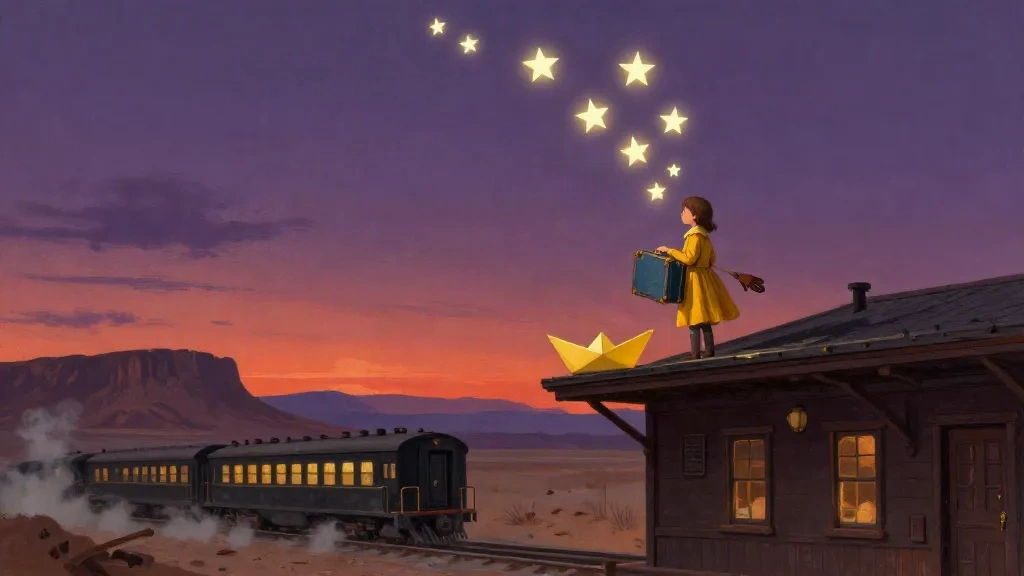
The train left without its passengers. Mira climbed onto the roof, holding the blue suitcase in one hand and the wool glove in the other. Her mother stood beneath the platform clock. Her father remained in the other century, alive enough to wait.
The signal turned saffron. The air turned plum. Smoke-grey clouds parted above the rails.
Mira opened the suitcase and released the seven points.
They rose through her hands, one by one, cold as coins. The paper boat slipped from her sleeve. It unfolded into a ladder, and the stars climbed it into the night. The first settled above the station. The second found its missing brightness in a childhood memory. The last hung above Mira, filling her palm with a small, steady heat.
Below, the deadline arrived.
It was not a bell. It was a train moving backward through the desert, carrying every promise her father had postponed. Mira stood on the roof and watched it pass. The engine sounded almost like her mother laughing.
When the stars formed the open hand, the sky changed color. Saffron burned through the plum horizon. Smoke-grey air lifted from the station roof.
Her mother whispered, “He can come home now.”
Mira looked toward the dark windows.
“Not yet,” she said. “Someone has to keep the library.”
The blue suitcase clicked shut. Inside, a blank book opened by itself and wrote: THE ARRIVAL OF THE LIVING DEAD.
Far down the track, the conductor unfolded a new timetable.
Station name: Somewhere the sun has not yet been invented.
Departure: after the first star goes out.





