 Netwrck
Hopeful Science Fiction.
The Last Performance
At sixty-eight, Elian Vey had forgotten how to enter a room, though he had never forgotten how to leave one. He had walked off three sets and two openings, and every one of those doors had been for him to go out of.
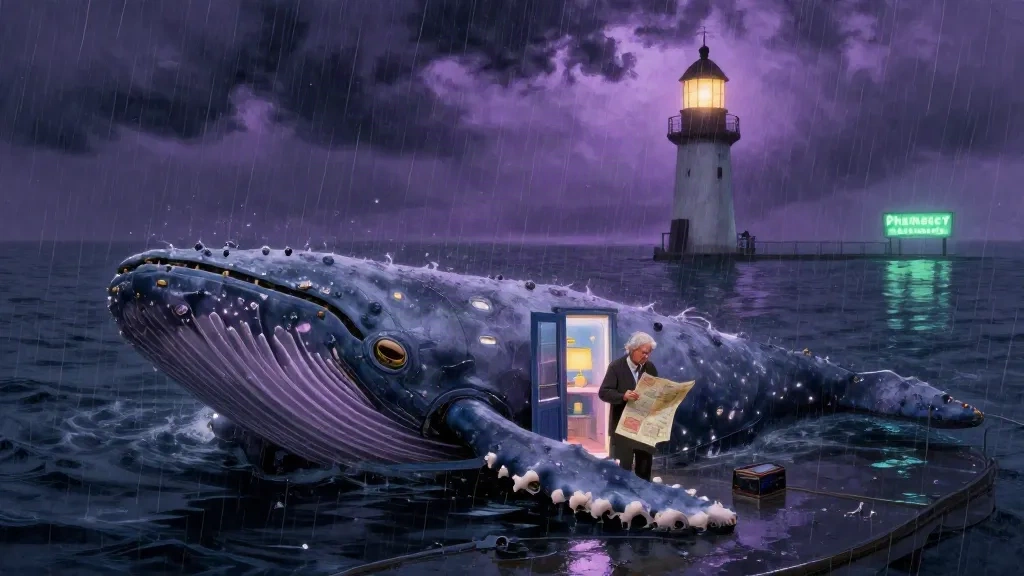
The rain came sideways off the water and lay on the asphalt deck in flat sheets. Beneath the deck the whale breathed: a slow rise, a settling, a ticking of ribs in blue pulses that came up through the soles of his boots. The creature lay along the shelf in ninety feet of black water, long as four city blocks, and it had lain there so long that the fishing fleet had a landmark in it and the gulls had stopped arguing over it.
Above his head the lamp turned, and it was no longer the light it had been. Lavender tonight, with a bruised orange seam along one edge where the arc was dying. When he was small, his grandmother had told him what the colors meant. Blue for a harbor still standing. Green for a road still open. And after green, she had said, the sea stops asking questions and starts making them up. He had laughed at that, at the time, at the counter in the keeper's kitchen with his chin in his hands. He had not laughed about the color of the lamp since.
Across two miles of black water, Cold Harbor was a low notch in the coast with all its windows dark. The green cross of Arden's Pharmacy still burned on the corner of Dock Street, the one powered thing left in town, the bill paid every month by a woman who had moved to Vantry eleven years ago and had never once stopped paying.
The house had grown up around the lighthouse while he was on the water: crooked rooms joined by narrow stairs, windows giving onto remembered weather, a draught that smelled of a kitchen he had not had in forty years. In the foyer waited a music box with a cracked lavender lid, and on the table beside it lay a keeper's log, ruled pages, the entries in his grandmother's square capitals, the last page ruled and blank. On the table beside that lay his grandmother's map, creased into quarters and softened by decades of hands until it seemed to be made of cloth.
He had promised Ilde Vey that he would perform one final role for her. Then, on the last night he ever performed, she had made him promise something else, and in March she was dead, and he was the only living person who knew the terms.
When the whale wakes, take the map to the room beneath the light. Do not let the house lie about the way.
He had promised. He had also not come, for twenty-three years, which was the same fact counted twice.
The Room That Grew
He climbed the tower because the room beneath the light was not there yet. You could not walk to it. He knew that from the log, from a line near the end of the winter his grandmother died, written in a hand that had begun to press too hard: It will not be a room until you are finished lying in it.
So he started at the beginning, on the second landing, and told the house the truth in the order it could use.
“I was the finest actor on the eastern coast.” A door appeared in the wall to his left, thin as a stage flat, and warm air came through it smelling of greasepaint, dust, and the particular cold of a stage after the house lights went off.
He let the sentence stand and watched the map on the foyer table crease once. Paper folding in a locked room is a small sound. This was a small sound, and it was in the wrong rhythm, the new crease landing off the beat of anything he had ever heard, a hem in a tune that had been whole a second ago.
“I left the mainland because my career was over.” The door thickened, and behind it a corridor appeared with a bare bulb burning at the far end. “I left because I was afraid.” The corridor finished itself in a staircase going down, with a handrail worn pale in the shape of a grip, four fingers deep, at the top.
He put his hand in the wear. It was warm. He took his hand out.
Then, in a doorway that had not been there before, his daughter sat on a child's chair facing a closed door, nine years old, in a coat buttoned wrong.
Elian stopped. Cold went up through both wrists and stayed there.
That was the first thing the house learned, and it learned it from him rather than from the whale: it did not need lies. It needed him to keep talking, in the wrong order, in the wrong house, while the map refolded itself one dishonest quarter at a time.
The Finest Actor on the Eastern Coast
The corridor gave into a theater with nine rows of seats and a blank wall where the set should have been. Someone was on the stage.
“I was The Salt Wedding,” Elian said, and the false wall behind the actor bloomed into a fishing village painted in streaky blues. “The father. Act One. I held the harbor in that role.”
“You held it beautifully,” said the man on the stage. He was forty-one and stocky and turning his cuff, and he had been turning that cuff for a long moment before Elian had come into the room. “You held it the way a man holds a door he intends to leave.”
“Ned.”
“You went out the stage door.”
“I was ill.”
Ned's cuff stopped. “You were ill,” he agreed, kindly, the way a man agrees to a child about a tooth. “And Ned went on. You know what I said for you in Act Two. I said the line you had already said in Act One, and I said it worse, and Mr. Danforth never noticed, and you were in the corridor the whole time with your coat on.”
The house took this the way soil takes rain. Somewhere above, paper folded, a quarter crease running crooked.
“I came back,” Elian said. “I came back for the curtain call.”
“You did not.” Ned nodded, easy, unbothered, a man stating a shipping report. Then he said: “Ask it right, Elian. Ask why you were in the corridor at all, with your coat on, at twenty to eleven.”
And Elian, who had spent a lifetime waiting for other people to put words in his mouth, found that he had one of his own, and that it was not the one he had brought.
Green Light Through Pharmacy Glass
A bathroom grew around him as he crossed the stage door: white tile, clawfoot tub, a window with the pharmacy's green cross throwing a cross of light across the water in the basin. It was the most honest room in the house and he knew it before the door shut.
“This is where I bought the pills,” he said. The tub filled very slowly, without a tap. “October, the week of the play. Forty of them. The man at the counter asked what they were for and I said sleep, and he wrote sleep on the bag in that way they do, half smiling, as if sleep were a country you were visiting.”
The green cross on the window brightened. The water rose over the clawfeet.
“I drove her to the overlook because she had said she wanted to stay with her mother. I said we would talk about it. I gave her my coat and I said I would be back at eleven and I locked the door and I went up to the theater because Ned had the flu and the understudy had a stiff neck and I was the finest actor on the eastern coast.”
He heard how the sentence went, and it was not the sentence he had lived with. He had lived with a better one. He had lived with I was a coward and I left my child alone on a cliff in a storm, which was clean, which had a shape, which a man could hold up in a courtroom or a bar or an empty room and be told that it was a tragedy and not a question.
“The door was open when they found the car,” he said. The tile under his feet went green. “They said the latch is worn. I have never found out if I locked it. I have never found out if the lock was broken, or if she got out, or if she got out because a man who loves his child walks back to the car and finds it unlocked and thinks: there, she is safe, she is warm, she can wait.”
The water stopped rising. Nothing in the room had changed at all, which was the answer.
“For twenty-three years I have been the coward,” he said, to the empty bath, to the green light, to the house that was listening harder than anyone ever had in his life. “A coward can be forgiven. I do not know what you do with the truth.”
The mirror fogged from the inside, and cleared, and fogged again, and he understood that this room was not a punishment. It was a tool. The house did not care whether he was a coward or a mystery. The house cared only that he keep opening himself up and letting the tide in.
The Child's Chair
He went up through the bath's ceiling, which is what the house wanted, and into a nursery with a low window and a chair set at a child's height, facing a door.
He picked up the music box from the foyer table. It fit in his hands exactly, the way a thing fits in the hands it was made for, which was the first unkind thing the house had done to him; everything else had been impersonal, and this was personal, and he had to sit down on a rug that smelled of wet wool.
He wound it. Twelve notes. He knew them the way you know a stair in the dark. His grandmother had hummed them while folding the map, and he had understood as a boy that the tune and the creases were the same instruction, and that the map only opened if the folds landed on the notes and the notes landed on the folds. Twelve notes. Four quarters. Three creases to a quarter.
He had got the order wrong, every time, for a quarter of a century.
The chair scraped backward across the floorboards. Beyond the door a piano played the same twelve notes, and then played them again with the third one wrong, deliberately wrong, the way a child gets a grown-up's melody wrong to see whether the grown-up will correct it.
“Mara.”
He said her name, and the house took it the way it took everything, and opened a narrow stair downward where the lavender lamp light fell across a door made of warm metal.
The Door Under the Light
Below the lamp the lighthouse had no walls, only a transparent floor, and under the floor the whale turned very slightly in its sleep, and the ribs rose up past him like the ribbing of a ship seen from the inside. The air smelled of oil, of hot brass, of the green chemical sweetness of the pharmacy sign, and of something underneath all of it that was simply cold and enormous and patient.
He spread the map on the floor with both hands. The ink moved the way weather moves over a field: slowly, and then all at once. The creases gave up their arguments, and a route came out of the paper, black line on wet wood, down through the engine rooms, across the old migration path, to a chamber with the green cross cut into the metal above it.
The music box said, in his grandmother's voice, pitched exactly as he remembered it through a wall in a house on Dock Street: The whale was built to carry the missing home. It cannot guess. A body is not a name. Your house filled itself with your lies until there was no address on any of it, and a carrier with no address is only a very large hole in the sea.
He went down. The metal stair took his weight with a low, patient note, like a bell struck once and left to ring.
The chamber was warm. Along the inner wall, in the light of his own lamp, names had been cut into the plating in a long column, and the newest ones were twenty-three years old, and among them, four letters from Cold Harbor's dead of the surge, and one line that stopped the breath in him, cut in the square capitals of a woman who had kept a lamp for thirty-one years: ELIAN VEY, WHO IS NOT YET LOST, BUT IS ALREADY LATE.
The great eye lay open a hand's width. In the amber behind it a human figure floated, wearing the costume he had worn in Act One of The Salt Wedding: the oilskin coat, the red neckerchief, the little tin of stage blood he had worn because the fake blood never stuck to his collar.
She was a woman of thirty-two. She had his jaw and none of his mouth.
The Address
“I came to bring you back.”
“I know.” Her voice arrived through nine feet of glass and water and forty years of being someone's daughter. “You said that on the beach. In the car, before. You said it the way people say the weather is nice.”
He put his palm flat on the glass. It was warmer than the air, which meant she was near, which meant the amber was thin.
“Say something true,” she said, “or it will not open.”
“I kept my promise.”
“No.” The word came without weight, the way a doctor says it. “You finally came.”
Below them, in the engine rooms, something turned over: a single heavy beat, and the whale's ribs went blue, then blue-white, and the house above them groaned and let go of a room Elian had not noticed losing.
“Then tell me the address,” he said. “There are two hundred and four names in that wall and one route on the map and it is not enough. I can carry a name, Mara, but I cannot carry a town. So tell me what to say.”
She looked at him for a long moment with the face of a woman deciding whether a man had come to be forgiven or to be forgiven with her, and she found, in him, neither.
“You tell them,” she said. “It has to be a voice in the room. It cannot be me. I am a passenger. Passengers do not give addresses.”
“That is not an answer.”
“It is the whole answer. You are the only one who has ever come.” She put her hand up inside the amber, and the glass was too thick for it to matter, and she did it anyway. “Ask the lamp. Ask the log. Ask your grandmother. And when it tells you, you will not want to, and then you will do it anyway, because that is the whole of what any of us ever does.”
The Route Home
He understood it in the theater, later, or in what the theater had become. It was in the log, in the ledger line his grandmother had ruled off the night the surge came: The lamp is fed names. The whale is fed the willing. Do not confuse the two, or the light goes out and the sea starts making up its own questions again.
To make a room, the house needed a lie. To make a door, it needed a truth. To make no room at all, it needed him to stand under the lamp and stop doing either, and say the one sentence he had been holding behind his teeth for twenty-three years, the one that was neither the coward nor the mystery but the actual and unadorned thing underneath both, which was that he had never come here to be forgiven, and that forgiveness was a thing a person could be given and then wear, and that he had wanted no gift.
He put the music box on the whale's eye, where it sat on the flat black of the lid, ticking out the twelve notes into the engine rooms.
“I want her to need me,” he said. “That is why I came. Not to be forgiven. Because a man who is forgiven has to change afterward, and I have had twenty-three years to change, and I did not do it. I came because I needed to be needed, and she has never needed me, and that is the only room I have ever been able to stand in.”
The house made a sound like a held breath let go.
And then the rooms went. The theater folded first, rows of seats collapsing inward like a paper fan. Then the nursery, then the bath with its green cross lying down flat in the water, then the corridors, the kitchens, the remembered weather. The house shrank to a set of stairs, and the stairs shrank to a landing, and the landing shrank to the single room beneath the light, transparent floor, no walls, and the map in his hands burning black-bright with a route that ran out to two miles of coast and stopped at a green cross on a dark street.
The whale opened its other eye.
Under the pharmacy sign, a small town began to light. One window, then a row, then a street, then the church steeple, then the whole notch of coast coming on like a filament in a bulb, twenty-three years of dark going out in the time it took a piano to play its tune twice. From the chamber wall came a sound Elian felt in his teeth rather than heard: two hundred and four small sounds at once, the sound of a carrier's list being struck off.
He opened the door in the whale's flank. Cold air came in carrying woodsmoke, and diesel, and cold Harbor, running.
What the Whale Carries
It was not a homecoming. He had known it would not be, somewhere under the lamp, and it is worth being exact about this, because a man who has waited twenty-three years is entitled to know the shape of the thing he was waiting for.
The people of Cold Harbor came ashore across two miles of black water on a road that was not there, and they arrived as themselves at the ages they had been, and there were two hundred and four of them, and the town had twenty-three years of nothing to show for their absence. A woman named Enid Marsh, who had been nine, was nine. Her mother stood on the Dock Street sidewalk with both hands over her mouth and did not know her, and did not need to know her, and said, there you are, in the voice people use for weather.
Mara came down the flank stair on her own feet, in the oilskin coat, thirty-two years old, and stood beside him on the wet deck, and looked up at the lamp.
“It is smaller than I remembered,” she said.
“You were nine.”
“No.” She said it gently. “I have been nine for forty years and thirty-two for none of them, and I remember the town as it was on the night, and I remember the whale, and I remember you at the stage door with your coat already on. I remember all of it happening at once, which is how the carrier stores things. You do not get a life in order. You get a life at the speed of being missed.”
She looked at him then, and there was nothing in it that had been waiting for him.
“I know the way now,” she said. “That is all I came back for.”
And she went down to the town, into a street of two hundred and four strangers who all knew one another's names, and he stayed on the deck, because there was a lamp above him and a lamp needs a keeper, and that had been the arrangement his grandmother had made before either of them was born.
He went up. The log was still open on the foyer table where he had left it, ruled page, blank line, and beside it the pen his grandmother had chewed the end of. He dipped it. He wrote the night down, the way you do: conditions, wind, color of the arc. Then he came to the line, the one the lamp is fed, and he had to decide who was missing.
He wrote his daughter's name first, because that is the hand a person reaches for, and the ink ran out of the line and off the page and onto the table, and the lamp did not so much flicker as refuse: green for a harbor still standing, but this one standing, and no address to give it.
Then he understood the last thing his grandmother had put in the log, in the flattest hand she had, the one she had used for weather: The whale carries the lost home. The whale also carries the willing home. They are not the same passage, and only one of them ends in a place you can live.
So he wrote his own name, and set the pen down, and stood in the crooked little house while the arc came up lavender, one night, and held.





