 Netwrck
Hopeful Science Fiction.
The Archive at Low Water
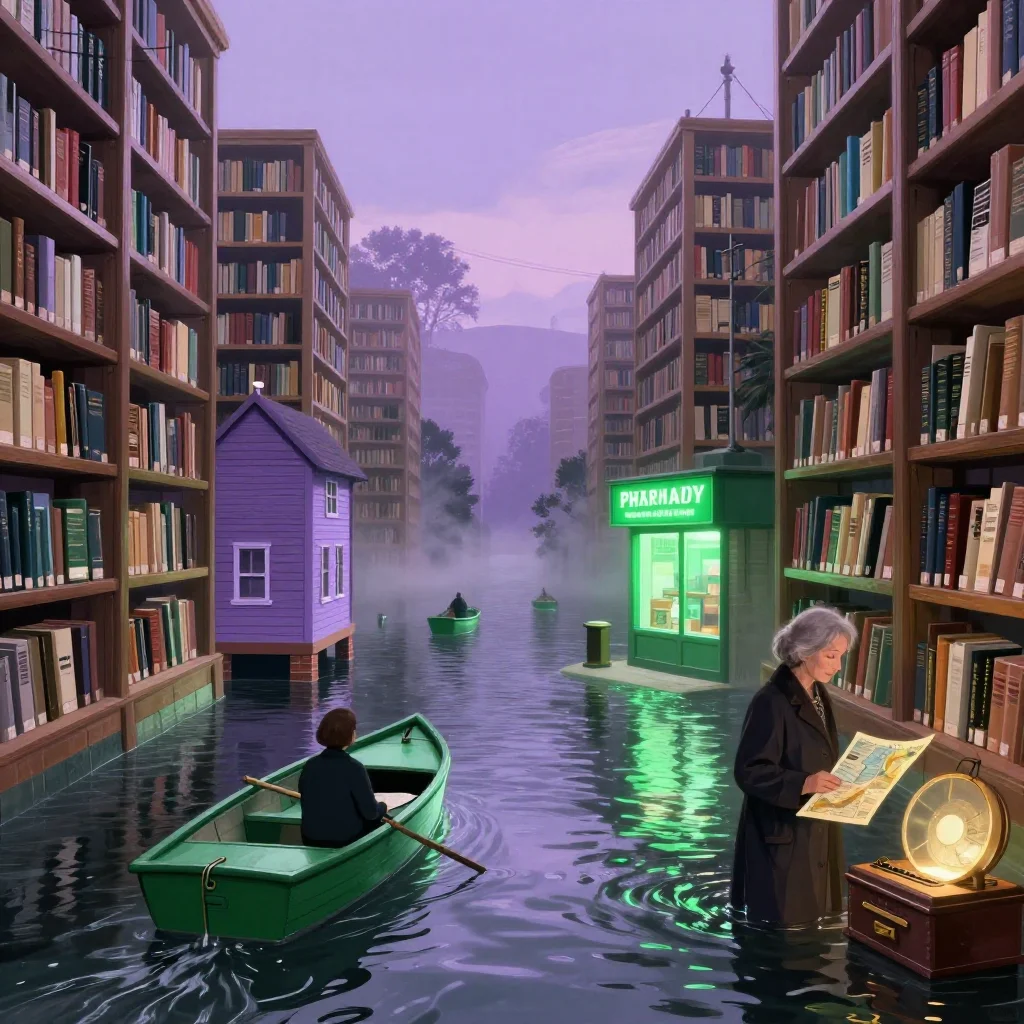
At low water, the library looked less like a building than a long gray fish resting on the mud. Its reading halls had sunk to their rafters. Only the upper shelves remained above the black water, and the librarians traveled between them in narrow green boats, rowing with oars wrapped in lavender cloth.
Mara Venn, retired actor, sat in the bow of the last boat. She had spent sixty years learning how to enter a room, leave it, and return years later wearing a different face. Now her face belonged to no one. The stage had taken her youth, her famous roles, and the comfortable fiction that applause could make a life permanent.
She had come for a promise made before she was born.
Her grandmother, Ilyra, had once rowed through this archive during the Flood Year and promised the city librarian that she would keep the true account of the evacuation. She never finished it. Before she died, she pressed a folded map into Mara's palm and said, “The rooms remember what we cannot say.”
The music box was sewn inside Mara's winter coat. Its melody had one note missing, so it played like a heart with a small hole.
The House With No Floor Plan
The promise led them to Beacon Street, where a narrow house stood above the floodline on six brick pillars. It had lavender shutters, wet asphalt shingles, and a pharmacy sign glowing green across the street.
“This was hers,” the librarian said.
Mara unlocked the door. Inside, the rooms were ordinary: kitchen, pantry, bedroom, bath. On the floor lay a folded map identical to Ilyra's.
“The old woman said the house grows a new room whenever someone lies inside it,” the librarian continued.
“You knew that and brought me anyway?”
“You brought the map.”
Mara unfolded it. Lines crossed the walls, crossed the flooded city, and ended in a square beneath the house. She set the music box on the table.
A door appeared between the pantry and the bedroom.
They entered. The room was full of stage wings: curtains painted with faces, racks of costumes, scripts bound in salt. On a chair sat a younger Mara, accepting an award and smiling as if the future were certain.
“I lied,” Mara whispered.
Another room appeared, filled with newspapers announcing her retirement.
“I lied about being content.”
The third room was dark. Inside, a child sat beneath a pharmacy sign, holding a music box that could not finish its tune.
What the Archive Remembered
“We need to get to the underground room,” the librarian said, studying the map. “But the house will not show it while the air is full of untruth.”
Mara understood. The promise was not only a document to recover. It was a truth she had to speak without costume.
She entered the dark room and opened the music box. The broken melody filled the house. In the newspapers, her quotations dissolved. On the stage, the painted faces lost their smiles. The child looked up.
“Ilyra did not fail the city,” Mara said. “She failed to tell one truth: the evacuation route had been altered by people who wanted the archive to drown.”
The child asked, “Why hide it?”
“Because she was afraid. Because fear made her promise sound braver than it was.”
Mara opened the music box's base. Inside lay a brass key and a slip of paper.
The key opened a narrow stair behind the newly built rooms. At the bottom was Ilyra's account: names, boats, destinations, and the exact hour the water reached the shelves. She had hidden it because someone was erasing the record.
When Mara placed it in the librarian's hands, the music box completed its final note.
A Door Open to Morning
At dawn, the archive boats carried the account through the upper halls. The librarians read each name into green, lavender, and rain-bright air. Families waiting on the higher floors heard where their missing members had gone.
The house added no more rooms. It did not shrink either. Mara walked through it with the librarian, finding small spaces that had once been hidden: a kitchen full of green light, a bath where the taps ran clear, a nursery smelling faintly of rain.
At the door, Mara unfolded Ilyra's map once more. The final square had become a star.
“Promises are dangerous,” the librarian said.
“Yes,” Mara replied. “But so is forgetting.”
She left the house, then returned to its porch to keep the old promise alive. Inside, the music box played every note. The archive shone behind the windows, and somewhere beneath the water, a new room opened—not because of a lie, but because someone had finally told the truth.





