 Netwrck
Speculative Fiction.
The River Kept Its Designs
Mara Venn surveyed emotions with a silver spoon.
She knelt at the riverbank before dawn, dipped the spoon beneath the current, and watched its reflection gather what the water carried. Grief clouded the silver first. Then desire arrived in bright, restless eddies. Fear moved low and cold, like iron filings beneath glass.
Her charts were private. She drew each reading on damp paper, folded it into a jar of pale salt, and locked the jar inside her raincoat. Once a year, alone, she tasted the mixture and named the emotion that had kept her from leaving the city.
That year the river carried architecture.
At first she mistook the submerged shapes for fallen trees. Then a bridge passed beneath the spoon, complete with its missing keystone. Another followed, its iron ribs flexing without breaking. She counted old crossings: footbridges drowned by reservoirs, border bridges demolished before dawn, a railway bridge preserved in amber for ninety-one years. Each held within its timbers a measure of what people had risked to connect.
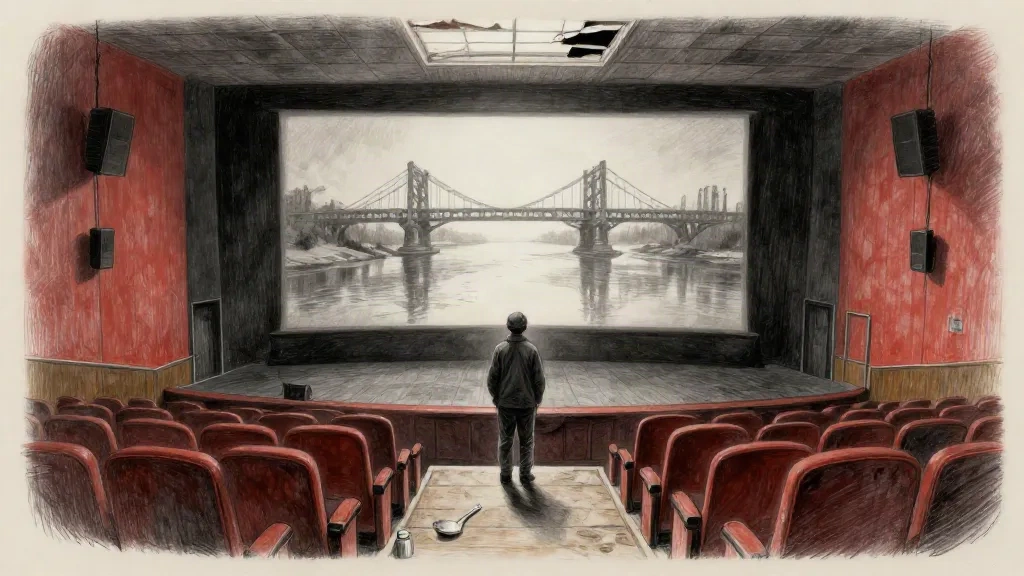
The river delivered the last crossing as she reached the abandoned cinema.
Rust peeled from its letters. The marquee had lost every bulb but one.
The Last Available Screening
Inside, dust lay over rows of red seats. The projection booth had been preserved, though the projector itself was gone. A strip of pale winter light entered through a broken skylight and rested across the empty stage.
On the screen, a woman was rowing toward a bridge that had never been built.
Mara knew the river. She knew the reeds, the gravel bar, the bend hidden beneath the hill. When the woman lifted her paddle, frost flowered along its blade. The future-image brightened.
She climbed to the booth and found the projector waiting: a compact machine assembled from spoons. Its empty reel held a strip of images without sprocket holes.
On the stage, beside the third row, sat a salt jar. Her initials had been scratched beneath its lid.
Mara opened it. The salt shone with river light.
A maintenance note was taped beneath the seat:
The future is not a destination. It is a debt left by the present.
She understood then that the cinema showed futures almost taken: a year after she left; a morning after her mother died; a city held together by one bridge longer than its usefulness. Each film owed its existence to somebody who had chosen not to make a small decision.
Her own future remained blank.
A Public Kind of Weather
Mara set the salt jar beneath the projector. When the machine turned, the room filled with silver light. The woman on the screen stopped rowing.
Mara stepped onto the stage and poured the salt onto the floor. It fell in grains, then streams, then a thin white line. The line widened into a river, crossed the auditorium, and reached the screen.
For years she had measured emotion in private because public grief invited advice, superstition, and correction. People said a bridge should be built, a road abandoned, a name spoken. They did not know that some distances could only be recorded.
Now she wanted every hand in the town to see the current.
She began with the spoon. Instead of dipping it, she held it toward the audience. Its reflection showed their faces divided by the same restless water: grandmother and grandson, creditor and debtor, two sisters not speaking. No emotion looked clean. None belonged to one person alone.
The projector changed pitch. The screen filled with the unbuilt bridge, its rails stretching toward both banks.
Then the river began returning the bridges it carried.
They rose through the salt as dark reflections: plank by plank, cable by cable. The auditorium filled with crossings that had failed, and with people standing on either side of them. Some were reaching across. Some were turning away. Some had already walked halfway before an unseen flood erased the place where they met.
The salt spilled over Mara’s boots. The spoon buckled in her hand.
Still she held it up. This was not measurement, she realized, but testimony.
At dawn, the doors stood open. Snow had entered without melting. Townspeople filled the aisle and watched the future bridge divide the screen.
Its unfinished span was occupied by every hand that had laid a stone, cut a cable, carried a plan across water. The bridge had not been destroyed. It had never been built. Yet for one pale morning, the people had crossed together, bearing the weight they had separately survived.
When the film ended, Mara placed the emptied salt jar on the projector. In winter light its glass was indistinguishable from the silver spoon.
The river had offered her a private memory.
She had given the town a river.
The Public Shoreline
Mara’s new charts covered the cinema screen. On the nearest wall, pinned where the old ticket window had been, she listed the crossings nobody remembered. Names were restored when witnesses remained. Where none did, she recorded only the current: the direction, pressure, and hour of the last person seen trying.
Her first public reading took place at low water. Farmers, ferrymen, and children stood on the gravel bar while she raised the spoon. Faces moved across its bowl, vast and unfinished. Nobody was asked to explain. Nobody was advised to forget.
By evening, the river had shifted a foot to the east.
Mara marked the new shoreline in rust red. Behind her, the cinema waited for another beginning, another life one decision away from collapse.
She kept the empty salt jar on the stage. Whoever needed it could fill it again.





