 Netwrck
Speculative Fiction.
The Mountain That Kept Still
At dawn, Mara Venn climbed into the observatory with a silver spoon in one hand and a salt jar in the other.
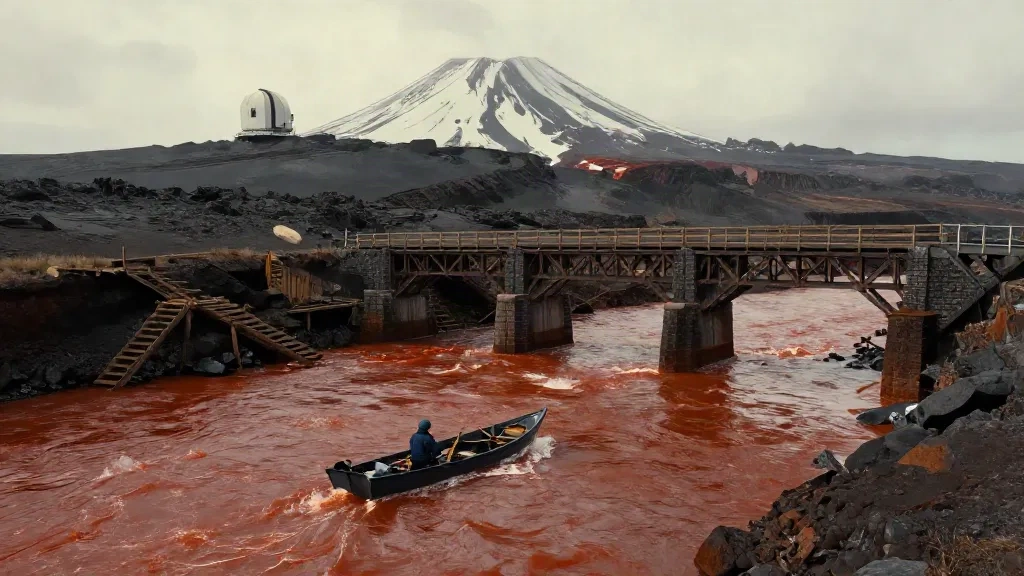
The observatory was cut into the caldera’s north wall, a black chamber opening toward a valley where snow lay thin as paper. Below it ran the Veyr, brown with volcanic sediment and swift enough to erase a footprint before the body could become a memory.
Mara was its last river surveyor. Her work was not to measure depth or width. She moved the survey boat downstream while the water carried people’s emotions, rendering them as currents: fear a jagged undertow, hope a green thread beneath the surface, grief a heavy blue bloom. She mapped what was felt but never named.
Her father had been a bridge builder. Every year, she marked the anniversary of his death by placing one grain of salt in the jar and stirring the river with the spoon. The ritual was private. Even the mountain, she believed, had consented to forget.
That morning, the river carried a bridge.
The Water’s Public Record
It entered the Veyr beneath the western glacier as a pale iron shape: trusses, stone arches, rope rails, drowned footways, a bridge made of black timber and burning thought. More followed. Bridges crowded the current, each built from a different century’s materials, each holding the names of those who crossed and those who failed to.
Mara stopped rowing. The boat pitched beneath her as the water divided around a procession of invisible architecture.
She knew the legend: the Veyr recorded every bridge ever built. The claim had always seemed like something old people said to frighten travelers. Yet the river was carrying their crossings now. She leaned over the side and saw faces in the reflection of the submerged spans.
Her father’s face among them.
He had built a footbridge over the Veyr when Mara was eleven. On the morning he died, he crossed it carrying a small parcel for her. She had never opened it. She had never told anyone that the last thing he gave her remained locked in a kitchen drawer beneath unpaid bills.
The bridge on the river pulsed rust red. Charcoal water moved through its empty trusses. A pale winter light shone above the glacier, exposing every plank and nail.
The Price of a Witness
By noon, the entire valley had gathered on the rim. They came with ropes, bells, maps, and questions. Some wanted to see bridges they had forgotten. Some wanted to recover crossings that had failed. Some had come only to prove the river had not betrayed them.
Mara stood beneath the observatory’s iron lamp and understood the complication. The river’s record did not distinguish between a bridge and a confession. Every structure it carried had been built to conceal something: poverty, betrayal, forbidden love, murder, the movement of armies. The water had preserved all of it without judgment.
To make the ritual public was to release more than her father’s death. It was to release every hidden crossing made by the people below.
She opened the salt jar.
Inside lay not salt, but a single coarse crystal shaped like a doorway. It had appeared in her jar after her father died, though she had never seen it appear. The river’s bridges began to turn toward her.
“You want a record,” she said. “You want witnesses.”
Then she dropped the crystal into the Veyr and struck the silver spoon against the boat’s rail.
The Crossing
The sound traveled upstream.
Every bridge in the river answered. Iron rang. Stone answered with a deep hollow note. The drowned timber bridge released a shape that rose from the water and stood upon the bank: her father, younger than she remembered, carrying a sealed parcel.
The crowd held its breath.
Mara walked into the river. It closed around her knees, then her waist. The bridges moved beneath her skin without cutting her. Faces surfaced in the current—her father’s among them, the faces of strangers, children, old enemies, women who had crossed in secret, men who had paid tolls they could not afford.
She understood then that the river was not asking to be believed. It was asking to be accompanied.
Her father offered her the parcel. She took it with wet hands. The paper dissolved into clear water, and the Veyr began to speak in every voice it had ever carried.
At the observatory door, she left the silver spoon.
In the valley, the salt jar stood open, its contents scattered.
By spring, no one believed the bridge had ended. They came to argue, confess, and marry beneath its impossible span. The river kept every crossing. Mara kept none of their names.
That was the public act: not telling them what the water meant, but showing them they were not the only ones who had needed a way across.





