 Netwrck
Speculative Fiction.
The Door That Was Not There
Mara Vale had spent forty years drawing coastlines that vanished beneath new reservoirs, streets erased by factories, and villages whose names had outlived their last inhabitants. Now she lived in a narrow room above a seed merchant, where she catalogued imaginary property for the old cartographic society. The society had stopped paying her, but the maps remained.
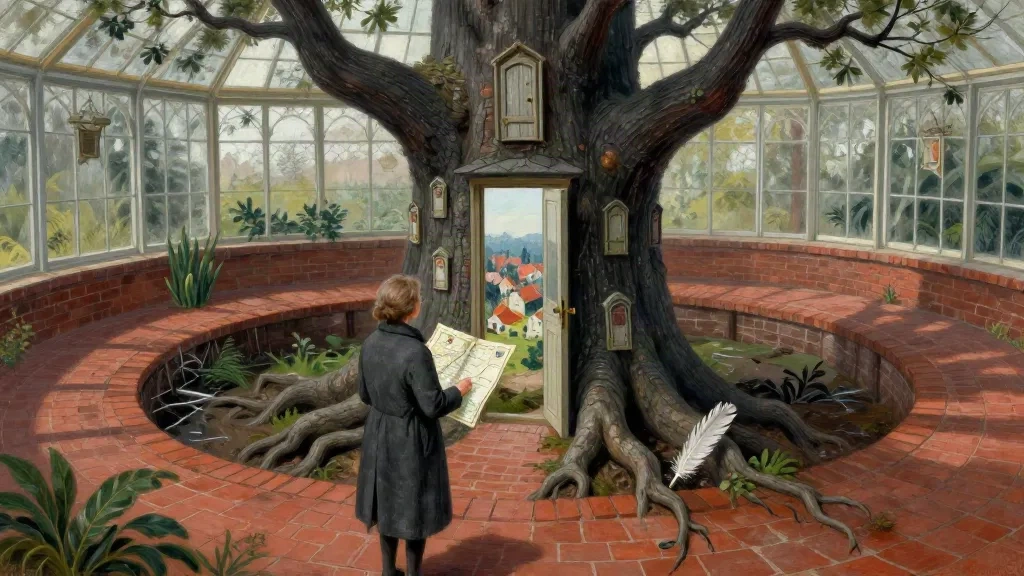
Every morning, she walked through the botanical garden. It occupied the crater where a railway had once passed, and its strangest tree grew beside the glasshouse: a black-trunked giant whose bark was stitched with narrow doors. Most were sealed. Some opened onto walls of brick, sand, or rain.
On the winter solstice, one door opened onto a place she recognized.
It was the village of Bellwether, drowned before Mara was born. She had drawn its last public house, its crooked bridge, and the field where children planted stones. Beyond the threshold stood the same house, though its windows shone with pale winter light. A woman in a red coat stood beneath the sign, holding a moth wing the size of her hand.
“We were lost,” the woman said. “The river took our names, and the new maps put roads where our homes had stood. Will you make a place where we can rest?”
Mara stepped across the threshold.
The Market of Certain Things
Bellwether was not empty. Its people moved silently between drowned gardens, carrying objects that had outlasted their meaning: a child’s shoe full of snow, a wedding ring, a jar of bees, a white feather from a bird nobody could identify.
At the village edge waited the market.
Stalls sold ordinary things: bread, buttons, salt, small animals in cages. But the valuable goods were displayed in glass bells and on black velvet. A red door that led to any desired room. A childhood returned whole. A loved voice saying the last words one had never heard.
The marketkeeper wore a charcoal coat and had no face. Mara was told that the expensive things were always true.
She drew a map of Bellwether in a ledger, placing the houses where she remembered them. Each stroke made another memory sharper. The drowned village rose in her mind: kitchens, gardens, arguments, wet hats, sleeping cats. It began to feel less like reconstruction and more like return.
She wanted a sanctuary for lost things, not merely a map proving they had existed. A room, perhaps, where the forgotten could remain without being corrected.
When she asked how to build it, the marketkeeper set down a white feather.
“Bring me the first truth you surrendered,” he said. “Bring me the first thing you made yourself forget.”
The Price of the Door
Mara had forgotten her brother’s last words.
Not their content. The words remained, bright and exact: Do not follow the road home; follow the road that remembers us. She had written them down, copied them onto the map, and then hidden the page beneath the floorboards after the funeral. She told herself she had forgotten because grief had made the sentence impossible to bear.
The market accepted the memory.
Her ledger filled with blank space where the sentence had been. She drew a sanctuary for Bellwether on the final page, giving it a garden, a well, and a bed for every lost thing. The tree opened its largest door.
Beyond it lay the botanical garden, unchanged, except that dawn had arrived without sunrise. The black tree’s roots lifted from the soil. Behind them stretched a hall of warm brick and winter light, its shelves crowded with shoes, feathers, jars, letters, and stones.
But one stall remained empty.
On it lay the white feather.
The marketkeeper had no face, yet Mara recognized the stillness of him. He had not taken the memory cleanly. He had cut it from her map and left the rest of her brother scattered across Bellwether.
“If you want a place where nothing is lost,” he said, “you must accept that something may remain lost.”
The Map Beneath the Dust
Mara opened her ledger. The blank space had become a thin blue river. Along its banks, new roads appeared whenever she looked away.
She understood then. The tree did not preserve places. It preserved the distance between them. Her maps could gather lost things, but only by making a route for whatever had been taken.
She drew one final door, not a door into a place, but a door onto the blank page. It opened into her brother’s last words. They returned as sound, as warmth, as a hand touching her shoulder. The memory was complete, and the loss was complete beside it.
At dawn, the tree rooted itself again. The sanctuary remained beneath the garden, and Bellwether’s villagers entered one by one. The woman with the moth wing placed it inside a glass case. Its dusty scales shone like tiny stained windows.
Mara kept the white feather. She did not claim it as payment, nor did she pretend it was innocent. Every map required something left out.
When the new visitors asked what the feather meant, she told them it belonged to a bird that had flown beyond the edge of the world. Then she hung it beside the door.
In winter light, the feather cast no shadow.





