 Netwrck
Hopeful Science Fiction.
The Door That Opened Downstream
On the first morning of the thaw, Mara Venn found a door standing in the mud beside the river.
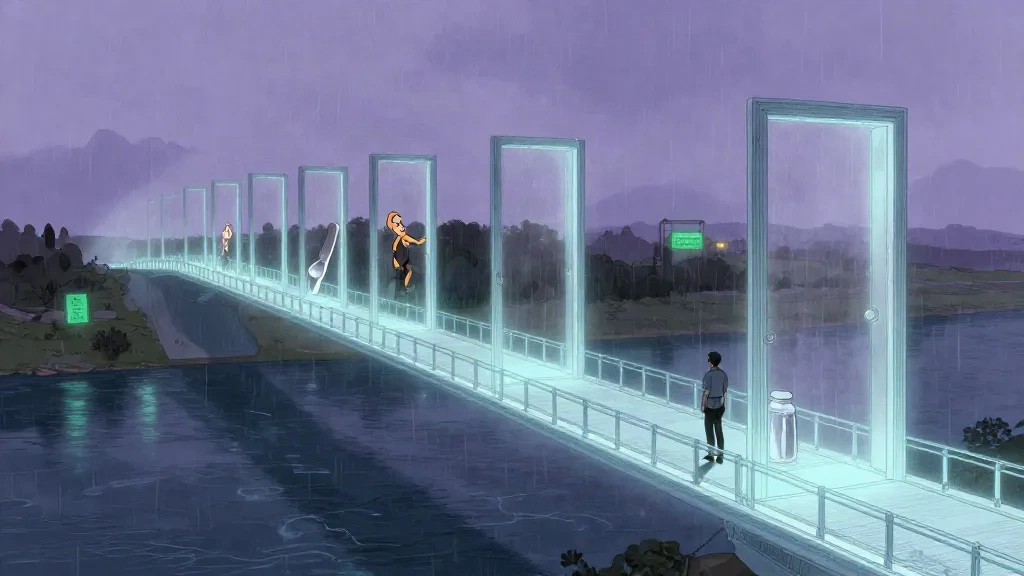
It was narrow, blue, and streaked with salt. Its brass handle shone like a wet stone. Behind it, instead of a room, she saw open water under a lavender sky.
Beyond the water stood the Museum of Doors, though no building had ever occupied that bank. A brass plaque on the doorframe read: COURAGE TO BEGIN AGAIN.
Mara was a river surveyor. She mapped emotions on moving surfaces: grief in the gray eddies beneath old piers, hope in the quick green flash where a current met clean air, shame in the silty curves that refused to go straight. Her instruments were a silver spoon for measuring fine changes in the current and a salt jar for marking the places where a feeling had lost its sharpness.
Every seventh morning, she returned to the same bend and ate one spoonful of river water after placing a pinch of salt on her wrist. Then she recorded the taste in a private ledger.
That was her ritual. No one else knew. It was not brave, exactly. It was simply hers.
The River’s Archive
The river carried records of every bridge ever built. Not their names or their dates, but their pressures. Mara could feel them beneath the spoon: the first timber bridge trembling over shallows, an iron span humming after rain, a footbridge built by children with rope and mismatched planks. Each bridge left a memory in the water, and the river carried all of them downstream.
That morning, the river carried something new.
A bridge that had never been built.
It moved beneath the surface in fragments: a span of golden light, two piers rooted in opposite banks, a line of footprints crossing at a place where no crossing existed. The water tightened around the vision, then released it.
Mara opened her ledger. The page filled itself with a sentence in her own handwriting.
You have mapped what happens alone. Now map what can happen together.
She closed the book.
At the museum, every opening held a different courage. One showed her standing in a courtroom speaking against a man who had wronged her. Another opened onto a crowd pushing through a winter storm. A third revealed a child crossing a flooded road with one hand held by a stranger.
Mara wanted to turn her private ritual into a public act. Not a spectacle. Not a sermon. A bridge small enough for one person to begin.
The Missing Span
She placed the salt jar on the museum’s steps and announced that anyone who could name a feeling they had carried alone might take a pinch.
No one came.
The river continued past the museum, carrying the pressure of forgotten bridges. The blue door remained open. Its lavender sky darkened.
Mara opened her ledger and read aloud the names of bridges that had failed. Some had rotted. Some had flooded. One had been built where the banks were too far apart.
“A bridge is not a promise that nothing will break,” she said. “It is an agreement to remain reachable while the water moves.”
At last, an old woman stepped from the shadow of the nearest doorway. She held out a trembling palm.
“I am afraid,” she said, “that my courage belongs to no one but me.”
Mara placed salt in her hand.
Then others came. A courier who had never spoken after losing her route. A child carrying a folded map. A keeper who had mistaken patience for safety. They stood in the green glow of the pharmacy signs across the water, each holding a small measure of what they feared to disclose.
The Public Crossing
Together they laid the salt in a line from the museum to the river. Mara touched the silver spoon to the current.
The unbuilt bridge rose beneath the surface.
It was not made of stone or timber. It was made of attention: the hand offered to a stranger, the name spoken aloud, the choice to remain present when the river changed course.
One by one, the people stepped onto it. The span held.
On the far bank, the Museum of Doors had opened into a public square. Its many doorways were no longer entrances to private courage. They were windows.
Mara took the salt jar from the steps and placed it at the center. She opened her ledger, but this time she did not write alone. She set the book on a stone table, and all the people added their lines.
By evening, the river carried every unfinished crossing toward the sea: not erased, not conquered, but accompanied.
At the final bend, Mara tasted the water. It was clear, faintly sweet, and bright with green reflections.
The bridge behind her was still there. It shone under the lavender sky, wet with spray, waiting for the next person to arrive.





