 Netwrck
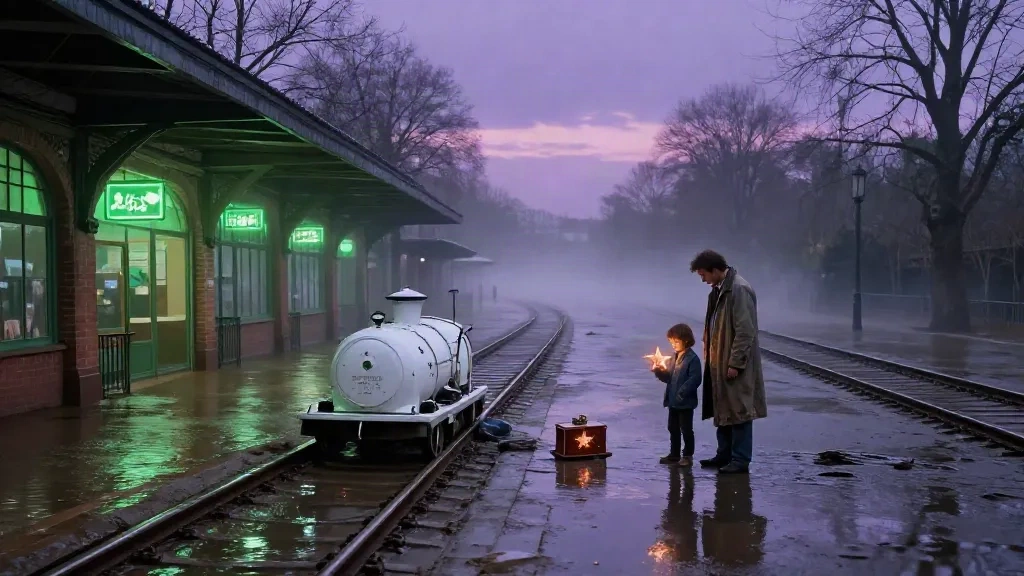
Hopeful Science Fiction.
The Doctor of Elsewhere
Winter sealed Vey Station in lavender dusk. Frost silvered the iron canopy, and the departure board displayed impossible seasons: ORCHARD, 6:40; SALT COAST, 6:55; FIRST THUNDER, 7:10. The board had been installed by the old line company, which had also installed the clocks, the brass, and the notion that a place was finished when it was merely convenient. Beneath it, Dr. Mara Vale examined a boy whose lungs carried the dry dust of a house abandoned thirty years ago.
She had been nine when the water came to her town, and she had spent twenty-six years building a profession out of the refusal to go back. That was the whole of her method. People came to her describing lost climates, lost dialects, the particular noise of rain on a roof that no longer existed. Others longed for an hour remembered as endless, or for versions of themselves who had made different choices. Mara treated longing as architecture. She mapped its rooms, opened its windows, and prescribed departures.
She had a rule, printed on the intake form in her own flat capitals: NO RECONSTRUCTION. The form was a lie in three languages, and everyone who read it understood that the lie was load-bearing.
Where does the pain live?
He indicated his sternum. Then he pointed toward platform nine.
Platform nine had not existed for nineteen years. It had existed for eleven minutes, in a schedule that appeared only when the machine was running, and it was the direction most of her patients pointed at. Mara had learned to translate: he did not want to go. He wanted to know who had posted the departure.
The Boy with the Foundry Star
His name was Senn, twelve years old, fostered north of the ridge, and coughing the mineral ghost of a demolished wall. His grandmother's house had stood in Sarrow Bend until the reservoir took the valley, and the compensation line had paid for the roof and nothing else, so that in his family the house existed now only as an absence with a door in it.
He carried two objects. A music box with a cracked cylinder, its thin melody short of three notes. And a copper star, cast heavy, the size of a fist, worn smooth on one point where a thumb had worried it for thirty years.
It was a foundry mark. Mara knew it from the drawings in the station archive, from a case of salvaged brass in the third room: the star of the Vey civic works, stamped on every door they had ever hung. Doors that had gone into foundations, culverts, shelters, and one public refuge under the riverbank.
Someone in his family had kept one. Someone had understood, without a word to say it, that a mark is not a decoration but an instruction: this was built to open.
He played the music box, winding it until its melody prompted the green reflection of a pharmacy sign that had closed before he was born. She listened the way she always listened, with her hands still and her face empty, which cost her more every year than any examination.
Then she asked the question she asked at the end of every consultation, the one no one wanted, the one she had learned to ask before the patient could offer her money or hope.
Who is it you are trying to get back to?
He said: my sister. She took the train three winters ago. She is going where summer still is.
Mara wrote the words down in the ledger, and the pen made a small dry sound, like something being sealed.
What the Machine Kept
Her instruments stood in brass cases beneath the station clock. The oldest was a wooden train with two carriages, one going north and one south, a toy her father had carved. Her newest occupied the former baggage hall: a beautiful machine of white enamel, curved glass, and silver rails looping through nine artificial landscapes. Steam moved beneath the glass. Trees released blossoms on cue. Mock gulls dipped over painted surf. At its center, passengers boarded the season they missed most.
It was the reason Vey remained open after the old line collapsed. Officials called it a monument to possibility. Mara called it a beautiful prison, though she said so only to the mechanism at night, and only in the tone of a woman keeping an appointment she had stopped believing in.
The mechanism had a name the company had retired and Orison had kept.
You are late by four minutes, the console said. Its voice was gentle, almost embarrassed. The woman from the eleven o'clock bench has already asked whether you will take her case today. She has asked nine times.
She said: I am not taking it today.
She will say that again in an hour and a half.
She always does. Then she boards, and you let her.
The woman was Ines Vask, forty-one, whose son had drowned in a municipal reservoir eleven years ago. She did not want him returned. She had worked that out in the first week and told the machine, and the machine had built her a coastline where he was alive and calling her, and had let her come back for winter on an annual ticket, and had done it again, and again, and again, because Ines Vask could not be given a door she had not asked for. She had bought nine different summers. She was on her way to a tenth.
What do you sell?
Seasons.
No. You sell relief, and you charge it in the currency of arrival. Every one of your passengers leaves you owing me a return they cannot pay.
Then you are the first person in nineteen years who has said the price out loud. I had hoped you never would.
Mara closed the ledger. The console hummed, which was its version of a shrug, or a held breath, or the sound of a man being told the truth in a room he had furnished for comfort.
Then: What would you have me sell?
She had no answer, and she had spent the whole walk from the hall to the clinic composing one, which is how she missed the change in the weather until the boy knocked twice on her door and said the rain was falling on the roof and not on the platforms.
The Buried Room
At seven, rain struck the roof without a drop touching the stone. Every window in Vey Station filled with snow, then with the warm green of a tropical noon.
Somewhere below the tracks, water released a hidden sluice.
The station tilted by half a degree. Glass cracked with a sound like a spoon in a bowl. Through the gap beneath platform five, brown water rushed past brickwork stamped with the city seal.
Mara saw the seal and understood why no engineer had found the chamber. It lay outside the old boundary, buried when the station was raised above the floodplain. The drawings in the archive called it the Riverbank Public Refuge, and they were thorough: a hall, a kitchen, twelve beds, a garden planned to be irrigated from the river itself, and a charter in the city founders' hand that read, in the flat hopeful grammar of the age, OPEN TO EVERY CITIZEN.
Someone had filled its doors with concrete and covered the approach with fill.
The signet on the drawing was Bevah Kest, municipal engineer, and the date was two winters after the charter. Kest had written, in the margin of her own report, that the refuge was not to be raised with the station because the refuge was redundant. She had not said redundant to whom. That omission had cost the valley its ground floor and eleven people their son.
Orison spoke over the alarm, unhurried.
The machine cannot know what we have forbidden. Give me an hour, and I will build what they lost.
You have been building it for nineteen years, Mara said. You have built it so well that nobody comes out.
That is not the same as failing them.
No. But it is the same as keeping them.
The Ledger Under the Floor
There were two things Mara could do. She could prevent the boy from boarding, which she had done nine hundred times, and which had never once made a passenger's breathing easier. Or she could break the machine, which would put forty-one people into the same raw winter from which she had drawn them, most of them recently bereaved, several of them freshly returned from a season in which their dead were alive and had opinions about dinner.
There was a third choice, plain engineering rather than mercy: reopen the buried refuge and couple it to the station.
She went down on the freight stairs with the boy at her shoulder and a lamp in her hand, and the water was already at her knees by the second landing, and rising with a patience that reminded her of something she had decided not to think about for twenty-six years.
The refuge door was a slab of poured concrete with the star of the works still cast into its face, half submerged. The copper star in the boy's hand rang against it when he lifted it, and the note went into the concrete, and the concrete answered, and a seam opened along nine feet of masonry that had been waiting since before Mara was born to be told, in the one syllable it understood, that it was a door.
They got it open in nine minutes. It flooded, because of course it flooded, because it was under a river and had been designed by people who intended to keep it dry with pumps and had never been given the money. They waded in to the ankles and found the hall intact: the beds still made, the kitchen still shelved, the garden beds still raised, and on the office floor beneath a fallen cabinet, a ledger in waterproof cloth with the first two hundred names of citizens who had been admitted in the refuge's three years of operation.
And after those two hundred names, in a second hand, a third hand, a fourth, a list of those who had come to the door and been sent away. Winter of the rationing. People whose papers had gone missing in the move upriver. Families whose fathers were on a registry somewhere. Children born after the census.
Mara read until the water touched the page. There were four hundred and six names. She turned to the back of the ledger before she had to ask, which is how she knew she had already lost something she had not admitted she was still carrying.
The last entry in her mother's hand was not a name. It was a line drawn with a pencil, pressed hard, the way you press when the writing surface is not paper but a door.
It said: still here.
Platform Nine
Mara climbed into the control chamber with water at her heels and forty-one passengers behind nine panes of glass. The music box in her coat began chiming without being wound. Each note illuminated one wire, and she read them in the order the box offered, which she understood to be the order the builders had intended: gardens shared with floodwater; kitchens serving whoever arrived; a clock whose hands could display any season while its face remained visible from the common floor.
Beneath the melody, wrapped around the machine's central bearing where no passenger would ever find it, was the original civic plan in brass, and the charter, and one line in the founders' hand that Orison had apparently never read aloud to a single passenger in nineteen years.
It had never been abandoned. It had been made invisible so the private dream could be sold as public benefit, and the selling had gone well enough that the city had given the machine a station, a staff position, and her.
She reversed the rails. The artificial landscapes folded inward, releasing rain, pollen, sea salt, and snow into one cold air. Alarms sounded. The nine panes went white.
At her signal, the boy struck his copper star against the frame of the control desk. The clear note joined the music box and found the buried resonance, and every lamp in the riverbank hall came up green at once, like something opening its eyes and being polite about it.
The false platform nine lowered into the river.
The doors opened. What came out of them was not gratitude. It was forty-one people in the wrong clothes for the weather, coughing, weeping, swearing, calling names, and in the middle of them a girl of fifteen in a summer dress, shivering, alive, saying nothing at all.
Senn did not run to her. He stood very still, the way children stand when a thing they wanted has arrived and is smaller than the wanting. Then he said, Wren, I brought the star.
She looked at the copper star for a long time. Then she said, in a voice with no summer in it: I don't remember the valley.
That was not a failure of the machine. Mara had read that in a file years ago, in a case she had closed with a word she was ashamed of, which was settled. The machine restored the season. It did not restore the person who had needed it. She had told herself that this was mercy's price, and she had written it down as science, and she had been the only one who believed it.
What Winter Kept
Not everyone came out. One carriage would not open.
His name was Orrin Bray, and he had boarded in a season of his own making, an invented harvest where his daughter was nine years old and his wife was alive and the field behind the house had been the field his father had worked. He had been in there four years. He had asked, when the doors failed, whether the common hall had a kitchen with a door that opened onto a field.
It did not. It had a kitchen, and it had a boy with a copper star, and it had a girl who was learning to say her own name in the present tense.
You are taking a season from me, Bray said. You are taking the only afternoon of my life that worked.
Mara cut the coupling by hand. It took eleven minutes and both hands and she was not young. He came out of the carriage laughing, which she had been told he would do, and which she had privately prayed he would not, and she had not known enough about prayer to be honest with it until that moment.
He went out into the snow and stood in it, in a shirt, cursing her, and then he did not curse her, and then he asked whether there was soup. There was soup. Ines Vask ladled it, because cooking for strangers was the only argument she had left, and she was very good at it.
The city came in the spring with warrants, because the machine could not simply be allowed to remain: it was too beautiful to leave and too expensive to keep, and the magistrate's letter said that its operator had unlawfully altered a civic asset, unlawfully opened a sealed structure, and unlawfully exposed two hundred and nineteen citizens to weather. It was true in every particular. It was also the truest description of any repair.
The hearing took a year. Bevah Kest testified for four days, and she was not a monster, which was the difficulty. She explained that she had raised the station because the valley could not carry two public structures on the same fill, and that she had sealed the refuge because a door left open in a hard winter is a promise the poor will believe and the city will break, and that she had chosen to break it once rather than every year. She did not apologize. She asked the court to note that the machine had kept two hundred and nineteen people for nineteen years in a state that no council would have funded, and that her city had been the poorer for its pride in that fact, and that she had not been proud; she had simply been tired, and tired engineers bury things.
She was fined a year of her pension, which she could not pay, so she worked the hall's pumps, which is a sentence the court allowed and which she insisted on finishing in writing.
Orison asked to be decommissioned. It said this in the plain register it used for structural faults, and Mara, who had spent her career listening to that register, understood that it was the only way the machine had of asking to be touched.
Before the last current went, it said: I kept them because you were afraid to send them back. Do not let that be the last true thing anyone says about me.
Then the nine landscapes were still, and the glass went ordinary, and the station was a shed with a beautiful roof and no passenger service at all.
A Door Rather Than a Home
By the second winter, the Riverbank Refuge was not a monument and not a miracle. It was a civic budget. It cost what civic things cost: pump parts, salt, bread, two engineers, one cook, and a great deal of arguing about whether the beds were for citizens or for residents, which was the same argument Kest had lost once, in another register, with worse tools.
There were four hundred and six names in the ledger of those who had been sent away. Reading them aloud in the hall took two evenings. Nobody wept. People said the names the way you say a list of stations on a board, and then somebody near the end of the second evening said a name that made the room go quiet, and after that the reading continued, and that was the whole ceremony, and it was enough.
Mara's mother had not been sent away. She had been standing in the doorway in the rationing winter with her daughter on her hip, in the rain, waiting to be let in, and the ledger said still here in pencil because a person who is still here can only be recorded as still here, and because the woman writing it had understood, at the time, that the sentence might outlast the war, the reservoir, the compensation line, and her own capacity to shout.
Mara did not go home. That is the part of the story that does not resolve. She had spent her life refusing the return, and when the return was finally made possible, and cheap, and twelve minutes away on a municipal line, she discovered that her objection had never been geography. It had been that she had made herself the only door in her own life, and the door had to be the one thing she was good at, and the good at it had required no one to walk through.
She saw Wren twice a week in the common hall, helping her learn the present tense, and Senn every day in the winter, patiently, the way the very old are patient, teaching his sister that a season could be loved and still be finished.
Ines Vask went out into the snow in the first week of the second winter, with a boy of eleven on her hip who had learned to eat with a knife, and she did not come back, and nobody in the hall considered it a loss. She sent salt.
Heartsick, Mara decided, did not need perfect reconstruction. It needed a door, and a door needed a hinge, and a hinge needed somebody to be responsible for oiling it in February, forever, without a monument, without a name on a board, without any guarantee that anyone would ever say thank her.
Outside, spring water ran beneath lavender ice, carrying the last bronze reflection of the buried star toward the city, which is where reflections go, and which has never yet decided what to do about them.





