 Netwrck
Hopeful Science Fiction.
The Note Under the Dish
At dawn, the observatory cast a lavender shadow across the wet asphalt. Sera played the old harmonium beneath the stars, its notes traveling farther than the radio silence. The instruments translated stellar pulses into sound: long tones for old light, clicks for vanished suns, a trembling chord when the sky received a new message.
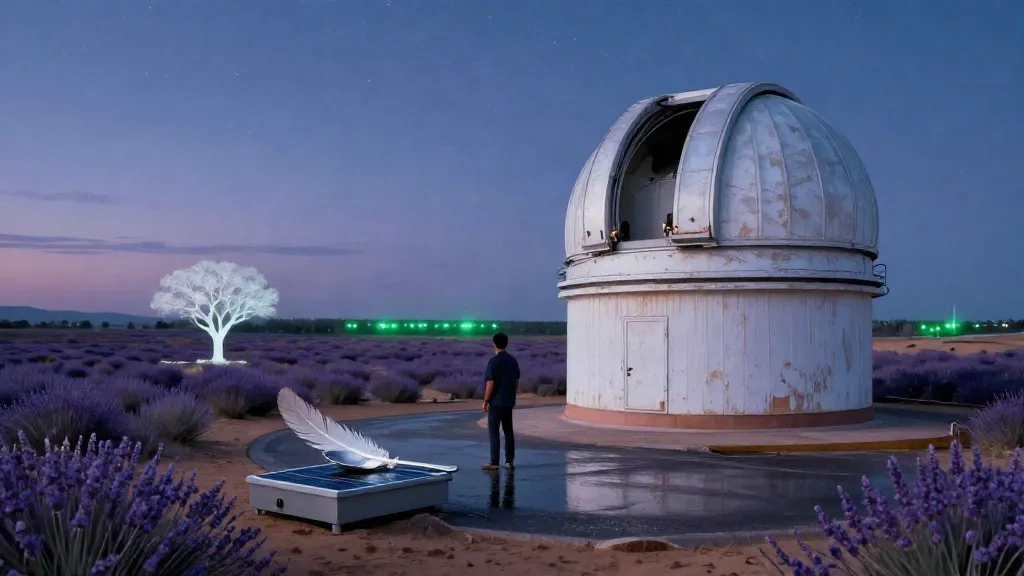
Beside her station rested two objects no one had claimed. A white feather, soft as a moth, and a silver spoon polished by generations of desert hands. The cook said the feather had fallen from the sky. The mechanic said the spoon had belonged to a child who promised never to lie. Neither story explained why the objects had appeared together.
Sera heard a note when the mechanic said it. A clear middle C, impossible beneath the harmonium.
“The spoon was mine,” he admitted. “I hid it because my daughter thought silver could keep a promise from breaking.”
The note remained after he spoke. Sera wrote it on her palm and returned to work.
One Winter, One Generation
That winter began with frost on the observatory’s copper roof. It did not thaw. Snow climbed the solar panels, sealed the access road, and buried the transmitter beneath a patient white hill. The stars still sent their messages, but the equipment began losing pieces to the cold. A mirror cracked. A motor seized. One by one, the observatory’s listeners left for warmer cities.
Sera stayed because she had made a promise to build something that could survive the storyteller. Her plan was modest: a small solar kiln to preserve instruments, a clockwork relay to repeat incoming signals, and a weather shelter for whoever came next.
But winter refused to end. A child grew into a woman beside the buried telescope. She learned the sky by watching its reflected light on the ceiling. She never saw the desert bloom, never tasted rain, never heard her mother laugh outside.
When the last mechanic died, he left Sera the silver spoon. “Keep it for the next person who tells the truth,” he said.
She answered, “You were afraid it would fail.”
A low, unfamiliar chord trembled through the room.
The Machine for After
Sera began with the spoon. She set it beneath the solar kiln and used its curved handle to reflect light into the receiver. It was a ridiculous shape for such an important task, but its bowl held the last green glow from the pharmacy sign beyond the hills. The signal strengthened.
She carved the harmonium’s notes into wooden cylinders, each groove connected to a different part of the relay. A true statement would loosen the machine’s spring. A lie would tighten it. Soon she understood that the mechanism was measuring more than honesty. It was measuring willingness to continue.
For decades, visitors came to confess. A nurse admitted she had chosen another patient over her sister. A pilot said he had abandoned a failing ship. A girl whispered that she remembered the sky before the snow and had pretended not to.
Every truth released a note. The white feather stirred in the intake, lifted by warm air from the kiln, and traced a silver shape against the violet sky. Sera realized it had never been a message from heaven. It was a seed, waiting for a machine with enough heat to open it.
What Winter Could Not Keep
On the morning her granddaughter turned sixteen, Sera carried the harmonium to the roof. The new relay had gathered a hundred notes. When the girl said, “I will leave,” the observatory answered with a chord so bright the snow shone lavender.
“You are not leaving us,” the girl said, touching the silver spoon.
Sera heard the note before the girl finished speaking. The machine sang. Somewhere beneath the ice, water moved.
By spring, the observatory had become a place where strangers left honest things for strangers who had not yet arrived. The winter finally broke. It did not melt gently. It opened, as if it had been holding its breath for a generation, and lavender clouds rolled over the wet asphalt.
Sera planted the white feather. It grew a tree overnight, white leaves shining with pharmacy green beneath the stars. The tree held every note the machine had learned.
Years later, travelers found the observatory when they were lost. The silver spoon hung beside the door. Its bowl reflected the northern lights, and the tree answered in a language made of every truth that had built it.
Even after Sera was gone, the machine spoke. The stars continued sending. The tree grew taller. And anyone who told the truth gave the future another note.





