 Netwrck
Weird Fiction.
The Seed's Hum
Mara Venn had not been to Earth in nineteen years, though she received its messages in fragments: a blue horizon on a public screen, a child asking where oceans were, a report of rain in cities that had forgotten rain. The orbital greenhouse called Lichen had made her a caretaker, a gardener, and finally a listener.
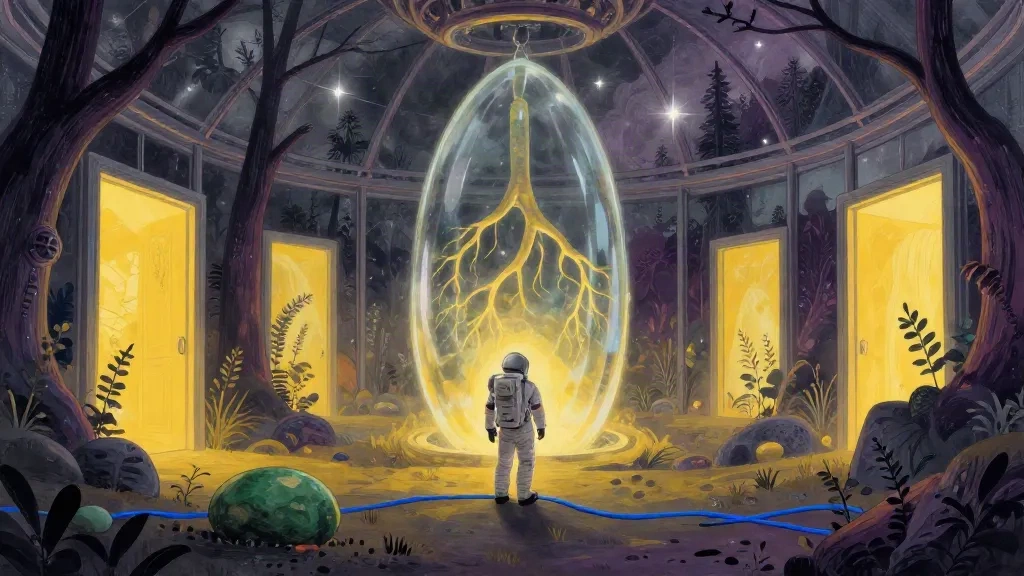
At its centre, suspended in a lattice of green glass, lay the seed. It was fist-sized, grey at the seams, and warm to the touch. Its shell was covered with a pattern like branching rivers. The seed remembered extinct forests, not as records but as pressure, a memory held beneath the bark of the world's last living things.
Mara heard the lost voices there. They entered the station as background noise: a rustle beneath ventilation, a murmur under conversation, footsteps crossing an empty floor. History had taught the universe to ignore them.
She wanted one voice back. Her mother's, perhaps. Or the voice of the first botanist who had touched the seed. Mara had a green stone in her pocket, worn smooth by years of waiting, and a blue thread tied around her wrist. She had promised the dead she would not confuse silence with peace.
Doors in the Rain
The storm began as a disturbance in the artificial atmosphere. Saffron clouds formed between the glass ribs, then darkened to plum. Lightning struck the station without heat, and every door in the greenhouse changed its mind.
Mara watched the hydroponics door open onto the observation gallery. The gallery opened onto the seed chamber. The seed chamber opened onto a corridor she had not seen since her first year aboard, where the floor shone with wet footprints.
People were caught between them. A technician carrying a water hose stepped through a wall and vanished from one room while appearing in another, still gripping the hose. A sleeping orderly slept in three places. The station became a sentence whose words kept changing position.
Mara followed the storm's rearrangement by following voices. The green stone warmed in her hand. The blue thread tugged gently at her wrist, its loose end pointing toward a door that should have led to the outside.
She opened it. Beyond it stood a forest under deep smoke-grey air. Its trees had no leaves, only translucent bark, and their branches moved like fingers trying to remember a shape.
The Voice That Moved Rooms
Every voice in the forest was speaking at once. Mara wanted to separate them, but the storm had made listening another kind of navigation. She followed the blue thread through a corridor filled with rain. It led her past doors marked with names, dates, and measurements of extinct rainfall.
Behind one door, a woman repeated a weather report. Behind another, an old man argued with soil. Behind a third, a child recited the names of trees while an adult whispered corrections. The voices were not memories of people but memories of their importance—the moment each had been noticed before the world moved on.
Mara's mother's voice was among them, diluted by generations. It said: Listen after the sentence ends.
She closed the door, then opened it again. The voice moved. The storm had carried it into the next room, where the doors were folding through one another. Mara followed, tying the blue thread around each handle so she would not lose the path.
The green stone split under her fingers. A warm root pushed through the crack and pierced the floor. Around it, the storm's doors stopped moving.
What the Seed Kept
Mara understood then that the seed did not store voices. It stored relationships. A voice mattered because it had answered another voice, because someone had needed it to continue, because the forest had made room for the sound.
She placed the green stone beside the root. Its halves rejoined, and the glass ribs overhead filled with saffron light. The blue thread unwound itself, crossing the chamber in a clean line toward the central chamber.
She followed it. Behind the final door was the place she had been avoiding: a small room with a microphone, a chair, and Earth's public broadcast arriving as a tired hiss. A rumour, but still a voice. Still something answering something.
Mara sat down and spoke. The station carried her words through the seed and into the forest, and the forest gave them back. Not louder. Not permanent. Only clear enough to return.
Then she stopped, waited for the silence after the sentence, and heard her mother answer.





