 Netwrck
Speculative Fiction.
The Last Room He Left
At sixty-eight, Elias Venn could remember only what had not happened yet. Not the past, which had grown unreliable, but the coming hours, which arrived at him fully dressed: the entrance, the lighting, the cue for his line. Every morning he woke to know precisely how his day would be blocked. Nine o'clock, the radiator that never quite warmed. Ten, the table read in the east room, four residents arguing about a play none of them had read. One, the placement of flowers beneath a magnolia that bloomed in a stairwell with no sun.
His wife's funeral came to him each autumn, precise and unbearable, though Ines remained alive and asked why he kept placing flowers beneath the winter magnolia.
He had been an actor for forty years, and now he performed small roles in the communal dining room of the Ardent Building, a place for people whose memories had misplaced their arrows. The building's staff called the condition deferred recall, which Elias considered a stage manager's term for the same thing: the event would happen, and it would happen to him, and he would be the last to know. Dr. Ferrant, who visited on Thursdays with her recorder and her patience, taught them to leave notes beneath their pillows. Not reminders. Evidence. She wanted them to write down what had actually occurred, in the flat declarative tense, because the future tense was where people went to hide.
Elias wrote nothing. He kept one note in his wallet, folded twice, soft as cloth from being taken out and put back:
Return to 14 Harrow Lane before the first snow.
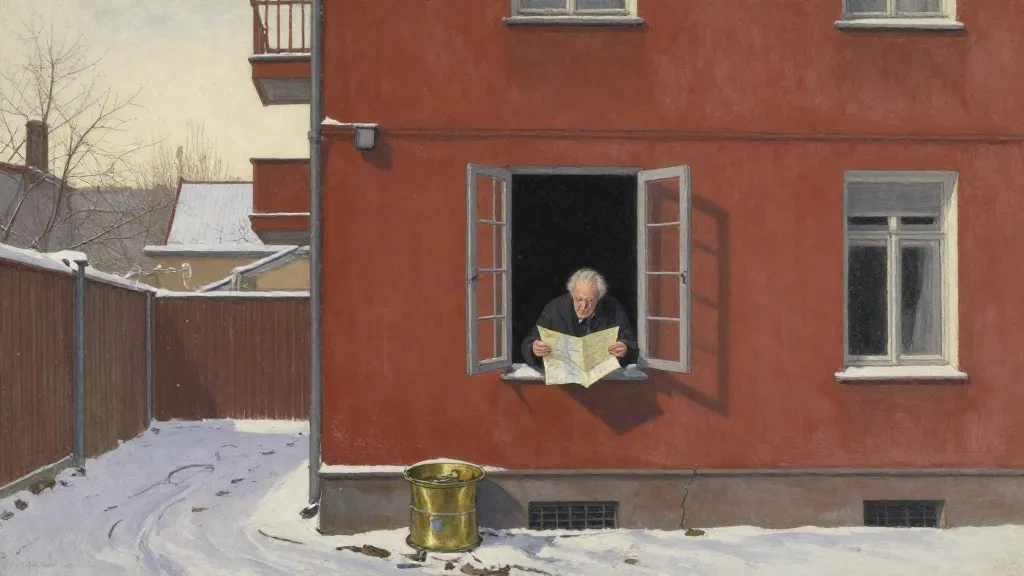
His father had written it on the back of a folded map, then pressed the map into Elias's hand at the door of the house where Elias had spent his ninth winter. The handwriting was his father's: a small, upright, unhurried script that never asked for a second look. Before leaving, his father had promised: if the house ever grew a room, he would take his mother through it safely.
Elias had forgotten the promise. He had forgotten, with an almost theatrical completeness, the winter itself. But his body remembered the brass key, the third stair from the top, the loose tile that clicked beneath his heel and announced him to a house that had learned his weight.
A House That Listens
The Ardent Building had no address that remained stable. On Tuesday it was on Fulton; by Thursday the post had followed it to a street that did not exist on any map Dr. Ferrant trusted. Its windows showed tomorrow's weather. Its elevator stopped at floors not yet built, and on the eleventh the doors opened onto a corridor of plaster and bare bulbs where nobody waited and nothing hummed. The tenants remembered each other's exits, which made a poor community and a fair audience.
The management office had warned Elias not to accept a room with more than one door. The warning was delivered by a young clerk named Adeyemi, who had been told to deliver it, and who delivered it the way one delivers news about a relative: quickly, and without looking at the face receiving it.
“Is one door the usual number?” Elias asked.
“One door is the usual regulation,” Adeyemi said. “Some tenants report a second.”
“And you?”
“I report what they report.”
Elias said he was accustomed to playing rooms that disagreed with the scenery. No one laughed. The dining room had grown a tolerance for modesty that he had not, in forty years, learned.
For eleven days the map stayed in his coat and behaved. Then, in the last week of November, it began to warm. Not from his pocket. From inside, as though something beneath the paper had remembered fire, or the boy who had carried it, or the house that had taken the boy in and never quite let him go.
Elias took the music box from the shelf beside his bed. It had belonged to his mother; it was small, brass, cheap, the size of a fist doubled, its tune missing one note where the second phrase should climb. The lid was scratched with initials — E.V. — not his. His father's hand. The scratch was shallow and satisfied, the work of a man with time and a file.
He did not remember receiving it. He remembered the sound: his mother striking it with the heel of her hand, impatient, twice, until the mechanism took.
Adeyemi watched him leave from behind the desk, and Elias understood, going out into a cold that smelled of iron filings and coming snow, that the clerk would file a note about it. The building had begun keeping records in directions he preferred not to read.
The Price of a Clean Exit
14 Harrow Lane had a low wall of soot-coloured brick, a gate painted the green of hospital ceilings, and a streetlamp that had been installed, judging by the rust pattern, decades after the last time anyone on that street had walked beneath it. The first snow had not arrived. The air held it in reserve, the way a theatre holds a scene it has not been given the cue for.
He counted the street. He was aware of himself counting, the way one counts bars in a difficult piece, to get through it.
The front door opened before he knocked.
Inside, the walls were charcoal, veined with rust-red pipes that carried a sound like a swallowed voice. Pale winter light lay across the floorboards without a sun; it came from everywhere and from nothing, and it made the dust look theatrical. The smell was cold upholstery, tea gone tannic, and, under both, the green-blanket smell of a house that had been kept aired for someone.
A woman sat at the kitchen table with her back to the door, in a blue coat he had forgotten. She had his mother's posture: the shoulders held slightly forward, the head tilted at the angle of a person listening to a room rather than looking at it.
“You promised to come back,” she said.
“You promised not to wait.”
“I promised to be here when you did.”
“That is a different promise.”
“It is the only one I could afford.”
He should have said something then. He was an actor of forty years; he had material for a hundred such kitchens. Instead he felt the old instinct rise in him, the one that had never once failed him: the instinct to enter a room before the audience discovered it lacked a wall.
His mother lifted the music box from the table. She had not asked him for it. One note sounded, thin and brass, and then another, and she set it on the table between them and said nothing, because the box was doing what she had always done with it: striking the same phrase twice, waiting for the part that would justify the whole song.
The Rooms the House Built
Behind her, where the pantry had been, a doorway appeared. Its frame was wet with fresh paint, and the smell of it was so acute and so recent that Elias felt the urge to apologize for breathing on it.
Inside was his father's desk. Mahogany, scarred ring-marks, a drawer that did not close. The folded map lay beneath a cup of black tea, perfectly preserved, the tea still sending up a thread of steam. Beside the desk a chair faced a window, and in the window stood a boy waiting to leave.
Elias recognized the coat, the shoes, the shape of a child's fear: not the fear of the street, but the fear of being the one who had to decide.
“You said you would take me through the room,” the boy said.
“I said I would come back.”
“That is not the same.”
“No.”
“No,” the boy agreed, and the agreement was worse than the accusation, because it had been waiting for him to arrive.
“Tell me what happened,” Elias said to his mother.
She opened her mouth. The walls exhaled plaster dust. A crack ran across the ceiling with a sound like a dropped tray, and behind the desk a second door appeared, smaller, painted the same wet green.
“I waited,” she said.
“Say more than that.”
“I waited because you told me you would return. And then I waited because I had already waited, and it would have been waste to stop.”
The second room held a bed, a narrow window, a suitcase packed for a journey his father had never taken. The labels were his mother's handwriting. The date was nine years before the winter.
“I let you go,” she said, “so that I would not have to choose.”
The music box, unattended, struck a phrase and stopped.
Elias had spent fifty-nine years believing the story his house told: that the past had been taken from him. That a frightened child had been sent out of a door and something in the walls had eaten the rest, and that what remained — the brass key, the third stair, the loose tile — was only residue, a house's leftovers. It had been a comfortable story. It placed him on the side of the damage rather than the side of the hand. He had been the child in the window. He had never once been the man who did not come back.
“I chose the work,” he said. “I chose it every day for forty years, including the days I called it a choice that had been made for me.”
His mother looked at the doors. “The house hears the difference,” she said. “It has been adding rooms since you arrived. It is very glad you finally said something true. It has so little to work with.”
Then he understood the rule, and it was the rule of a theatre, which is to say a rule about what can be held: a room opened when he admitted what had been kept in it. Every door the house had built was a door he had installed himself, decades ago, with a sentence he had not meant.
The Room That Was Never Built
He went into the rooms one by one, because there was no other order available and because that is how you work through a house: from the near end, slowly, with your hands out.
In the first, his father at forty sat practicing apologies to an empty chair, rehearsing them in order of usefulness rather than sincerity. In the second, his mother left through a door she had promised never to use, carrying the suitcase, and did not look back at the room, and Elias understood — late, decades late — that she had not looked back because looking back had been the one thing she could not afford to be seen doing. In the third, a hallway he had never walked, with a child standing beneath a window holding a folded map in both hands, too large for him, as though the map had been handed to him by someone taller who intended to come back and take it.
Then there was the argument. It had no furniture. The walls were close and unpainted, and his father was standing, and he was nine, and it went exactly the way he had spent his life imagining it went, and then it went another way, because in the version the house had kept, his father was the one who had shouted last, and he was the one who had gone down to the street, and the map had been pressed into his hands by a man who had already decided to keep it.
That was the lie the room had been built for. He had carried it out into the world for fifty-nine years, that his father had driven him away, that the promise had been extracted at knifepoint, that the man on the other side of the door was the one who had broken it. It had been the most useful thing he had ever told himself, and he had told it to Ines, and to agents, and to a boy in a window fifty years later.
“He gave it to me,” Elias said.
The room made no sound. Rooms like that never argue. They wait for the man to stop.
“He gave it to me and he left, and I decided the leaving was the whole of the story, because I did not want to be the one who had to write the rest.”
On the desk in the next room lay the map, still damp from the tea, and its back had changed. His father's small upright script had spread beneath the ink like roots under a floor, branching into corridors, staircases, a whole survey of a house that had not existed when the promise was made. The house had not merely added walls to the old plan. It had built a history out of the distance between what they said and what they meant, and it had been at that work, patiently, for sixty years, in a town where snow came late.
At the centre of the map, in pale pencil, a small square sat surrounded by doors. No ink touched it. No note. No lie had ever been laid down in that square, and so no room had ever been built over it.
Elias unfolded the map across his father's desk until the paper complained, and set the brass music box on top of it, and struck the tune with the heel of his hand, twice, the way his mother had, and the mechanism took, and the phrase climbed to the place where the note was missing and stopped.
He supplied it. Not loudly. The missing note was the first note of the promise, the one his father had had to leave room for when he ruled the back of the map.
What the Building Could Not Keep
The square was not a room. It was the absence of one: a small square of unbuilt floor in a house of additions, with no walls, no ceiling, no window, and no doors. Standing in it was like standing in a mark on a page where a drawing had been rubbed out. The pipes did not carry sound there. The dust stayed where it was.
His father was waiting on the other side of nothing, old and indistinct, holding the same map in both hands, the way the boy had held it.
“I promised you a way through,” his father said.
“You promised me I would come back.”
“Yes.”
“And then you left first.”
“I wrote the note on the back of the map. I made sure there was somewhere to put the sentence.” His father looked at the brass box under Elias's hand. “I did not keep the tune. I only marked the gap. I was afraid of being able to sing it.”
The house listened. Elias could feel it in the pipes, in the winter light pooling around his shoes, in the patient arithmetic of walls deciding whether they had earned another door. It did not want mercy. It had never wanted mercy. It wanted the sentence, exactly as spoken, by a man who was not performing it.
He had rehearsed this his whole life. He had the line in four versions and had used none of them.
“No,” he said. “I came back. But not for you.”
He said it to his father, and he said it to his mother, and he said it to the boy in the window who had been standing there for fifty-nine years waiting to be told the difference between the two promises, and he meant every syllable of it, including the cruelty in it, which was his, which he had earned, and which he was not going to soften in order to be forgiven faster.
The house took the sentence at its full value. The wet green paint on the far door dried and flaked. The brass pipes let go of the voice they had been holding for sixty years. Somewhere above, a floor stopped being a floor, quietly, the way scenery is struck.
The room did not grow another door.
Instead, the one before them opened onto the Ardent Building: the east room, the table read, four residents arguing about a play none of them had read, and a dining room with breakfast waiting, and a future that had not yet decided whether to arrive.
The Cost of Meaning It
The bill came due, as bills do, in instalments, and the first instalment was memory.
Elias came back through the lobby and up the stairs, and for the first time in fifty-nine years his past arrived in the past tense, uncut, unlit, in the order things had actually happened. Not the script. The walk home. The cold. The specific humiliation of a nine-year-old in shoes he had outgrown. The long career, recounted without staging, all of it, at once, with the faces of the people he had stepped on arriving in his head at the correct times, in the correct rooms, on the correct stair.
He could not stand in the corridor and weep, so he went to his room and sat on the edge of the bed with his hands between his knees like a man at a dentist's, and he let it all go through him, and it took most of the afternoon, and nobody in the building comforted him, and the building was not cruel about it. That was the arrangement. You could be spared the memory or you could be spared the weight of it. Not both.
In the dining room that evening, a woman in a blue coat sat at the far end of his table and did not know him. She had come out of the map with him, or she had been waiting in the Ardent all along, and Elias understood that the difference mattered less than he wanted. He sat down across from her and said his name, and then her name, and then the truth, which took him until the coffee went cold and the others began to leave and Dr. Ferrant came in from the corridor with her recorder off, having decided, wisely, not to ask.
She did not forgive him. She said she was not going to, and that this was fair, and that she would like him to keep bringing the flowers, because the magnolia was hers and she had chosen it. Then she went up to the room that was not hers, and Elias discovered that he had a ninth-winter house and an eighth-floor flat and would have to learn to sleep in the hours where the two agreed.
Dr. Ferrant, later, at the foot of the stairs:
“Your note under the pillow. Is it evidence now, or is it still a rehearsal?”
He considered lying, felt the building consider it too, and heard — or thought he heard — the pipes inhale somewhere below the floor.
“Evidence,” he said.
“Write it flat,” she said. “Past tense. What happened, who was there, what you did.”
He wrote it flat. It took him four nights. His handwriting was his own, and it was not his father's, and where he had once written Return before the first snow he now wrote, in the plain declarative grammar of a man giving evidence: I did not come back. Four times in the phone book I stood at the door and did not come back. My son was nine. My name was on the back of the map in my father's hand and I have carried it as a thing that was done to me for fifty-nine years, and it was done to me, and I also did not stop it.
The snow came that night, the first of it, dry and early and leaning sideways. The Ardent stood in it the way it always had, at an address that could not be trusted, with a lift that would stop at a floor nobody had built, for a population whose exits were known to one another. The house on Harrow Lane, when he went to it in daylight, had no room behind the pantry. The doorframe was still there, painted over from the inside, a rectangle of slightly different white, and the pipes ran cold, and the map lay on the kitchen table with tea dried into a brown ring around the square at its centre, which he now understood was not a room. It was a place kept empty in case he ever told the truth, which he had never done, and which the house had therefore never had to furnish, and which had been the only honest square in the whole of that house.
Ines found him there in the dark, standing over it, hands flat on the table on either side of it like a man at a graveside he had finally stopped trying to place.
“The flowers are mine,” she said. “The magnolia. I want you to stop bringing them like a rehearsal.”
He nodded. The pipes, for once, carried nothing at all.





