 Netwrck
Hopeful Science Fiction.
The River’s Memory
At the monastery of Saint Orison, cut into the dark flank of a comet, every corridor sloped toward the same chamber. Nera Venn arrived there with silver dividers in one hand and a salt jar in the other. Her occupation was listed as river surveyor. In practice, she mapped emotions as they moved across the living channels beneath the monastery.
Water there obeyed no ordinary law. It climbed when a bell rang, thinned around concealed grief, and grew warm beneath anger. On its surface, feeling appeared as color: lavender for wonder, the gray of wet asphalt for fear, and a brief pharmaceutical green whenever someone hoped too hard to be mistaken.
Nera’s maps were private things. She made them after midnight, when the monks had gone to sleep and the only light came from the pharmacy signs across the comet’s ravine: green crosses burning in the permanent dark. She recorded the river’s movements in a narrow atlas, never showing anyone.
Her desire had a name in the monastery records: the Public Mercy Ceremony. Once each year, she would lay her atlas before the river and cross the water without a bridge, carrying nothing that could be claimed as a road.
The Bridges Beneath
The river objected immediately.
It rose in a black wall and poured over the chamber floor. Names appeared in its current. They were not the names of people. They were the names of bridges: Hunchback Span, the Queen’s Stone, Old Mercy, Nine Lanterns, the Bridge That Was Burned Before Its First Step.
Every bridge ever built had passed through this river. The water carried their records downstream: the timber and the iron, the tolls and the songs, the footsteps of those who crossed in joy or grief. Beneath the monastery, the river remembered not only where the bridges had stood but why they had been made.
One by one, the records crowded around Nera. A bridge for lovers. A bridge for soldiers. A bridge built to keep a kingdom from drowning. A bridge with no destination, built because someone feared the water.
Each name tried to become a name in her atlas. She held the silver dividers tighter, but the salt jar slipped from her coat and rolled across the floor. Its lid came loose.
White salt poured into the river.
The water hissed. The bridges disappeared from the surface, and with them went every human emotion moving through the chamber. Nera felt her own hope vanish into the dark current.
The Silver Spoon
When she reached down to recover the salt, a small silver spoon surfaced beside her hand. It was the spoon from the monastery kitchen, though no one had carried it to the river.
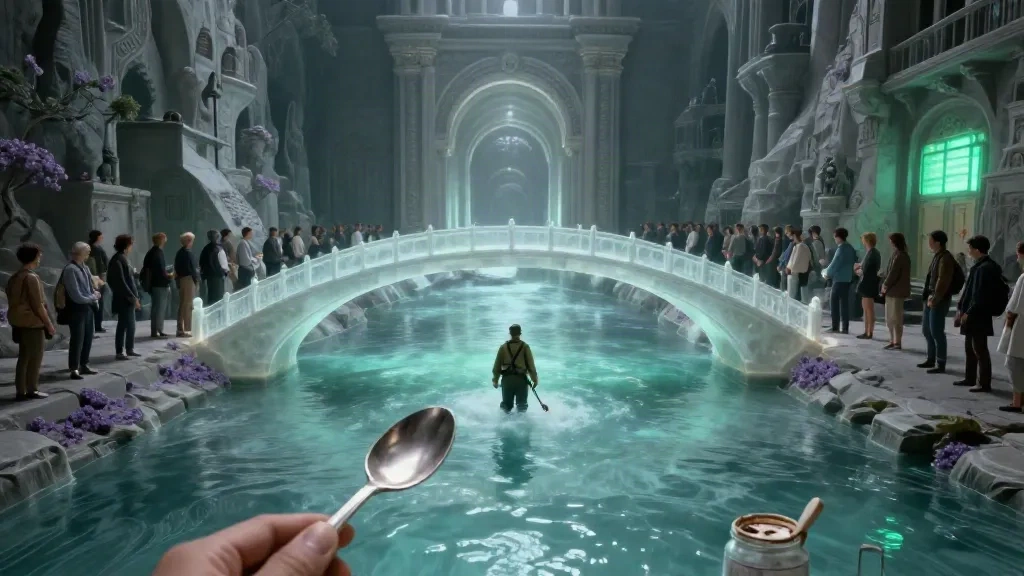
Its bowl held a single drop of clear water. In it, Nera saw herself as a child beside a winter ford, learning to measure depth by watching the current against her knees. That memory had taught her that no river is the same twice.
She lifted the spoon. The river began to return the bridges, but not as names. They came as crossings: a footstep, a plank, a hand extended, an animal crossing beneath a low moon. The silver spoon trembled in her grip, showing her the difference between carrying a map and making a way.
She could still hide. She could report the flooded chamber, blame the salt, and let the river keep its private history. The next morning, the monks would discover a mess. The Public Mercy Ceremony would be postponed. Her atlas would remain in the drawer where no one could use it.
Instead, Nera placed the spoon on the salt jar.
The two objects struck together with a clear, bright sound. The river answered. A narrow path opened across the chamber, made not of stone or wood but of remembered crossings. It led from her side to the monastery door, then beyond it into the ravine.
The Public Crossing
At dawn, the monks gathered at the threshold. Beyond them, the comet’s settlement waited beneath the green pharmacy signs. People had come from the outer tunnels, carrying lamps, tools, and children who did not understand why the river was singing.
Nera set the salt jar at the edge of the water and the silver spoon beside it. Then she opened her atlas and tore out its most private page.
She laid the page on the crossing. Lavender, wet asphalt, and pharmacy green rose from it and passed into the current. The river carried the colors outward, across the ravine and into the settlement. Doors opened. Someone laughed. A child pointed toward the light.
Then the river lifted a wall of records: every bridge, its cost, its failure, its courage. The crowd grew silent. Those who had benefited from a bridge could not claim innocence. Those who had been denied one could not pretend the crossing had never mattered.
Nera stepped onto the water.
It held beneath her, though every bridge record pressed against her ankles. She carried the silver spoon in one hand and the salt jar in the other. At the far side, she offered them to the waiting strangers.
“The river remembers,” she said. “We do not have to remember alone.”
One by one, the people crossed. The comet monastery opened its doors, and the river carried their names—not as bridges claimed them, but as a public record of what they had chosen to carry together.





